


Birthday T Shirts for Adults: A Practical Buying Guide

You're usually not buying one shirt when you shop for birthday T-shirts for adults. You're trying to coordinate a mixed group, keep everybody comfortable, and make sure the shirts still look decent after the party photos, the wash, and the one person who always tosses clothing into a hot dryer. That's where these projects go sideways, not in the mockup stage, but in the decisions that get skipped before the order is placed.
A birthday shirt for an adult behaves more like a small apparel job than a novelty purchase. The blank, the fit, the print method, and the care instructions all affect whether the shirt gets worn again or disappears into a drawer after one event.
Table of Contents
Why Adult Birthday Shirts Trip People Up - The real issue is not the slogan
Choosing the Right Blank Garment - Start with the fabric behavior, not the size label - Ask for measurements, not just S, M, and L
How DTF Printing Works on Adult Tees - When DTF is the right call
Getting Fit Right for Mixed Adult Groups - Measure the shirt people already like - Use a fit workflow that reduces surprises
Designing for Adults Who May Not Want a Slogan - Keep the shirt useful after the party
Care, Washing, and Print Longevity - Keep the first wash conservative - Wash a sample before the run goes out
Ordering Timeline and Lead Time Logic - Back-time from the event date - Keep the approval chain short
Why Adult Birthday Shirts Trip People Up
The failure pattern is familiar. Someone picks a funny design, sends the same size chart to everyone, and assumes the shirt will work because the mockup looks clean on a flat screen. Then the group shows up with different body shapes, different comfort levels, and different ideas about whether they want their age printed across the chest.
Adult birthday shirt orders also run into the return problem. Clothing and footwear returns are common, with a 2025 consumer survey finding that 68% of consumers had returned clothing or footwear during the previous year, and 61% said poor fit was the main reason (IEOM Society proceedings). That matters more for custom apparel because a printed shirt can be harder, or impossible, to send back once production starts.
The real issue is not the slogan
A shirt can be funny and still fail the event if the cut is wrong, the print feels stiff, or the wearer visibly opts out by the second photo. That's common when buyers treat coordinated apparel like disposable party swag instead of wearable clothing. The group doesn't remember the mockup. They remember whether the shirt sat right on their body and whether they'd wear it again.
Practical rule: If the shirt only works for one person's body and one person's sense of humor, it's not a group order yet. It's a one-off with extra steps.
Birthdays are also not a single-day buying event. They sit inside a year-round gift-giving cycle, so adult birthday shirts often support milestone birthdays, family dinners, trips, office gatherings, and event clothing that gets planned at different times of the year (CardSnacks survey context). That's why the shirt deserves more attention than a cheap novelty buy.
Choosing the Right Blank Garment
The blank is the part people underestimate first. A shirt can look great in a mockup and still feel flimsy, clingy, boxy, or unstable once it's on an adult body and washed a few times. Treat the blank as a performance choice, not just a color choice.
Start with the fabric behavior, not the size label
Cotton-rich shirts usually give a familiar hand feel, which many buyers prefer for casual birthday wear. Blends can improve dimensional consistency and drying behavior, which is useful when the shirt needs to hold shape across a mixed group. That trade-off matters more when the shirt is meant to be reused for annual birthdays, reunions, or club events.
ASTM D6321/D6321M is a useful framework here because it gives you a standardized way to think about machine-washable T-shirt evaluation across knitted fabrics and fiber blends (ASTM D6321/D6321M). In practice, that means asking what happens after laundering, not just how the shirt looks on day one.
Ask for measurements, not just S, M, and L
Nominal sizes are too vague for adult orders. Published garment measurements are the safer reference because chest width, body length, and sleeve length affect fit more than the size letter on the neck label. A lighter fashion blank can work for a one-night photo moment, but it can also feel too thin or too unforgiving for people who want a shirt they'll wear beyond the event.
Working standard: If a supplier can't show you garment measurements, you're guessing.
Color also matters. Dark blanks usually give stronger contrast for bold artwork, while lighter blanks can make pastel or low-contrast graphics harder to read. For birthday shirts, that becomes a readability issue, not just a style preference. The shirt has to look good in person and in photos, especially when the design includes names, dates, or small joke text.
A practical spec for adult birthday shirts is simple. Decide whether the shirt is meant to be one-night celebratory wear, reusable event clothing, or a keepsake that needs stable fit after washing. Then choose the blank that matches that use, instead of defaulting to whatever the supplier already has in stock.
How DTF Printing Works on Adult Tees
DTF, or Direct-to-Film, is easier to understand if you think of it as printing a detailed graphic onto film, adding adhesive powder, curing it, and then heat-applying it to the shirt. The process handles small text and full-color artwork well, which is why it shows up so often on custom adult tees. For birthday shirts, that flexibility is useful when the design includes names, faces, inside jokes, or multicolor graphics.
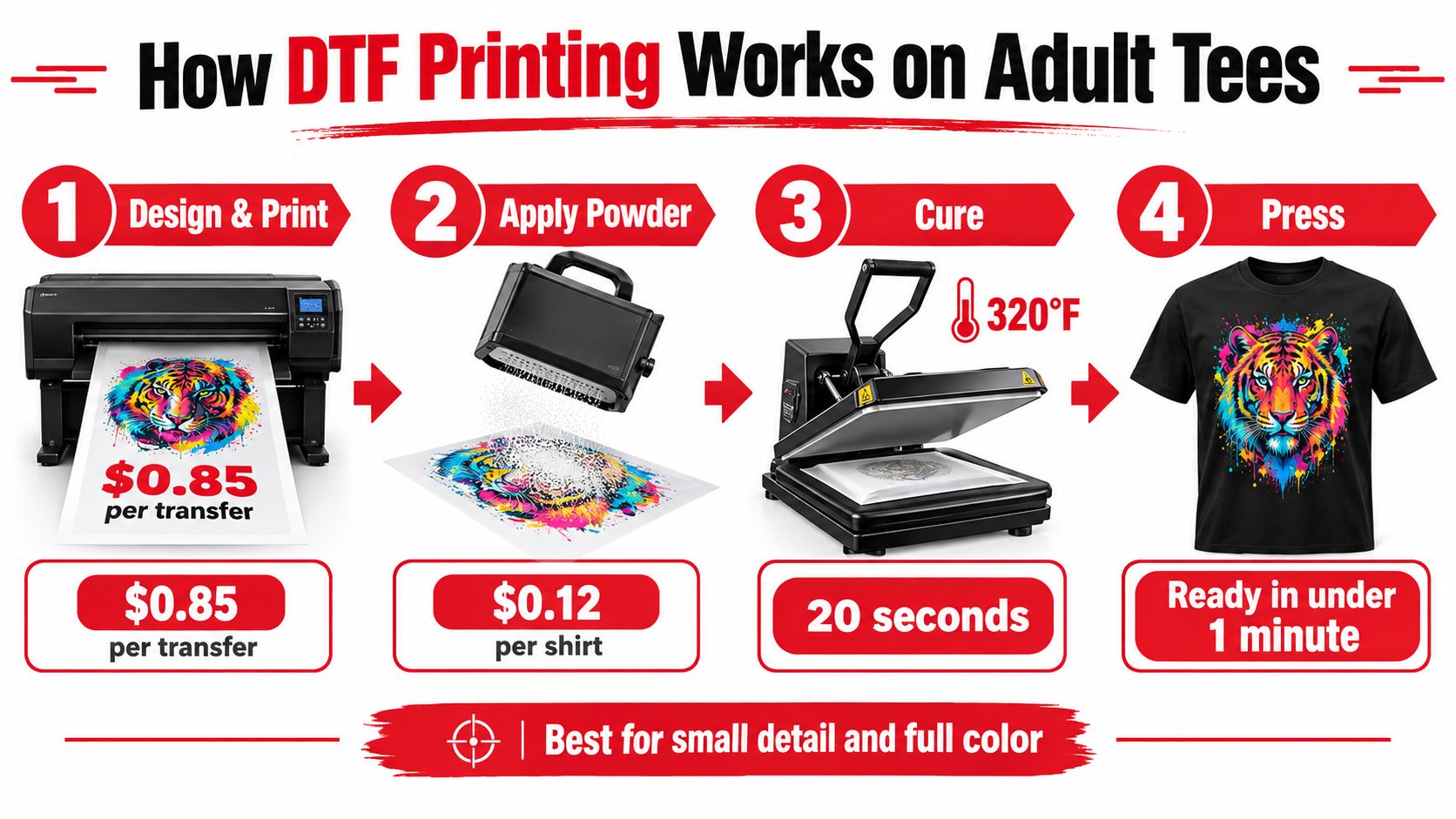
The strength of DTF is detail. It's well suited to graphics that would be expensive or slow to set up in screen printing, and it gives you more flexibility for small batches or one-off shirts. That makes it practical for birthday groups where the honoree wants a special shirt and guests need slightly different versions.
The trade-off is feel and dependency on the blank. Large solid designs can sit more noticeably on the fabric, and edge durability depends on both press quality and how the shirt is worn and washed. If the shirt is going to be rubbed hard, packed for travel, or worn repeatedly, the quality of the blank and the pressing consistency matter as much as the artwork itself.
When DTF is the right call
DTF tends to make sense when the artwork is detailed, the group is small, or the order needs different names or variations. It also works well when the buyer wants color-rich artwork without committing to a large production run. A clean DTF job can look sharp on adult birthday shirts, especially when the design is more about a message or graphic than about texture.
The wrong use case is expecting it to behave like embroidery or a soft vintage screen print. Those are different looks, with different wear characteristics. DTF can still be the best choice, but only if the buyer wants what DTF does well.
Wear X Apparel, LLC offers custom DTF printing and garment selection support for T-shirts and other apparel, which fits this type of adult birthday project when you need a made-to-order route with print and blank guidance. One example of a DTF production reference is this process visual.
Getting Fit Right for Mixed Adult Groups
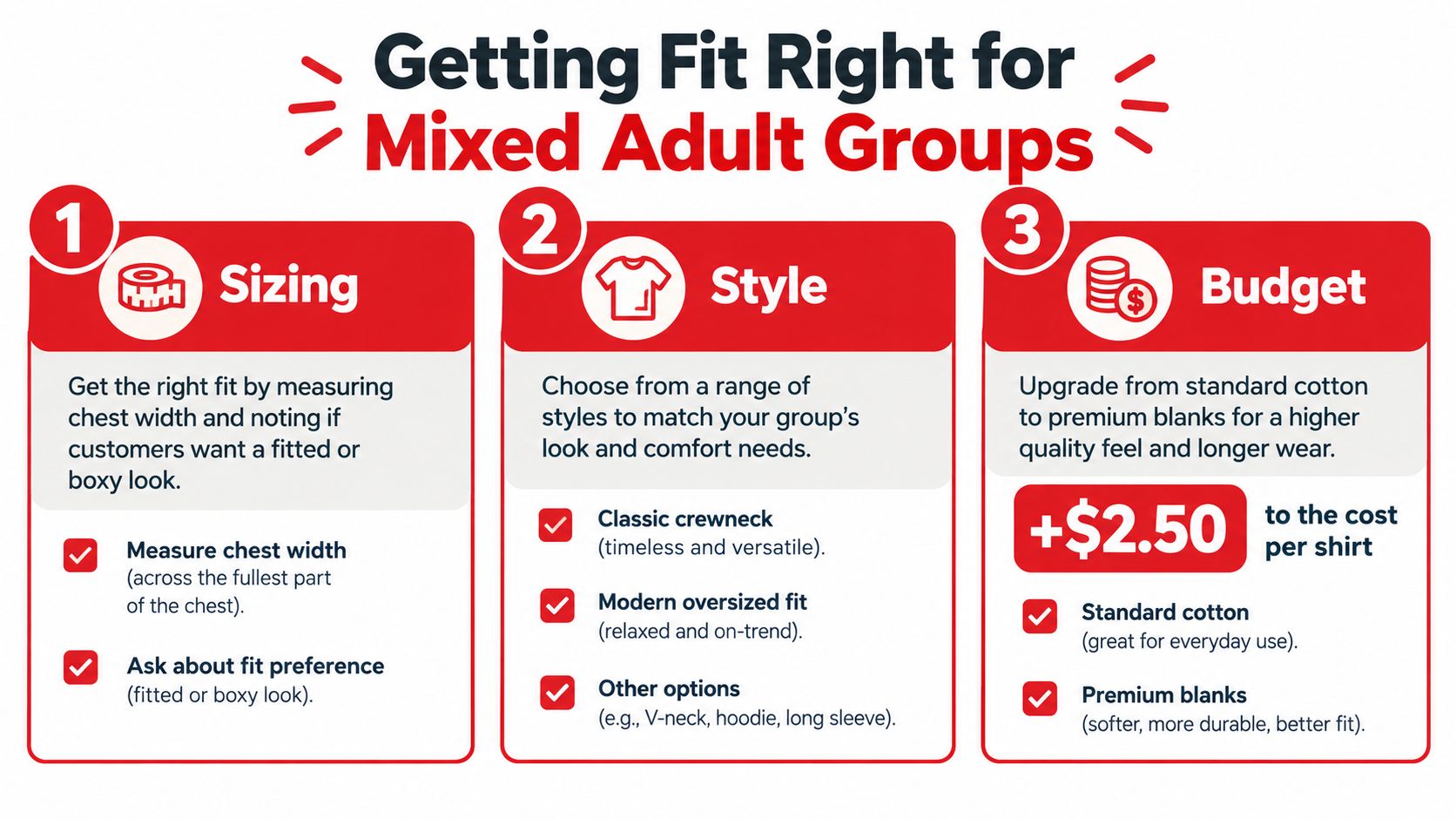
Fit is the biggest risk in a group order because adult bodies aren't interchangeable. The same shirt can hang neatly on one person, feel cropped on another, and look too boxy on a third. If you order by size label alone, you're betting against reality.
Measure the shirt people already like
The safest starting point is a favorite-fitting shirt. Measure chest width, length, and sleeves on that shirt and compare those numbers to the supplier's chart. That gets you closer to what people will actually wear, instead of forcing everyone into the same nominal size.
Unisex, women's, relaxed, and oversized cuts all fit differently, even before fabric behavior enters the picture. A unisex shirt can look right on one wearer and awkward on another because proportions shift, not just overall size. That's why “everyone gets unisex” isn't automatically inclusive.
Use a fit workflow that reduces surprises
A low-risk order process is simple:
Collect a favorite shirt reference: Ask each wearer for a shirt they already like and measure it.
Record the body preference too: Note whether they want a fitted or boxy look.
Check the chart against real measurements: Compare chest, length, and sleeve data, not just size letters.
Order a sample when possible: Confirm how the blank feels after laundering before approving the run.
Add a small buffer only if the seller allows it: Extra pieces help only when replacement or size swaps are realistic.
A sample shirt is especially useful for mixed-size groups because one dimension shift can affect wearers differently. It also helps you catch whether the shirt reads well across body types and whether the design sits in the right place on the chest.
A good size chart doesn't remove fit risk by itself. It only works when the buyer uses it against real garments, not against wishful thinking.
Designing for Adults Who May Not Want a Slogan
A birthday shirt can carry the party without advertising the wearer's age. That matters for adults who want to join in, but prefer a quieter look or want the shirt to work after the event.
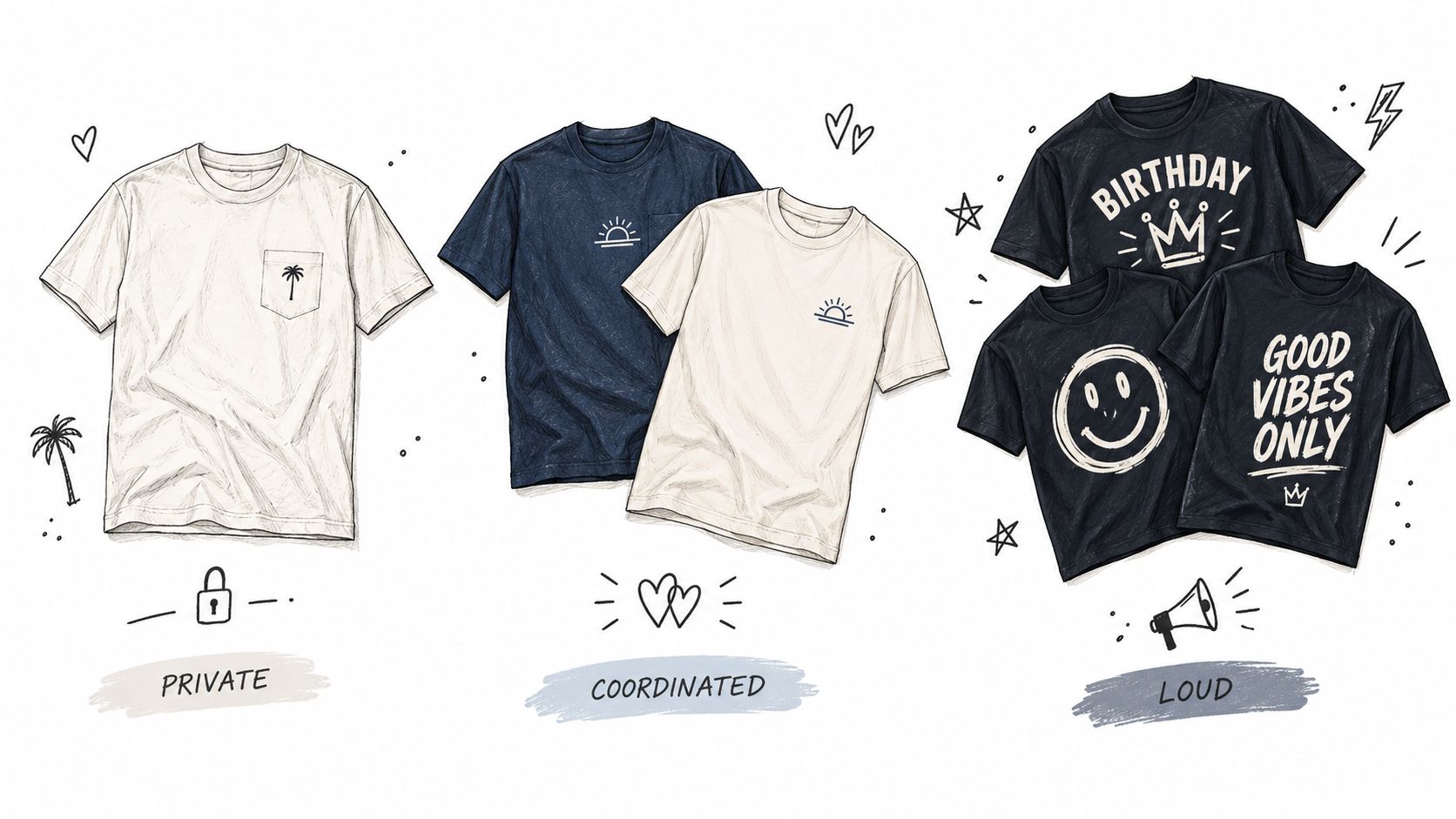
Three participation levels solve most of the tension. Some guests want fully matching shirts. Others do better with coordinated colors and different graphics. A third group only wants the honoree in a printed shirt, while everyone else uses a small accessory, a color cue, or no shirt message at all.
Keep the shirt useful after the party
Shirts that get worn again usually avoid loud age numbers and use simpler marks. A birth year can feel less pointed than a large age graphic. So can a nickname, a shared symbol, coordinates, a hobby reference, or an inside joke that means something to the group without shouting to strangers.
Privacy matters too. A full name, age, or other identifying detail can show up in public photos even if the wearer did not plan for that. Adults who are careful about social media usually want that discretion built into the design from the start. Recent birthday culture reporting also points to smaller, more personal celebrations, which makes subtle shirts a better fit for many groups.
A good birthday shirt gives people a way to participate at their own comfort level.
Care, Washing, and Print Longevity
Care instructions aren't a formality. They're part of the product, because a shirt that's washed badly can fail even if the print was perfect at press time. The Federal Trade Commission requires textile apparel care information to address washing method, water temperature, drying, and warnings when expected care could damage the garment (FTC care labeling rule).
Keep the first wash conservative
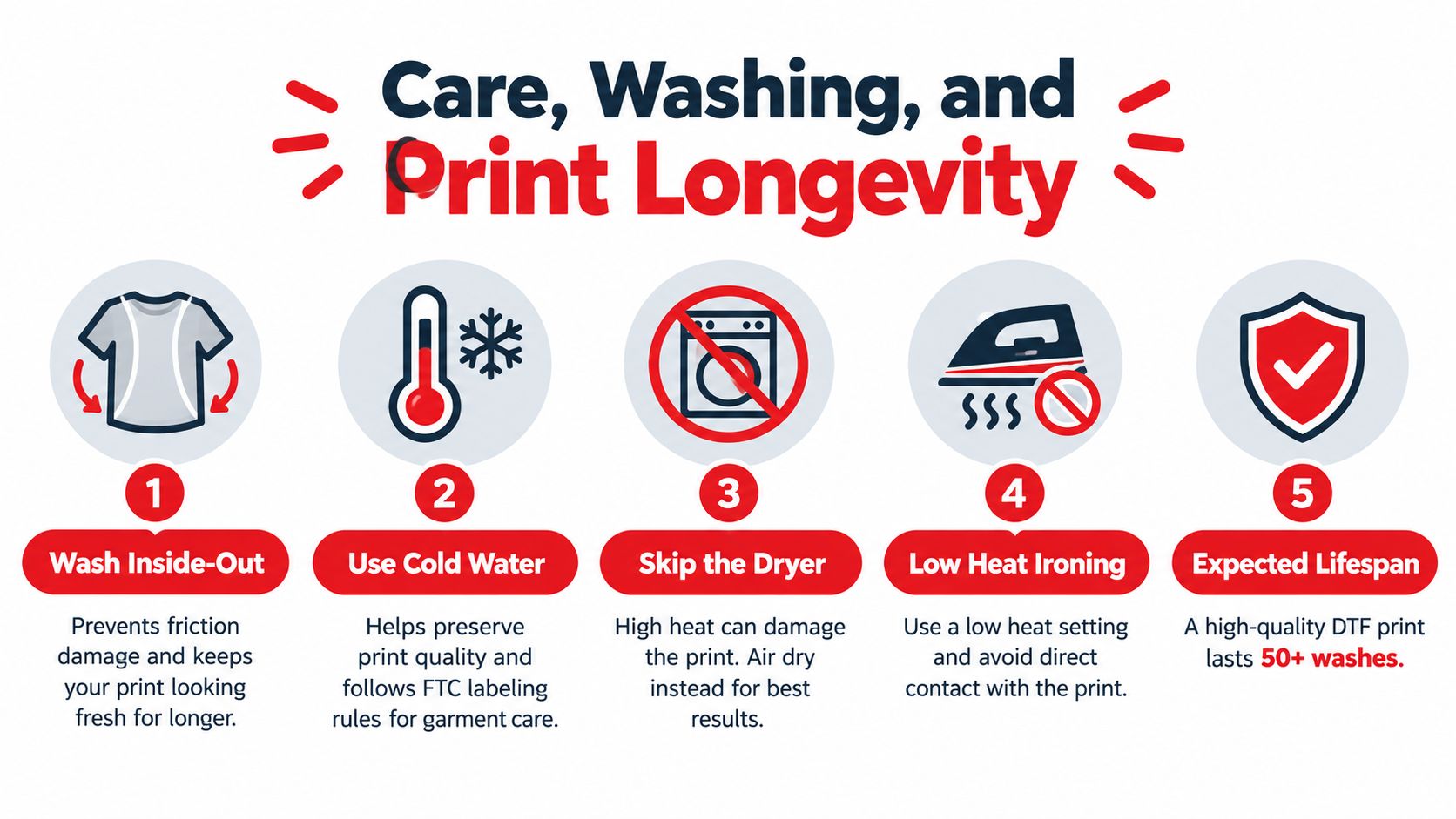
Cold or cool washing is the safest default for DTF birthday shirts unless testing shows the print can tolerate more. Turn the shirt inside out to reduce friction on the graphic, and avoid aggressive bleach use or hot drying unless the garment has been tested for it. If ironing is needed, keep heat low and avoid direct contact with the print.
ASTM wash-evaluation practices also support checking how the shirt behaves after laundering, including color change, surface condition, and dimensional change. That matters because a print can look fine while the garment itself shrinks or distorts enough to ruin the fit.
Wash a sample before the run goes out
One production sample should be washed before approving a larger order. Then inspect the print edges, stretch recovery, color change, and dimensional change. That one test catches a lot of the problems that don't show up in a dry press inspection.
If the sample fails in a home wash, the event shirts probably will too.
For a hangtag or care card, keep the wording simple. Cold wash, inside out, low heat or air dry, no direct iron on the print, and avoid harsh bleach unless the garment is specifically approved for it. That's enough for most buyers to follow and enough for most custom shirts to stay presentable through the event and beyond.
Ordering Timeline and Lead Time Logic
Late ordering breaks more adult birthday shirt projects than weak art does. The work moves through approvals, blank sourcing, sample checks, print production, packing, and shipping, and each step needs a little room to breathe. If one step slips, the rest stack up fast.
Back-time from the event date
Start with the event date and work backward. A birthday trip or group dinner needs space for one approval round, one sample check, and shipping that is not at the mercy of carrier delays. Narrow windows force harder choices, such as limited blank stock or a simpler design that can move faster.
Minimums matter too. A single honoree shirt is a different job from a larger group run, because sourcing and unit economics change with the order size. One shirt can move quickly on the design side, while a group order usually needs more size confirmation and more production planning. Once the order depends on several garment variants, the calendar gets tighter.
Keep the approval chain short
A clean workflow usually looks like this, as shown in the on-demand production timeline.
Approve artwork first so blanks are not already in motion when the design changes.
Confirm garment choice and measurements before production starts.
Wash the sample if the order size justifies it, especially for shirts meant to be worn again.
Pack and ship with a cushion so the shirts are not arriving the day of the event.
If a buyer wants a faster path, the trade-off is usually fewer options. That might mean taking a blank that is in stock, limiting revisions, or skipping extra checks that would catch fit or print problems earlier. A custom shirt order usually takes longer than people expect, so the safest move is to leave time for corrections instead of paying rush charges for something that could have been caught sooner.
Putting It All Together Before You Order
Before you release the order, check the sample against the intended use case. Confirm the blank feels right, the print sits where it should, and the shirt still looks clean after a wash test. Document any defects with photos and send them to the production team before a larger run is approved.
The best adult birthday shirts aren't just fun to look at. They fit mixed-size groups, survive normal laundry, and give adults a choice about how loud they want the celebration to be. If you lock in those decisions early, the shirt stays in rotation instead of ending up in a drawer after the party.
Wear X Apparel, LLC handles custom DTF apparel and garment selection for projects like birthday shirts for adults, including single pieces and group orders. If you want help choosing blanks, checking fit, or setting up a print-ready design, visit Wear X Apparel, LLC and start the conversation before the event date starts closing in.
Comments