


T Shirt Printing Prices: A Practical Pricing Breakdown

A single digitally printed shirt typically lands between $20 and $30, while a 50-piece screen-printed run often drops to $10 to $15 per shirt. That gap exists because quantity, setup, print method, artwork, garment choice, and delivery charges all change the landed price.
You're probably looking at a quote right now that says something like “custom shirts, $12 each,” then watching the number change when you mention a second print location, a faster deadline, mixed garment sizes, or a more substantial blank. That experience isn't unusual. A shirt quote is rarely one price for one object. It's a stack of costs attached to a specific design, quantity, garment, deadline, and delivery address.
I've quoted enough apparel jobs to know that two printers can give you numbers several dollars apart and both be honest. One may include artwork preparation and shipping. Another may show a lower production figure, then add setup, proofing, rush handling, or delivery at checkout. The useful question isn't “What do your shirts cost?” It's “What will my exact project cost, delivered?”
Table of Contents
Why One Number Never Tells the Whole Story - Why honest quotes still differ
The Building Blocks Behind Every Quote - The seven cost drivers
Where the Money Actually Goes in a DTF Print - Labor is the cost buyers don't see
Three Real Orders With Real Totals - Scenario one, 12 club shirts - Scenario two, 50 company shirts - Scenario three, 100 ranch workwear shirts
Getting an Accurate Quote From Any Printer - Put these details in the first message - Compare landed totals
Why One Number Never Tells the Whole Story
A buyer often starts with a simple request: “I need custom shirts for an event.” The printer asks how many, what color, what design, and when they're needed. The buyer answers, receives a per-shirt figure, and assumes the decision is finished.
Then the details arrive. The event needs 12 shirts, not a large run. The artwork has two colors on the front and a name on the back. A few people need larger sizes. The deadline is next week. Suddenly, the original per-shirt number no longer describes the project.
That first quote may have been accurate for a different set of assumptions. A larger order spreads fixed artwork and setup work over more garments. A second location creates another production step. A rush deadline can require schedule changes and additional handling. A premium blank changes the garment line before any ink or transfer is applied.
The practical rule: compare complete delivered orders, not attractive headline prices.
Why honest quotes still differ
Suppose one shop quotes $11 per shirt and another quotes $15. The cheaper quote may use a basic blank, one print location, standard production, and separate shipping. The higher quote may include a heavier garment, artwork cleanup, quality checks, and delivery. Neither number means much until the specifications match.
Historical screen-printing examples show why volume matters. One-color screen printing was reported at approximately $4.50 per shirt for 24 units and about $1.50 per shirt at 500 or more, with setup charges of roughly $25 to $40 per color. For a four-color design, the same example reported approximately $8.25 per shirt at low volume and about $3.40 at scale. These figures are discussed in the history of T-shirt production and pricing, and they illustrate the basic economics without pretending to be a universal current quote.
The right comparison asks for the same blank, artwork, print locations, quantity, deadline, finishing, tax treatment, and shipping destination. Once those inputs match, the difference between quotes becomes useful instead of confusing.
The Building Blocks Behind Every Quote
A reliable quote starts by separating the order into parts. Ask the printer to show these components, even if the final invoice combines some of them.
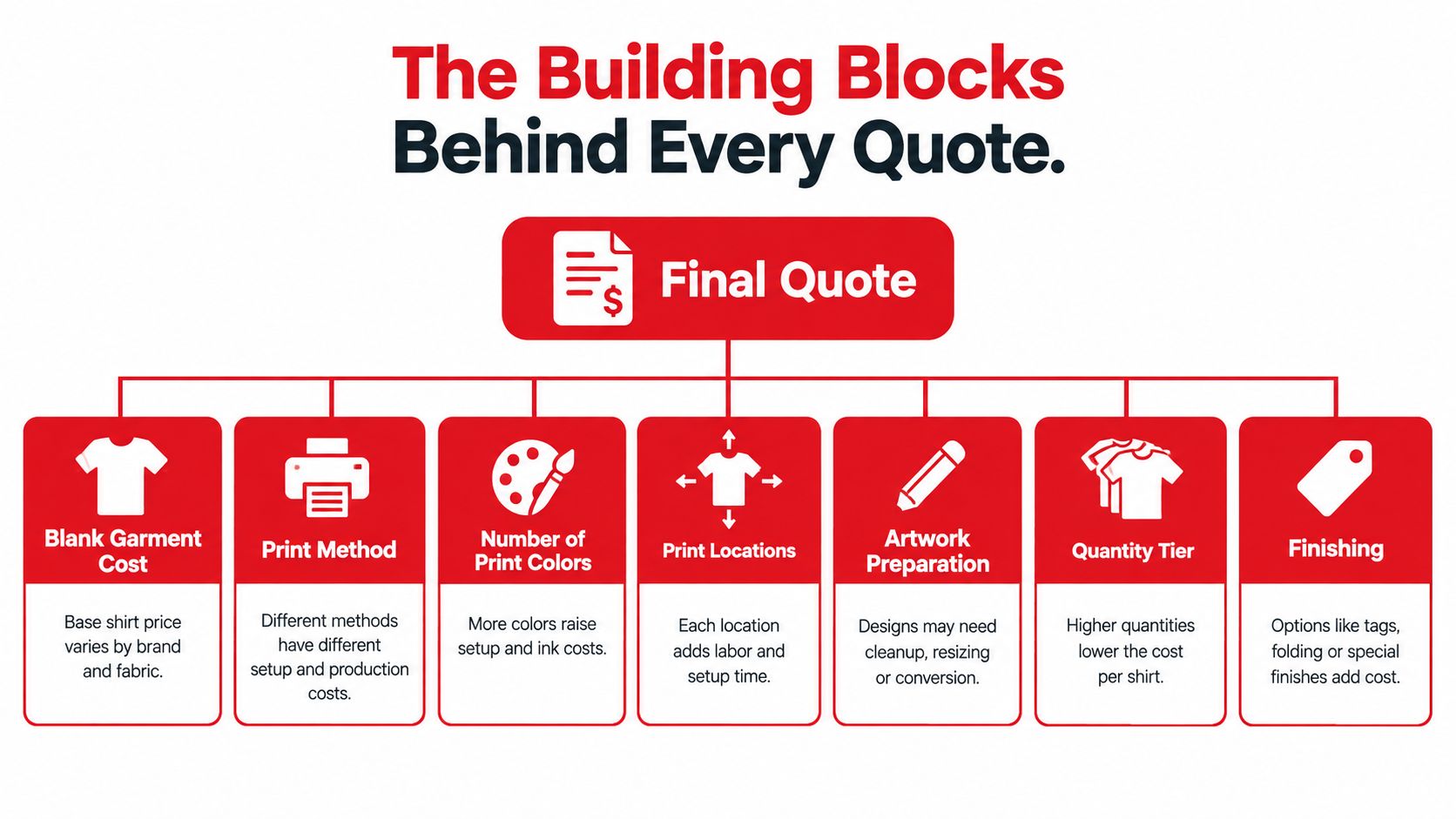
The seven cost drivers
Blank garment cost: The shirt, hoodie, or other base item varies by brand, fabric, weight, construction, and size range. A workwear shirt and a lightweight event tee shouldn't be priced as if they're interchangeable.
Print method: DTF, screen printing, DTG, and heat transfer each distribute setup, labor, and material costs differently. The best method depends on quantity and artwork, not on a universal ranking.
Number of print colors: Screen printing usually requires color-specific setup, so more colors can raise preparation and production costs. Digital methods handle complex artwork differently.
Print locations: A front print is one production area. Adding a back, sleeve, or other location adds handling and decoration work.
Artwork preparation: A finished, print-ready file is easier to process than artwork that needs cleanup, separation, sizing, or revision. Ask whether proofing is included.
Quantity tier: Larger runs distribute fixed work across more garments. Small orders carry more setup and handling cost per item.
Finishing and delivery: Folding, bagging, labeling, individual packing, rush service, shipping, and taxes can change the landed total after printing is complete.
A useful way to organize your information is to keep a visual garment reference beside your quote request. It helps you specify the actual product instead of asking for a generic “black shirt.”
The biggest mistake is treating every line as equally negotiable. You control quantity, print locations, artwork complexity, and deadline. You may have less control over labor, equipment maintenance, and shipping. A good quote makes that distinction clear.
Print Methods Compared Side by Side
The method should follow the order. For a dozen personalized shirts, DTF can avoid traditional screen creation and support detailed artwork. For a repeated design at larger volume, screen printing can lower the decoration cost because setup is spread across more garments. The crossover often sits near 50 units, depending on design, garment, and printer.
Method | Typical Setup | Best Quantity | Color Complexity | Fabric Flexibility |
|---|---|---|---|---|
DTF | Digital artwork preparation, transfer production, powder application, and pressing | Short runs, variable designs, and orders below roughly 50 units | Strong fit for full-color and detailed artwork | Broad garment compatibility, subject to fabric and heat requirements |
Screen printing | Color-specific screens and press setup | Repeated designs at larger quantities | Most economical with limited colors, though multi-color work is possible | Strong on suitable garments, with fabric and ink choices affecting results |
DTG | Artwork preparation and garment pretreatment | Small to moderate runs with detailed designs | Good for full-color artwork and gradients | Best on compatible garments, especially suitable cotton surfaces |
Heat transfer | Transfer preparation and heat-press application | Short runs, names, numbers, and variable personalization | Flexible for detailed designs and changing information | Broad flexibility, but durability depends on transfer and garment pairing |
For a 12-piece event order, start by asking for DTF or another digital option. The absence of screen creation can make a short run more practical, especially when every shirt has a different name or detail. For a 50-piece team order, compare both DTF and screen printing. A simple repeated design may favor screen printing, while a photographic or highly detailed design may justify digital production.
At 500 pieces, screen printing deserves serious attention when the artwork repeats and the color count stays manageable. The method's economics improve when the same setup is used across many garments.
Choose the process that matches the work. A low setup method isn't automatically cheap, and a high setup method isn't automatically expensive. Quantity determines how much each setup matters.
Garment construction still matters. For example, the RXB Marlboro Rodeo Hoodie uses an 8.5 oz./yd² 70/30 ring-spun cotton/polyester blend with a 100% cotton face, a fleece-lined hood, double-needle sewing, and a three-dimensional velvety chest logo. That kind of heavier branded garment belongs in a different quote conversation from a basic lightweight tee.
A product reference for production planning is also available through this apparel decoration example. Use it to think in terms of the actual garment and decoration combination, not just the print technique.
Where the Money Actually Goes in a DTF Print
DTF pricing gets misunderstood because buyers see the transfer materials and assume those materials represent most of the cost. They don't. A proper decoration quote includes ink, film, hot-melt powder, electricity, operator time, equipment wear, cleaning supplies, quality control, waste, rework, and order handling.
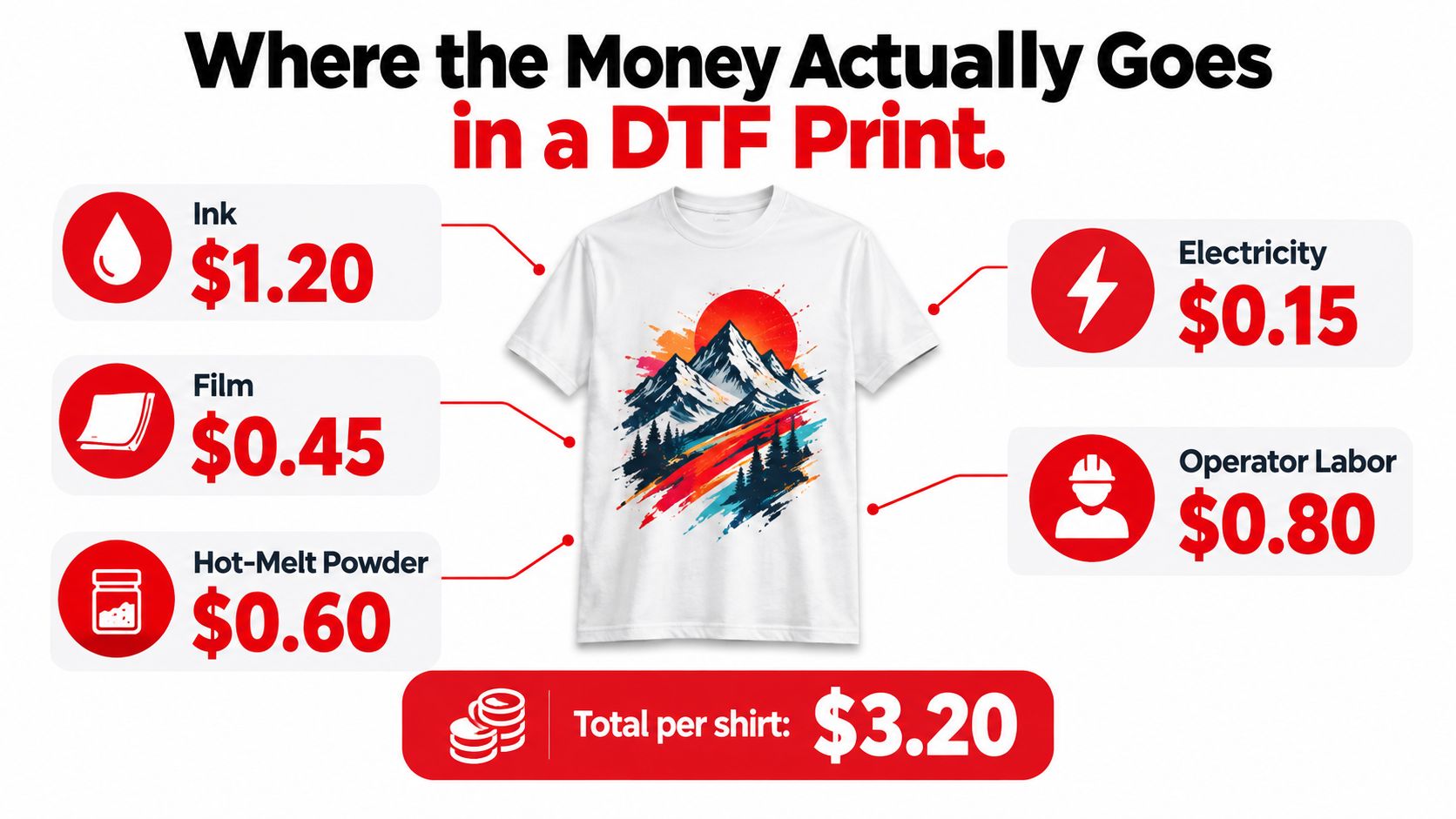
One published DTF production model assigns €0.65 to ink, €0.054 to film, €0.16 to powder, €0.02 to electricity, €3.33 to 10 minutes of labor at €20 per hour, €0.85 to maintenance and wear, and €0.35 to 7% waste, for a total of €5.46 before the garment, shipping, selling overhead, and profit. The detailed DTF cost breakdown shows why a material-only markup can badly understate the work.
Labor is the cost buyers don't see
The operator has to inspect artwork, prepare the print, manage the transfer, apply powder, cure it, position it correctly, press it, peel or finish it as required, and check the result. A small mistake can force a reprint or damage a garment. Those tasks don't disappear because the design is digital.
Consumables may represent only about 15% to 20% of the final cost, while labor, quality control, equipment depreciation, rework, and order handling carry much of the remaining burden. That ratio is a pricing principle, not a promise that every shop uses the same accounting method.
A fair DTF quote should separate the garment from the decoration. Print area matters because a larger design consumes more film and ink. Coverage matters because dense artwork can increase production and inspection time. Quantity matters because batching can reduce repeated handling.
The practical structure is simple:
Garment line: The selected shirt or apparel item.
Print-area tier: A charge tied to chest, full front, back, sleeve, or another defined size.
Artwork service: Cleanup, resizing, proofing, or sampling when required.
Fulfillment: Folding, labeling, packing, shipping, and rush handling.
For a closer look at the production process, this DTF printing reference can help buyers understand why the press step is only one part of the workflow.
If a quote looks suspiciously close to the cost of transfer materials alone, ask what happens when a print misaligns, a garment is defective, or artwork needs correction. A printer who accounts for those realities is protecting both the order and the margin needed to complete it properly.
Three Real Orders With Real Totals
The following scenarios are planning examples, not universal market quotes. They show how to build a landed total by assigning a value to every cost category, rather than pretending the shirt itself explains the final number.
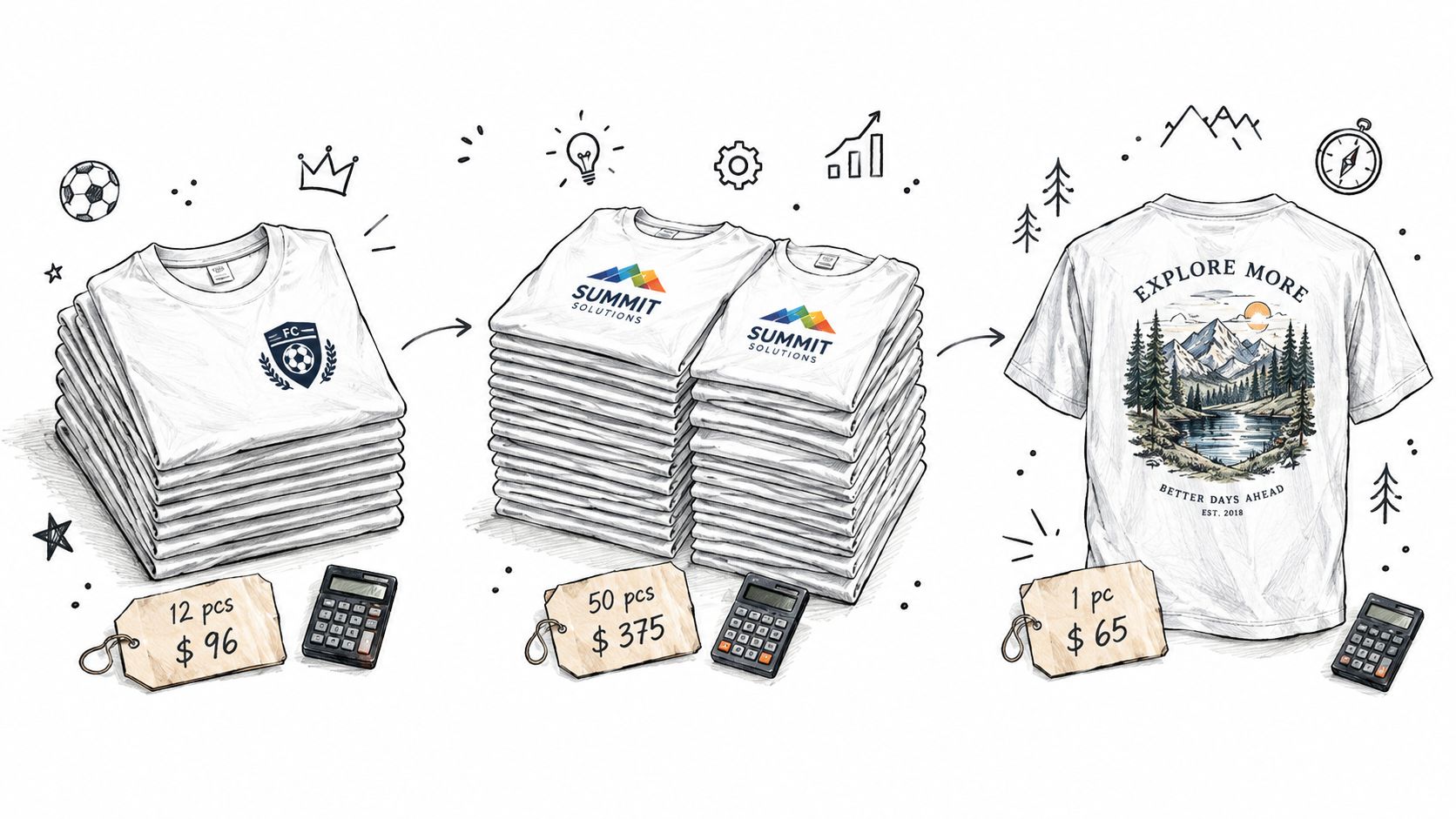
Scenario one, 12 club shirts
A small club needs 12 shirts with a two-color front design. Because the run is short, DTF avoids screen creation and handles the artwork without charging for separate color screens.
Cost component | Planning total |
|---|---|
Blank garments | $96 |
DTF front print | $120 |
Artwork and proofing | $30 |
Finishing | $24 |
Shipping | $20 |
Landed total | $290 |
Per shirt | $24.17 |
This order lands at roughly $24.17 per wearable item. The buyer can lower the total by simplifying artwork, choosing a less expensive blank, combining shipping with another order, or accepting a standard deadline. Adding a second location would move the number upward.
Scenario two, 50 company shirts
A company needs 50 shirts for an offsite, with a four-color front and a one-color back. A repeated design makes screen printing worth comparing, but the second location and extra colors still add production work.
Cost component | Planning total |
|---|---|
Blank garments | $400 |
Screen printing, front and back | $350 |
Artwork and setup | $140 |
Finishing | $75 |
Shipping | $45 |
Landed total | $1,010 |
Per shirt | $20.20 |
This order is more efficient than the 12-piece run, but the artwork complexity and two print locations prevent it from reaching the lowest possible unit cost. Removing the back print would usually have a larger effect than arguing over a minor garment substitution.
Scenario three, 100 ranch workwear shirts
A ranch orders 100 shirts with one stable, single-color chest print. The design is repeated, the quantity supports batching, and the decoration remains straightforward.
Cost component | Planning total |
|---|---|
Blank garments | $700 |
Screen printing | $180 |
Artwork and setup | $65 |
Finishing | $100 |
Shipping | $60 |
Landed total | $1,105 |
Per shirt | $11.05 |
The higher quantity brings the unit price down because fixed work is distributed across more garments. Before ordering extras, confirm whether the printer will preserve the same artwork file, blank garment, color, and decoration specifications for a reorder. A lower first-run number is less useful if the next batch won't match.
These scenarios also expose the buyer's strongest levers. Quantity, print locations, color complexity, garment choice, and deadline matter more than obsessing over a single material line.
The Cheap Quote Is Not Always the Best Value
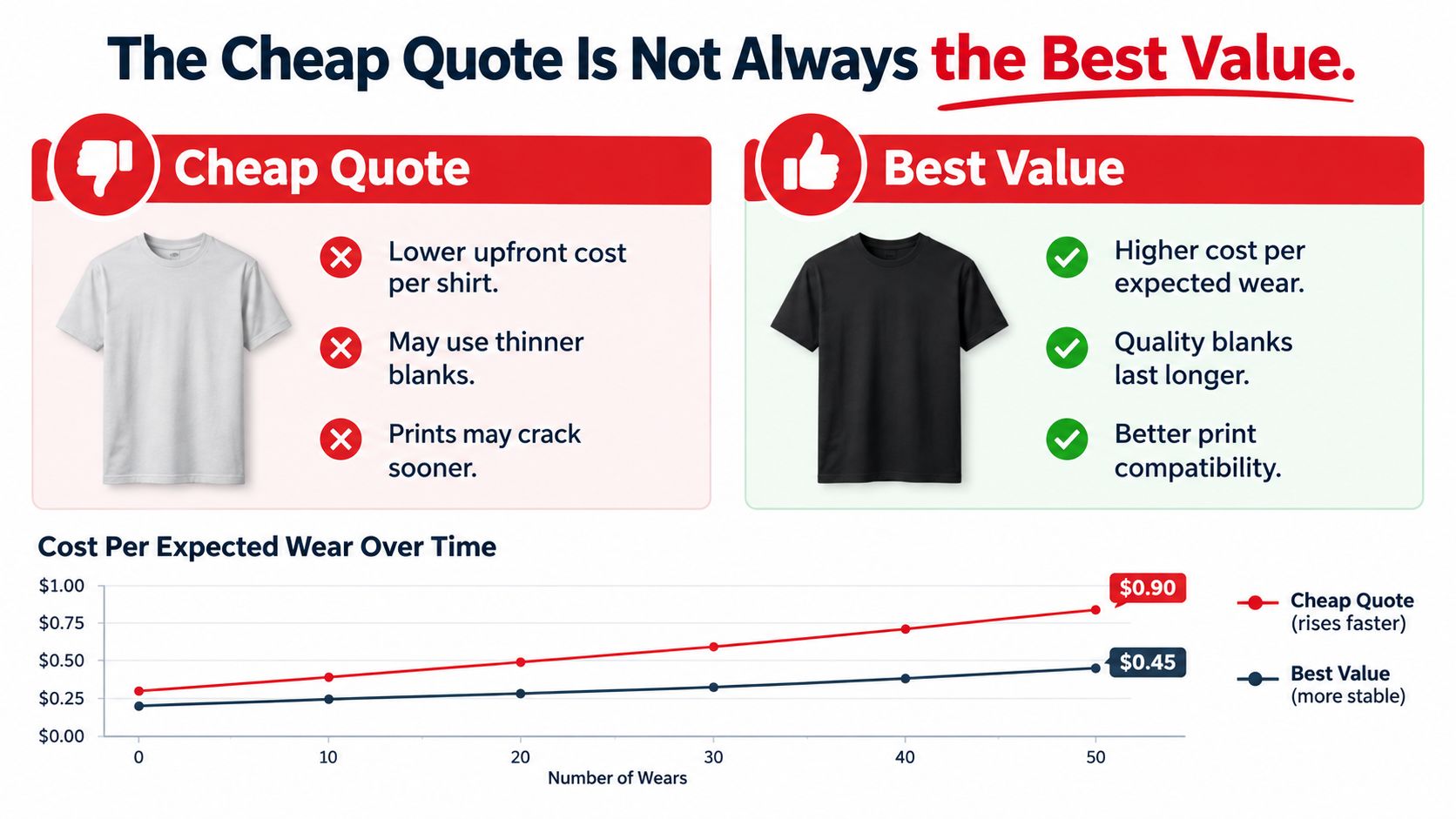
The cheapest shirt can become the expensive choice if people won't wear it. A rough blank may save money on the invoice while producing an item that feels uncomfortable, fits poorly, or loses its visual appeal quickly. For staff apparel, branded merchandise, and outdoor workwear, the relevant measure is cost per expected wear, not only cost per printed unit.
Fiber choice affects comfort, climate suitability, shrinkage, color behavior, print compatibility, and end-of-life options. Polyester can make sense for certain performance needs. Cotton or cotton blends may make more sense when softness, everyday use, and a natural-fiber preference matter. No fiber wins every situation.
A global sustainability briefing reports 92 million tonnes of textile waste annually, while garment-use duration has fallen by roughly 36% since 2000. The same source reports that 75% of shoppers consider sustainable clothing essential or desirable, 75% prefer cotton, cotton blends, or denim, and 59% say they're willing to pay more for natural-fiber clothing, as documented in this UN-Habitat textile waste and consumer research release.
That doesn't mean every buyer should choose the most expensive blank. It means the blank should match the intended life of the garment.
For event shirts: prioritize a comfortable fit people will reuse after the event.
For ranch or outdoor workwear: prioritize construction, climate suitability, and print compatibility.
For branded merchandise: prioritize the feel and appearance that reflect the brand.
For promotional giveaways: choose a practical garment rather than paying for features recipients won't value.
A $1 increase in blank cost can be sensible if it improves repeat wear and reduces the chance that the shirt gets abandoned. Ask what the garment will be used for, how often it should be worn, and whether the print method suits the fabric. That conversation produces better value than chasing the lowest catalog line.
Getting an Accurate Quote From Any Printer
Send the printer a complete intake instead of “How much for shirts?” A complete request reduces follow-up, prevents hidden assumptions, and gives you a quote you can compare.
Put these details in the first message
Garment: Specify shirt type, preferred fabric, color, weight, and whether the order includes hoodies or other items.
Quantity: Give the total and the size breakdown. Mention whether each garment has the same design.
Artwork: Attach the actual file and say whether it's print-ready or needs cleanup.
Decoration: State the number of colors, print dimensions, and every print location.
Deadline: Give the date the garments must be in hand, not merely the event date.
Fulfillment: Include the shipping ZIP code and whether garments need folding, bagging, labeling, or individual delivery.
Ask these questions directly:
Is the quote for the exact garment and size range I requested?
Does the decoration price include setup, artwork preparation, and proofing?
Are front, back, sleeve, or other locations priced separately?
Is shipping included, and are taxes or rush charges separate?
What happens if the artwork needs revision or a garment fails quality control?
Can you confirm the production timeline and delivery date?
Will a reorder use the same blank, garment color, artwork file, and decoration settings?
Compare landed totals
A quote that says $10 per shirt may not be cheaper than one that says $13 per shirt if the first excludes setup, artwork, rush service, or shipping. Community pricing discussions also show why buyers should ask how setup changes with ink colors and print locations, then compare delivered totals for identical specifications in the custom T-shirt pricing discussion.
Copy this into an email:
Please quote [quantity] units of [garment and color], with [size breakdown], [print method if known], [print locations and dimensions], and the attached artwork. Please separate garment, decoration, artwork or setup, finishing, rush charges, shipping, and taxes, and confirm the delivery date and reorder specifications.
That message gives the printer enough information to price the job. It also tells you quickly whether the shop is willing to be transparent.
A Simple Framework You Can Reuse on Every Order
Use this formula for every apparel project:
Blank garment + print method + print area + setup or artwork + finishing + rush + shipping = landed project total.
Then divide the landed project total by the number of wearable items. That result is your real per-shirt price.
The largest movements usually come from quantity and print complexity. More pieces can distribute fixed work. Fewer print locations can reduce handling. Simpler artwork can reduce preparation. A standard deadline can remove rush pressure. A better blank can raise the invoice while lowering cost per expected wear.
Don't ask for a generic shirt price. Give the printer the garment, quantity, artwork, locations, deadline, and destination, then ask for a separated landed quote. Good pricing is learnable, and a printer who welcomes those questions is giving you a better basis for the decision.
Wear X Apparel, LLC provides garment selection support and DTF printing for single items and batch orders, including shirts, hoodies, team apparel, event garments, and organizational projects. Visit Wear X Apparel, LLC with your artwork, quantity, garment preferences, and deadline to request a quote built around the actual landed cost of your order.
Comments