


Is DTG Printing Good Quality: The Honest Truth

Yes, DTG printing is good quality when the fabric, pretreatment, and curing match the design. It can produce detailed graphics with strong color durability, but testing found that polyester or polyester blends performed best after the first wash, while dye sublimation delivered the greatest color stability across five washes on those fabrics.
So why do some DTG shirts look retail-ready while others fade, dull, or lose definition quickly? The printer is only one part of the production system. Garment composition, surface texture, pretreatment coverage, ink formulation, curing, and washing conditions determine the result.
A production manager doesn't approve a DTG order by looking at a fresh print under bright shop lights. The right question is whether the graphic still meets the intended standard after laundering, handling, and normal wear. That means judging detail, hand feel, color accuracy, adhesion, and durability separately.
Table of Contents
The Real Answer to DTG Print Quality - Quality is an outcome, not a printer specification
How DTG Quality Is Measured in Production - Detail and hand feel - Color accuracy and durability
Fabric Selection and Its Impact on Results - Compare the substrate before approving the artwork
Pretreatment and Curing as Quality Drivers - Where production failures begin
DTG vs DTF - Choosing the Right Method - Select by fabric and finish - What each method does well
A Practical Quality Checklist for Buyers - Ask these questions before approving a run
Caring for Your DTG Prints to Maximize Longevity - Use a low-stress wash routine
The Real Answer to DTG Print Quality
The direct answer is yes, DTG printing can deliver professional-quality apparel graphics. It works especially well for photographic artwork, gradients, fine lines, complex illustrations, and short runs where creating screens would add unnecessary setup. The process applies water-based ink directly to the garment, allowing the artwork to become part of the fabric rather than sitting on it as a thick plastic layer.
DTG is also a mature commercial technology, not a temporary novelty. The first commercially available DTG printer, the Revolution, appeared in the United States in 1996. Mimaki presented a garment printer in 2004, and Brother introduced the GT-541 in 2005 as its first ground-up DTG printer. Those milestones reflect decades of development in printheads, white ink, garment handling, and curing systems. The history of direct-to-garment printing documents that progression.
Quality is an outcome, not a printer specification
A high-resolution printer can't compensate for the wrong blank. A clean artwork file won't rescue uneven pretreatment. Correct ink coverage won't survive if the garment isn't cured properly. That's why two shirts printed with the same file can look noticeably different when their fiber content or surface texture changes.
The most useful production definition of good quality includes:
Sharp detail: Fine text, thin lines, gradients, and photographic areas remain readable and controlled.
Comfortable hand feel: The print stays soft and breathable instead of feeling like a heavy plastic patch.
Color performance: The output is sufficiently vivid and consistent for the garment and brand requirements.
Durability: The graphic retains acceptable appearance after washing and ordinary use.
A peer-reviewed comparison of DTG, dye sublimation, and screen printing found that screen printing achieved the most accurate reproduction of the target brand color, while DTG on polyester and polyester blends showed the strongest durability after the first wash. Across five laundering cycles, dye sublimation on polyester or blends showed the greatest color stability. The textile-printing comparison study supports a practical conclusion: DTG isn't automatically the best method for every fabric or quality target.
Production rule: Approve the garment and process together. Never approve a DTG print file in isolation.
How DTG Quality Is Measured in Production
A professional quality check separates appearance from performance. A print may look impressive immediately after curing and still show weak adhesion, uneven white underbase coverage, or rapid color change during laundering. Production teams therefore assess several characteristics instead of relying on one visual impression.
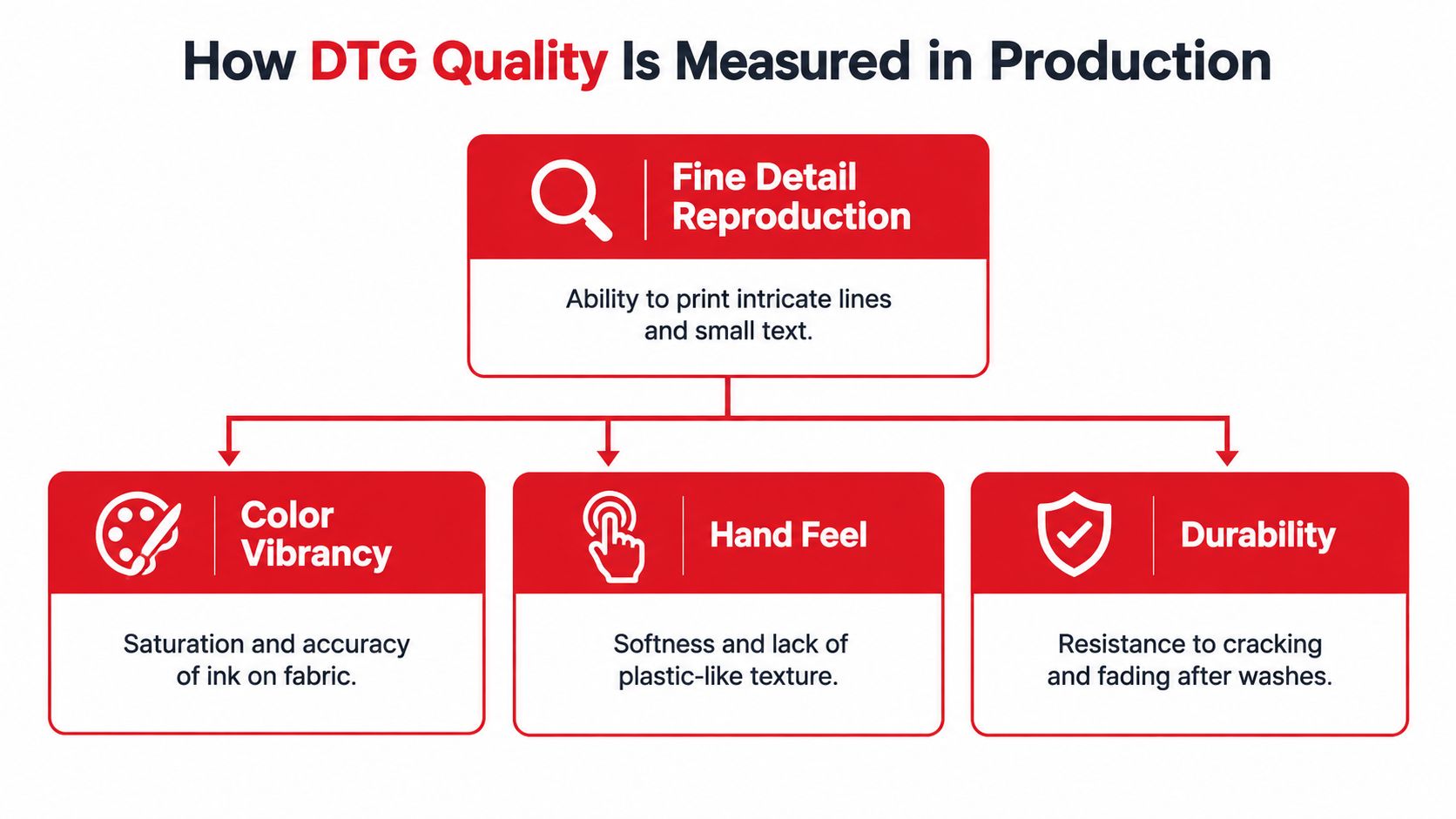
Detail and hand feel
Fine detail reproduction is one of DTG's strongest advantages. The printer can place many small ink droplets to build gradients, photographic shading, small type, and intricate linework without separating the artwork into individual screen colors. That makes DTG a strong fit for artwork that would be expensive or visually compromised with conventional spot-color production.
The print should also feel integrated with the garment. Water-based ink can produce a soft, breathable result, particularly when the fabric accepts the ink properly. The goal is not just softness immediately after production. Excess pretreatment, incomplete drying, or excessive heat can change the texture and leave the surface stiff.
Color accuracy and durability
Color quality has two separate dimensions: vibrancy and accuracy. A print may look bright but still miss a specific brand color. Research measuring color differences with spectrophotometry and the CIE Delta E method shows why visual judgment alone isn't enough. In one controlled textile study, color-change values generally began to plateau by the fourth wash, while yellow showed weaker retention than cyan, magenta, and black. The controlled laundering and color study links final performance to the garment fiber, preparation, ink, cure, and washing conditions.
For demanding work, request a physical sample and inspect it under normal lighting. Check small lettering, dark-garment white coverage, saturated yellow, smooth gradients, edge registration, and the feel of large solid areas. If exact color matching matters more than photographic detail, discuss screen printing as an alternative rather than assuming DTG will meet every color specification.
Fabric Selection and Its Impact on Results
Will the same DTG artwork look equally good on every blank? No. Cotton, polyester, and blends accept ink differently, so fabric choice affects saturation, edge sharpness, hand feel, and wash performance before the printer starts.
Cotton is usually the safest DTG starting point because its absorbent surface works well with water-based textile inks. It supports detailed graphics and can produce a soft finish. That does not make 100% cotton an automatic durability winner. Controlled testing found that untreated polyester and cotton-polyester blends sometimes retained color better than untreated 100% cotton, even when cotton was the ink manufacturer's recommended substrate. Approve the actual garment and ink combination, not a fiber label alone.
Compare the substrate before approving the artwork
Garment type | Production consideration | Practical recommendation |
|---|---|---|
Cotton | Usually receptive to water-based DTG ink and detailed artwork | Strong starting point for soft, detailed graphics |
Polyester | Can create bonding and color-management challenges | Test carefully, or compare DTG with sublimation or DTF |
Cotton-polyester blend | Results vary with fiber ratio, surface, and preparation | Approve a fabric-specific sample before a larger order |
Dark garment | Requires controlled white underbase coverage | Inspect opacity, edges, and pretreatment consistency |
A dark garment adds a separate production risk: the printer must lay down a white underbase beneath the color. Uneven coverage makes the design look gray, muted, or patchy. Excess white ink increases weight and changes the way the graphic feels on the fabric.
Use a visual reference such as the Cowboy and Cowgirl garment example when assessing how artwork interacts with a specific surface.
The RXB Marlboro Rodeo Hoodie shows why garment specifications matter. It uses an 8.5 oz./yd², 70/30 ring-spun cotton/polyester three-end fleece blend with a 100% cotton face, plus a fleece-lined hood and generous fit. The cotton face may print well, but the blend and heavier construction still require a test print. Surface texture and pretreatment response determine the finished appearance.
Buyer guidance: Choose the garment for its intended use, then test the print on that exact garment. A cotton face, synthetic back, and fleece surface will not behave identically.
Pretreatment and Curing as Quality Drivers
Pretreatment is the step buyers rarely see and production teams can't afford to ignore. It prepares the garment surface so the ink, especially white ink on dark apparel, can form a stable print. Uneven spraying creates uneven color, halos, weak coverage, and inconsistent wash performance.
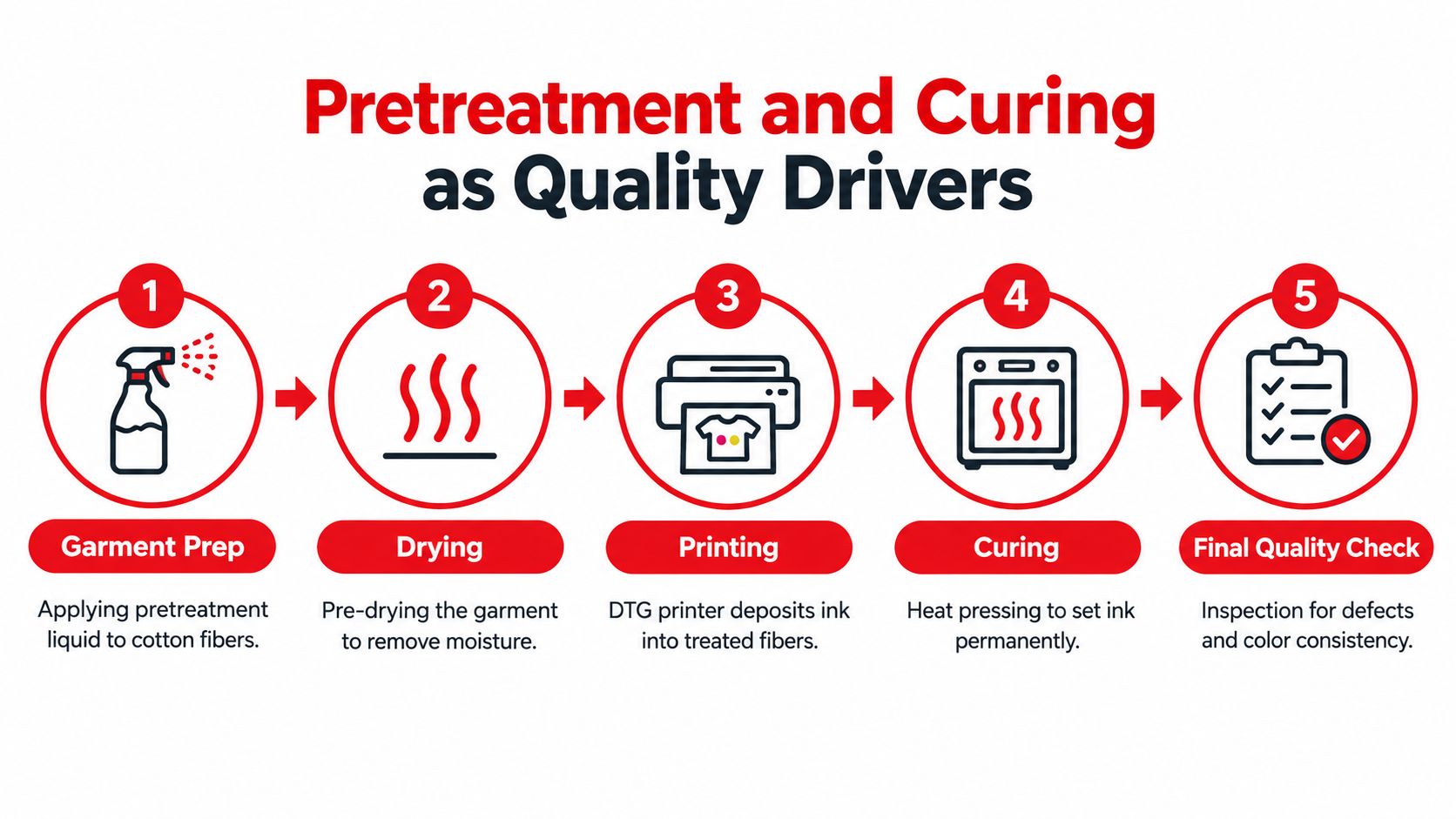
Where production failures begin
A reliable workflow controls the entire sequence:
Garment preparation: Flatten the fabric and remove lint or surface contamination.
Pretreatment application: Apply a consistent layer suited to the fabric and ink system.
Drying: Remove excess moisture before the garment enters the printer.
Printing: Lay the garment flat and maintain accurate platen positioning.
Curing: Apply the required heat and pressure so the ink bonds properly.
Insufficient curing can leave the print vulnerable to washing and rubbing. Excessive heat can stiffen the hand feel or affect white ink appearance. Pretreatment that is too heavy can create a harsh surface, while too little may produce dull color and weak adhesion.
A serious shop should retain a washed control sample from each garment class, not just inspect the first fresh shirt. The relevant checks include white-ink adhesion, registration, fine-detail reproduction, color consistency, and the behavior of large saturated areas. A standardized laundering approach is more useful than a quick visual inspection because laboratory textile studies use spectrophotometry and ISO 105-C06-equivalent laundering procedures to quantify color change and durability. The laundering and DTG durability research reports that DTG combined with polyester or polyester-blend materials provided strong color durability after the first laundering cycle, while also emphasizing that results depend on ink, substrate, pretreatment, and curing.
The following production demonstration shows how garment preparation, printing, and heat finishing fit together.
DTG vs DTF - Choosing the Right Method
DTG and DTF can both produce excellent apparel graphics, but they solve different production problems. DTG prints directly into the garment, while DTF prints the design onto film and transfers it with heat. That distinction affects fabric compatibility, surface feel, production handling, and the kinds of garments that make sense for each method.
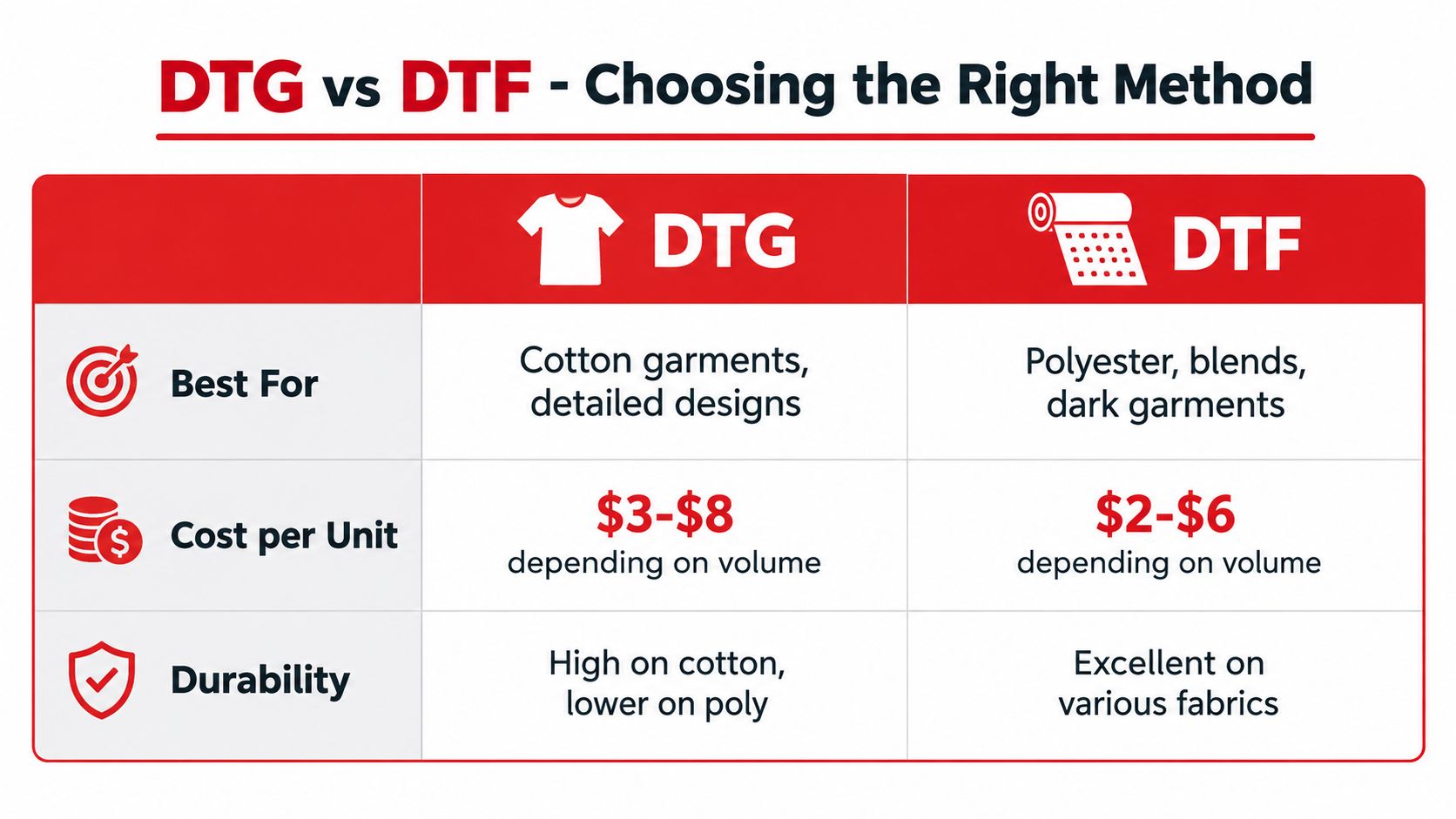
Select by fabric and finish
DTG is usually the better fit when the buyer wants a soft, integrated print on a compatible natural-fiber garment. It handles detailed artwork without the visible film edge associated with transfers. The result can feel more like dyed fabric, particularly when pretreatment and curing are well controlled.
DTF is the more flexible option when the garment is synthetic, heavily blended, dark, textured, or otherwise difficult to manage with direct ink application. A transfer provides a separate decorated layer that can adhere to a wider range of surfaces. That flexibility can matter more than the softest possible hand feel for performance apparel, team garments, event uniforms, and mixed-fabric orders.
Wear X Apparel, LLC presents DTF garment printing and apparel production services, including garment selection support and production for custom apparel. That kind of method-first consultation is useful when the buyer isn't sure whether a favorite garment will accept DTG reliably.
What each method does well
Requirement | DTG | DTF |
|---|---|---|
Natural-fiber garment | Strong choice when properly prepared | Works, but may feel more like a transfer |
Synthetic or challenging fabric | Requires careful testing | Often the more practical option |
Photographic detail | Strong capability | Also supports complex, full-color artwork |
Softest integrated hand feel | Main advantage | Transfer layer remains perceptible |
Exact brand color | May require proofing and adjustment | Also requires color control and approval |
Short custom production | Well suited to detailed, varied artwork | Useful for varied garments and transfer stock |
Don't choose by trend or by a generic durability promise. Match the method to the fabric, the artwork, the expected handling, and the buyer's tolerance for a transfer feel. Research on textile quality also warns against treating sustainability as automatic. Digital printing can reduce water and chemical use compared with conventional rotary screen printing, but heat fixation and process waste still affect the total outcome. The textile-printing quality and sustainability research supports evaluating the complete workflow rather than praising one method in isolation.
A Practical Quality Checklist for Buyers
A buyer can prevent most print disputes before production by asking for evidence instead of accepting the phrase “retail quality.” You don't need to understand every printer setting. You do need to verify that the provider has tested the exact garment, design, and intended use.
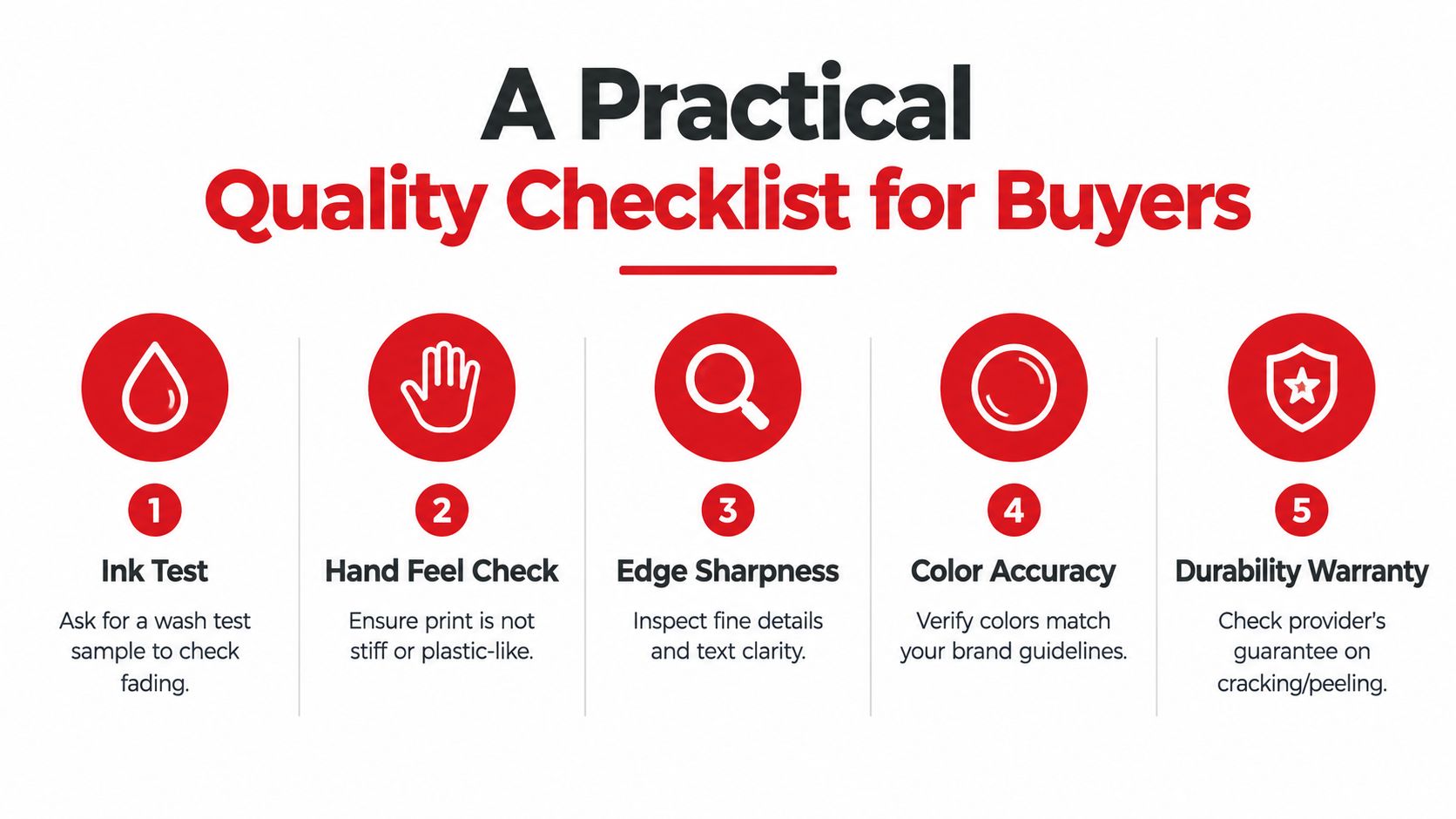
Ask these questions before approving a run
Request an actual sample: Use the same garment, artwork size, colors, and placement planned for production.
Ask how the garment is prepared: The provider should be able to explain whether pretreatment changes by fabric and color.
Review the dark-garment underbase: Look for even white coverage, clean edges, and no visible patchiness.
Inspect the smallest details: Check fine text, thin lines, gradients, and registration under ordinary lighting.
Request a wash-tested control: For uniforms, workwear, outdoor use, or event apparel, judge the print after laundering rather than only when new.
Clarify care instructions: Detergent, temperature, cycle duration, and drying conditions influence fading and bleeding.
Define the acceptance standard: Agree in advance on color tolerance, print position, hand feel, and acceptable variation between garments.
A credible provider won't treat a sample request as an inconvenience. The test should answer a specific question, such as whether a dark blend holds a bright white base or whether small lettering remains readable after washing.
Wear X Apparel, LLC provides garment selection and custom apparel production support with DTF as a core method. For a buyer comparing DTG and DTF, a consultation can help identify whether the selected garment and use case require direct printing, a transfer, or a different decoration process.
Approval standard: If the provider can't explain how the print was tested, treat the quality claim as unverified.
Caring for Your DTG Prints to Maximize Longevity
Production quality gives a garment a strong starting point, but washing determines how that quality holds up in real life. Detergent chemistry, water temperature, abrasion, drying heat, and exposure to direct heat all affect a water-based textile print. The correct care routine is simple, and it protects both the graphic and the garment fibers.
Use a low-stress wash routine
Turn the garment inside out before washing. This reduces direct rubbing against other garments and the inside of the machine. Use a cold or cool cycle with a mild detergent, and avoid bleach or aggressive additives unless the garment-care label specifically permits them.
High dryer heat adds unnecessary stress. Air drying is the gentlest option, while low heat is preferable when machine drying is necessary. Don't iron directly over the printed area. If ironing is needed, turn the garment inside out and keep direct heat away from the graphic.
Wash inside out: Limits abrasion against the printed surface.
Choose mild detergent: Reduces chemical stress on the ink and fabric.
Avoid high heat: Protects color and helps preserve the garment's surface.
Follow the care label: The blank garment's construction still controls washing limits.
A small change after washing doesn't automatically indicate a production defect. Some color adjustment can occur as the fibers settle and the garment experiences normal laundering. A more serious warning sign is rapid loss of coverage, widespread cracking, bleeding, severe dulling, or peeling after reasonable care. Those problems may point to unsuitable fabric, inconsistent pretreatment, or incomplete curing.
For demanding orders, keep one approved sample and compare delivered garments against it after the same care routine. That gives you a practical reference for color, placement, hand feel, and detail. It also separates a process problem from damage caused by harsh washing or drying.
The answer to “is DTG printing good quality” is therefore practical rather than absolute. Yes, DTG is a strong production method for detailed apparel, but the garment and process controls decide whether the finished print earns that description.
Wear X Apparel, LLC helps customers select garments and produce custom apparel with DTF printing for individual pieces and batch orders. Visit Wear X Apparel, LLC to discuss your garment, artwork, and intended use before committing to production.
Comments