


Bulk T Shirts Buying Guide: Pricing, Minimums, and More

You've got a tour, fundraiser, work crew, or merch drop coming up, and the order looks simple in a spreadsheet: shirt style, color, quantity, logo. The risk appears when the boxes arrive. A color is unavailable, the replacement blank fits differently, the print shop needs more time, or the size mix leaves half the team swapping shirts before the event.
That's why bulk t shirts should be managed as a production run, not a larger retail purchase. The blank, decoration method, shrinkage performance, size grading, quality checks, and delivery chain all affect the final cost. This guide focuses on the decisions that protect a DTF-printed order from reprints, rushed freight, and unusable inventory.
Table of Contents
What Counts as a Bulk T Shirt Order - Bulk, wholesale, and custom mean different things
Pricing Tiers and Minimums for Bulk T Shirts - Match the tier to your actual demand
Lead Times and How to Schedule a Bulk Run - Build the schedule backward
Quality Checks That Protect Your Bulk Order - Use a written inspection matrix
Choosing the Right Blank for Teams, Events, and Merch - Match the blank to the job
Sizing, Size Mix, and How to Avoid Costly Reorders - Plan the mix before quoting
Why Bulk T Shirts Are Worth Planning Carefully
A small brand preparing 600 printed tees for a tour can lose margin before the first shirt is sold. Three blank colors may arrive with noticeably different fits, one critical color may be back-ordered, and the printer's schedule may move by a week. None of those problems starts at the heat press. They start when the purchase order treats every T-shirt as interchangeable.
Once an order grows beyond a small group run, the garment becomes part of a coordinated production system. The supplier has to secure the exact blank, the decorator has to reserve capacity, the artwork has to match the chosen surface, and the finished goods have to arrive in the right size and color combinations. A cheap blank that requires a replacement shipment can cost more than a better-specified garment bought at a higher initial unit price.
Production rule: Approve the actual blank, not a product photo or a substitute style.
The global T-shirt category is already a large, mature apparel market. One industry summary values it at $30.68 billion in 2026 and projects $44.81 billion by 2035, while another estimates $185.2 billion in 2024 and $221.5 billion by 2032. The figures differ because the reports use different product scopes, methods, and geographic coverage, but both point to a significant and expanding basics-apparel category. See the industry estimate comparison for the underlying figures.
That scale gives buyers access to many colors, weights, and fits, but it also creates more ways to choose incorrectly. Bulk T-shirts work well for uniforms, events, clubs, and branded merchandise because they're easy to replenish and decorate. The cleanest runs come from making the operational decisions before the PO locks, when changing a blank or revising the size mix is still inexpensive.
What Counts as a Bulk T Shirt Order
A blank T-shirt is a production input. It's the canvas that receives your artwork, and the canvas affects the result. A smooth, stable cotton surface may accept fine DTF detail cleanly, while a loose knit, heathered blend, or very heavy garment can change how the transfer sits, stretches, and feels after application.
Think of DTF as a printed layer being bonded to fabric with heat and pressure. The transfer can work across many garment types, but the blank still controls the surface tension, texture, color interaction, and wearer experience. A heavyweight cotton tee won't behave exactly like a lightweight tri-blend, just as linen and tightly woven cotton take decoration differently.
Bulk, wholesale, and custom mean different things
These terms often appear together, but they describe different parts of the transaction:
Bulk describes the quantity. One purchase covers multiple garments, often with shared artwork, colors, or production requirements.
Wholesale describes the buying and pricing model. A wholesale account may offer volume tiers, case quantities, or supplier-specific minimums.
Custom describes the decoration or alteration. The shirts may receive DTF, screen printing, embroidery, labels, or another treatment.
A bulk order can be blank or decorated. A custom order can be small. A wholesale purchase can include multiple styles and no printing at all. Ask the supplier to quote the exact combination of blank style, color count, sizes, decoration, and delivery destination, rather than relying on a general “bulk” price.
The blank's construction also matters when you're comparing products outside a T-shirt order. For example, the RXB Marlboro Rodeo Hoodie uses an 8.5 oz./yd² 70/30 ring-spun cotton/polyester blend with a 100% cotton face, a generous fit, fleece lining, and double-needle sewing. Those specifications describe a heavyweight hoodie, not a T-shirt blank, but they illustrate the level of detail a production buyer should capture before approving a garment.
Pricing Tiers and Minimums for Bulk T Shirts
Bulk pricing usually has three practical levels. Smaller decorated runs offer flexibility, mid-volume shops improve the unit economics, and wholesale decorator accounts make sense only when the buyer can confidently use the inventory.
Supplier Tier | Typical Piece Count | Common Minimums | Per-Unit Price Band | Setup Notes |
|---|---|---|---|---|
Print-on-demand-style bulk | 24 to 72 | Minimum may apply by design or garment | Higher | Flexible quantities, limited leverage on production time |
Mid-tier decoration shop | 100 to 500 | Often separated by style, color, or print location | Mid-range | DTF can reduce setup complexity for detailed artwork |
Wholesale decorator account | 1,000+ | Larger commitments by style and color | Lowest | High volume can spread setup and handling costs |
These ranges are planning categories, not universal supplier rules. A shop may define its minimum by total garments, by each style, or by each color and print location. Ask whether 200 mixed-color shirts count as one run, several color runs, or separate minimums.
DTF changes the cost calculation for many orders in the 50 to 200 piece range because it doesn't require a separate screen for every ink color. That makes detailed, multicolor artwork practical without the same screen-setup structure used for screen printing. DTF still has labor, film, powder, pressing, quality control, and finishing costs, so avoiding screens doesn't mean the job has no setup or handling expense.
Match the tier to your actual demand
Use the smallest tier that gives you a reliable landed cost and enough stock for the planned use. A team ordering for a fixed roster may benefit from a mid-volume run, while a new merch brand should avoid buying a wholesale quantity before testing fit, color, and sell-through.
Request an itemized quote that separates:
blank garment cost
decoration cost
artwork or file preparation
setup or handling
folding, bagging, or labeling
freight and delivery
reprint or replacement terms
The lowest blank price isn't automatically the lowest finished cost. A split shipment, inconsistent substitute, or size correction can erase a volume discount quickly. Price the complete run, then compare vendors on the same specification.
Lead Times and How to Schedule a Bulk Run
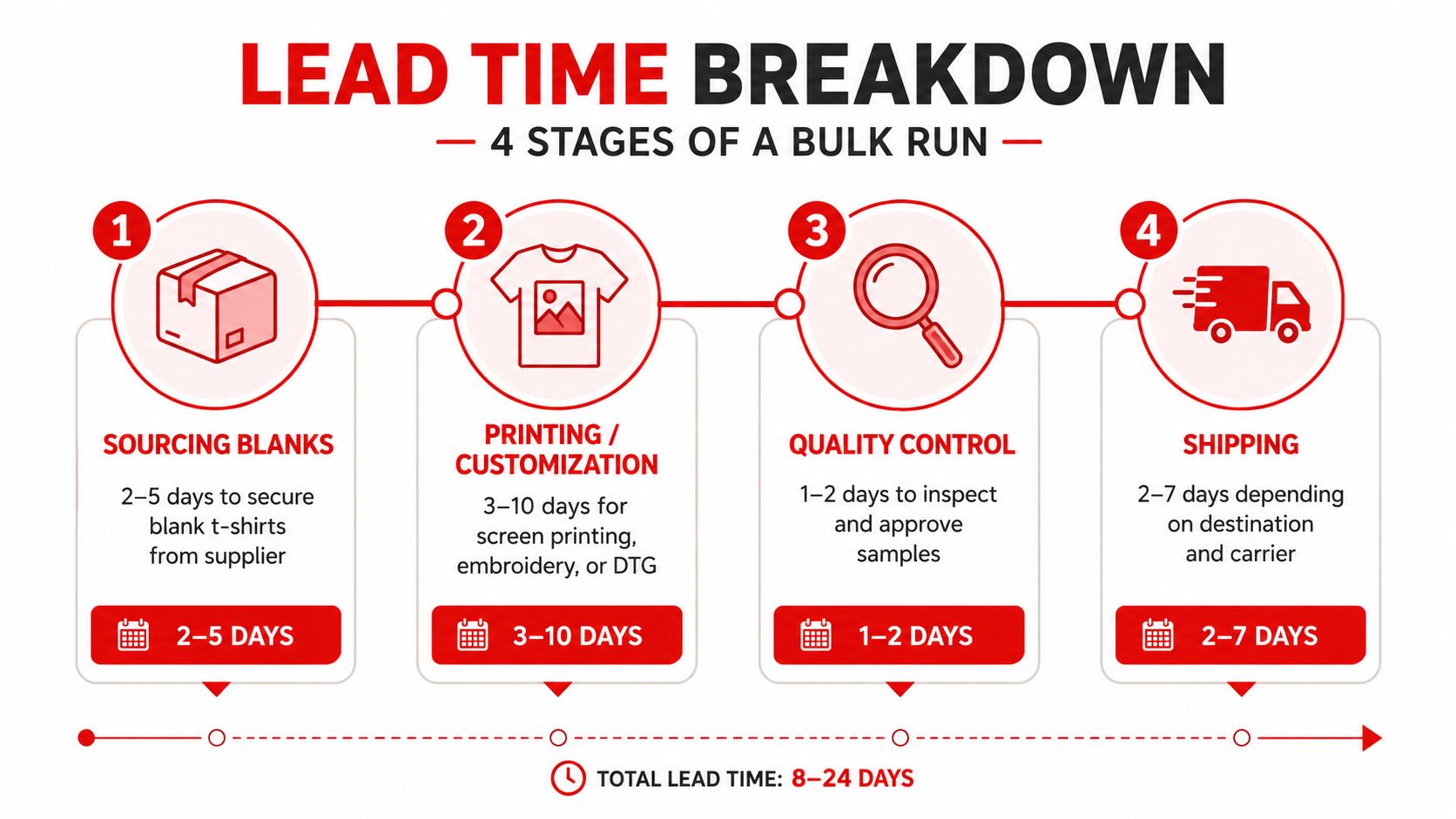
A bulk T-shirt deadline is a chain, not a single lead-time figure. The schedule must account for blank sourcing, DTF production, finishing, and shipping, with the slowest stage controlling the handoff to the next one.
For in-stock blanks, sourcing may take 2 to 5 business days, according to the production assumptions in this brief. Back-orders and non-standard colors can extend that stage. DTF production also scales with quantity. A press may process roughly 50 to 100 shirts per hour, so a 500-shirt run can occupy a full print day before folding, sorting, or packing begins. Those production figures are operational estimates, not guarantees, and the exact speed depends on artwork size, garment handling, press capacity, and inspection requirements.
Build the schedule backward
Start with the date the shirts must be worn or shipped to customers. Then work backward through these handoffs:
Approve artwork and the actual blank. Resolve color, placement, size, and file questions before production time is reserved.
Secure the garments. Don't schedule pressing around an assumption that the warehouse has every color and size.
Print and apply the transfers. Quantity, artwork complexity, and garment count determine press time.
Finish and sort. Folding, bagging, labeling, and size sorting can add a half-day on a large run.
Move the shipment. Ground freight may take 3 to 5 business days, and split shipments between the blank supplier and decorator can create avoidable delays.
Use this bulk production workflow visual when assigning responsibility for approvals and handoffs. Add two days of buffer for reprints, label mix-ups, or a late carton. If the date is hard, confirm the latest acceptable ship date in writing, not just the estimated arrival date.
Quality Checks That Protect Your Bulk Order
Quality control starts before the press. When the cartons arrive, pull a blank from each case and compare it against the approved sample. Check the color, construction, measurements, and fabric weight before anyone applies a transfer.
GSM measures fabric mass per square meter, but it doesn't predict shrinkage, stability, or print behavior by itself. The buyer should specify both the fabric weight and shrink-performance requirement in the tech pack or PO. Industry guidance for knit T-shirts commonly targets about 3% or less dimensional change after standardized laundering, while untreated cotton can show roughly 5% to 8% lengthwise shrinkage when compacting or sanforization is insufficient. Review the bulk T-shirt shrinkage testing guidance alongside the supplier's test method.
Use a written inspection matrix
Check Point | What to Inspect | Acceptable Tolerance |
|---|---|---|
Fabric weight | Compare the received blank with the listed GSM using a fabric scale | Investigate a variance greater than 8% from the listed weight |
Shrinkage | Wash and dry a sample using the intended care process | Approve only after post-wash measurements meet the PO requirement |
Stitch integrity | Inspect side seams, shoulder taping, hems, and ribbing | No skipped stitches, exposed raw edges, or open seams |
DTF adhesion | Check the first decorated garments for edge lift, peeling, or incomplete bonding | No visible lifting or weak edges |
Artwork placement | Compare print position, size, and color to the approved proof | Match the approved placement and artwork specification |
Untreated cotton commonly shrinks 3% to 8% in length and 2% to 5% in width, while sanforized or pre-shrunk cotton is typically held under 1% dimensional change. Cotton-poly blends usually fall around 1% to 3%, and polyester around 0.5% to 1%, as outlined in this shrinkage testing reference. The first wash drives most dimensional change, so a post-laundry measurement is more useful than trusting a size label.
A pre-production sample on the actual blank is essential for a substantial run. For DTF, inspect the first 10 shirts off the line for adhesion, edge peel near seams and hems, color registration, and placement against the approved proof. Keep the approved sample with the order records, and use the decoration inspection reference to keep the review consistent.
Choosing the Right Blank for Teams, Events, and Merch
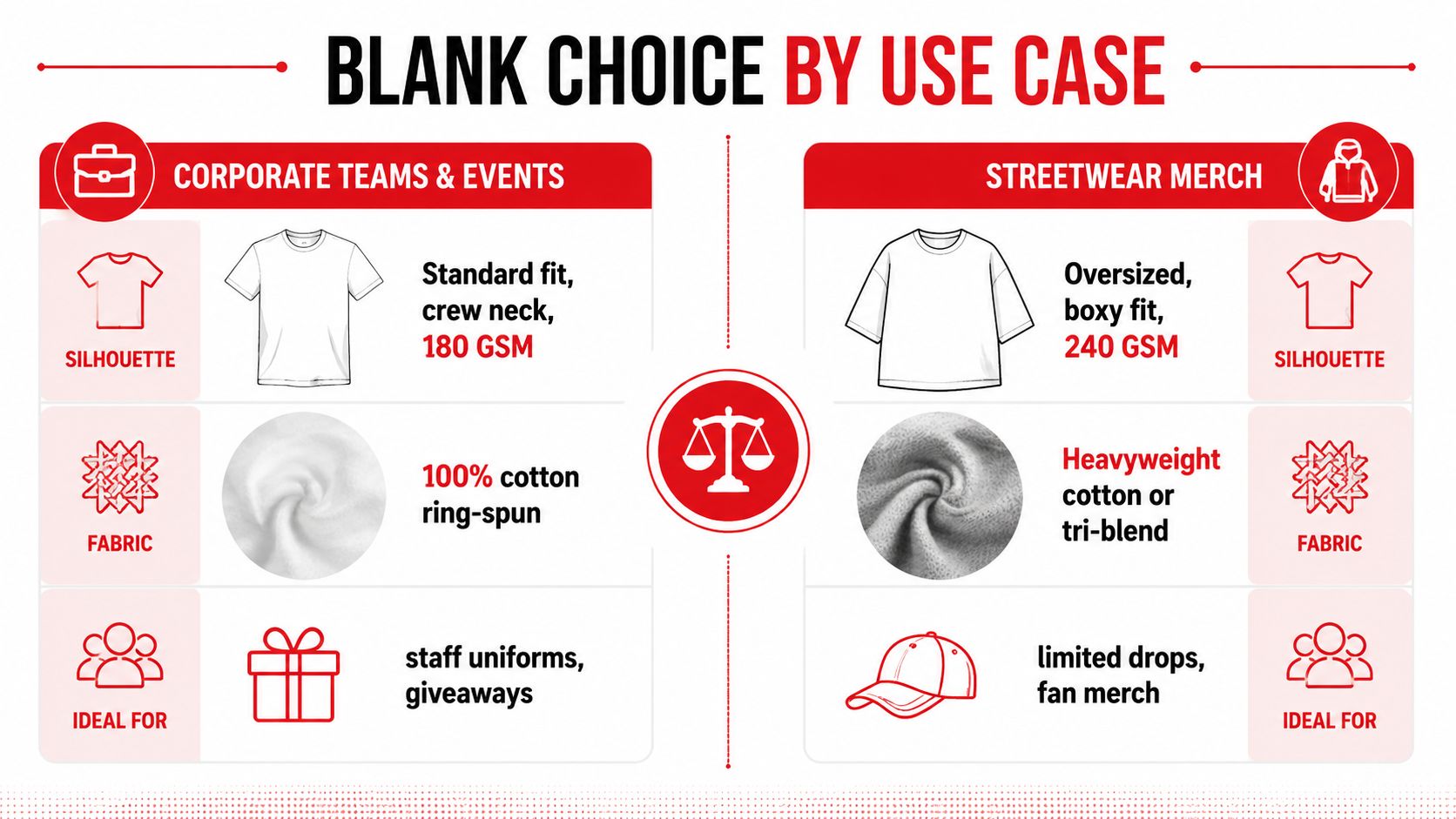
Blank selection should follow the wearer and the use case, not a trend board alone. Independent coverage identifies oversized, relaxed, and heavyweight T-shirts as prominent 2025 directions, with relaxed fits described as especially popular and heavyweight styles returning strongly. The practical question is whether that silhouette supports repeated washing, all-day movement, layering, print placement, and the expectations of the person receiving it. See the 2025 T-shirt trend analysis for the background.
Match the blank to the job
For staff uniforms and event crews, a mid-weight classic cut is usually easier to size across a mixed group. It also gives DTF transfers a predictable surface without making the garment feel overly fashion-specific. A standard silhouette is easier to replace later because the wearer expects a familiar fit.
Streetwear merchandise can justify a heavier, boxier blank. The structure gives large graphics a more substantial base, and the garment itself feels like part of the product rather than a disposable carrier for the artwork. The trade-off is cost, added weight, and a size mix that may need more room in the larger sizes.
Giveaways prioritize reach and unit economics. A lighter budget blank can work when the print is the main reason someone accepts the shirt, but it won't create the same premium impression as a heavyweight or retail-oriented garment. Choose the expectation first, then test the DTF transfer on the exact fabric.
A thick, boxy tee and a fine-line DTF design can work together, but they need a press test. Heavy fabric may handle a broad graphic well, while a delicate design can look visually lost if the placement and scale are too conservative. Review the DTF garment example before approving a production placement.
Sizing, Size Mix, and How to Avoid Costly Reorders
Sizing needs its own workflow. A size chart on a supplier website describes the garment, but it doesn't tell you how your team, audience, or customers will divide across the available sizes. For a group order, collect actual information from team rosters, event registrations, previous orders, or retail sales instead of guessing from a generic adult mix.
Create a graded spec sheet for the exact blank. Record chest width and body length by size, then compare those measurements with the post-wash sample. This matters even more with relaxed and oversized silhouettes, because a buyer may interpret “large” as roomier than the supplier intended, or treat a fashion fit as if it were a standard uniform cut.
Sizing safeguard: A sample should answer two questions, not one. Does the shirt fit before washing, and does it still fit after the intended care process?
Plan the mix before quoting
A useful planning sheet can separate the order into three demand patterns:
Size | Team / Staff | Event Giveaway | Online Resale |
|---|---|---|---|
XS | Use roster data | Keep limited unless requested | Test against audience data |
S | Use confirmed wearer measurements | Stock according to attendee profile | Track sell-through by color and fit |
M | Use confirmed wearer measurements | Prioritize common requested sizes | Compare with prior sales |
L | Use confirmed wearer measurements | Prioritize common requested sizes | Compare with prior sales |
XL | Use confirmed wearer measurements | Hold practical event stock | Monitor returns and exchanges |
XXL and above | Confirm individually where possible | Reserve based on audience needs | Plan by product and customer data |
Don't treat that table as a universal percentage split. It's a collection framework. Add a small reserve at the size tails when the order supports it, because a shortage in an uncommon size can force an urgent replacement or leave a participant without the intended garment.
Online apparel returns were 19.3% in 2025, compared with 15.8% across all retail, according to the cited retail benchmark. That doesn't directly measure custom bulk orders, but it does show why fit uncertainty deserves operational attention in apparel. Review the apparel return benchmark and use the lesson practically, collect sizes before ordering, publish garment measurements, and record every swap as evidence for the next run.
A Practical Checklist for Your Next Bulk Order
Before sending the PO, make the order easy for another person to audit. A production file should contain the approved blank, color references, artwork, size mix, delivery milestone, and inspection notes. If a reorder depends on someone remembering a conversation, the process is already fragile.
Confirm the blank. Record the exact style, colorway, fabric composition, fit, and GSM. Compare the received garment with an approved swatch rather than a website image.
Match decoration to artwork. DTF suits detailed, multicolor transfers and varied garment types. Screen printing can make sense for large solid-color runs. Embroidery belongs on placements and garments that can support its weight and texture.
Approve the production sample. Use the actual blank in the actual color. Check artwork scale, placement, surface feel, and adhesion before releasing the full run.
Lock the size mix. Pull historical orders, rosters, event responses, or resale data into the PO. Keep the graded measurement sheet with the artwork proof.
Schedule from the hard date. Work backward through blank sourcing, printing, finishing, inspection, and transit. Confirm who owns each handoff and where tracking information will be stored.
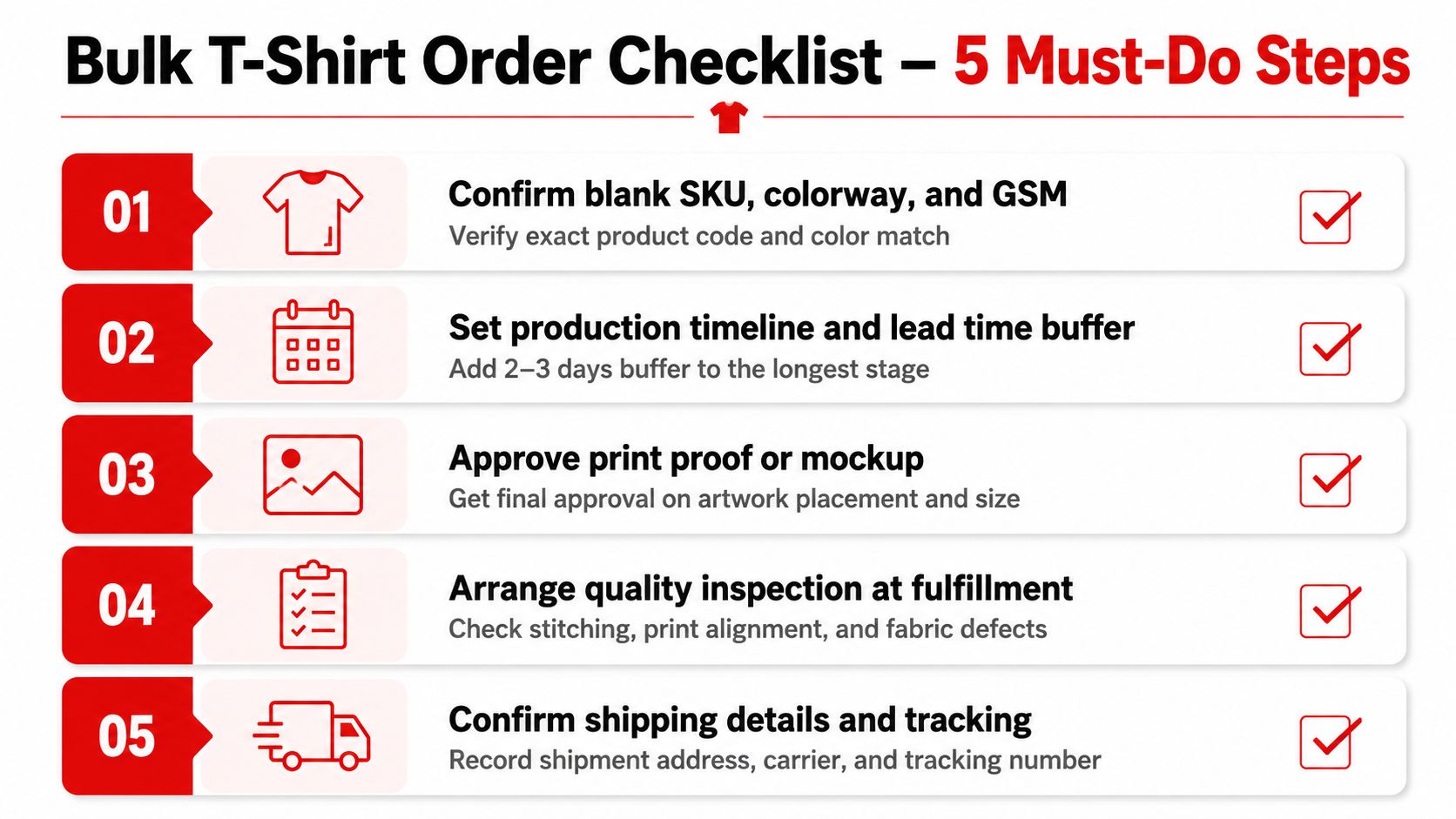
Save the completed checklist in the order folder and duplicate it for recurring programs. That gives the next order a baseline for blank consistency, DTF placement, size demand, and defect tracking. Wear X Apparel, LLC provides garment selection support and DTF printing for T-shirts, hoodies, teams, events, organizations, and made-to-order merchandise, with custom projects handled through its service channels.
Visit Wear X Apparel, LLC with your garment type, artwork, quantity, size mix, and delivery date ready. The team can help match the blank to the use case, prepare a DTF production plan, and coordinate the checks that keep a bulk run from turning into a costly reprint.
Comments