


Customizable Messenger Bags: A Practical Buyer's Guide

You need ten branded messenger bags for a client visit next month. The catalog has the wrong color, the supplier wants a large minimum order, and the logo sample looks fine on screen but starts lifting where the flap folds. That's not a design problem alone. It's a production mistake that began with choosing the bag before choosing the substrate, decoration method, and use case.
Customizable messenger bags give you a larger branding surface than a small accessory, but they also expose every weak decision. The fabric affects abrasion and ink adhesion. The flap and strap create high-contact zones. Artwork that looks sharp on a flat proof may fail when transferred onto an angled pocket or repeatedly rubbed against a jacket. This guide takes you through the full decision chain, from material and decoration to file preparation, durability, quantity, and lead time. By the end, you'll be able to defend your choices in a quote conversation without sorting through catalog language that hides the trade-offs.
Table of Contents
Why Customizable Messenger Bags Are Worth a Closer Look - Utility creates repeat visibility
What Makes a Messenger Bag Customizable - Map the surface before choosing the method - Separate the substrate from the surface treatment
Matching Decoration Method to Bag and Design - Why DTF is often the flexible answer
Artwork Placement and File Prep That Actually Prints Clean - Assign the artwork to the right zone - Prepare files for the production process
Durability and Everyday-Carry Performance - Read fabric specifications as use signals - Match the build to the carrying environment
Ordering Quantities, Lead Times, and Reorders - Identify what actually controls the schedule
Why Customizable Messenger Bags Are Worth a Closer Look
A messenger bag earns attention because people carry it through the places where brands want to be seen. A team member takes it to a site visit, a student carries it between classes, an event worker uses it while moving through a venue, and a courier relies on it during a full shift. The bag keeps working after the handoff, which makes it more useful than merchandise designed for a single moment.
The category itself is established and substantial. The global messenger bag market was estimated at $3.81 billion in 2025 and is projected to reach $6.22 billion by 2034, implying about 63% growth across the forecast period and a 5.6% compound annual growth rate from 2026 to 2034, according to Market Intelo's messenger bag market overview. That forecast doesn't guarantee a particular custom order will succeed, but it does show why messenger bags remain a practical format for consumer use, team identity, events, resale, and corporate merchandise.
Utility creates repeat visibility
Promotional-product research supports the format for a straightforward reason. A 2026 industry summary reports that 73% of recipients use promotional bags weekly, while bags remain in use for about 11 months on average, compared with 6.6 months for the average promotional item. The same messenger bags market research summary reports approximately 5,800 impressions per item over its usable life and an average cost per impression of $0.004.
Those figures matter only if the bag survives normal handling and the decoration stays readable. A cheap bag with a peeling logo becomes negative brand exposure. A well-specified bag becomes a useful uniform element, a saleable product, or a practical gift that people choose to carry.
Production rule: Treat the bag as a working product first and a branding surface second. If it can't handle the intended load and environment, a larger logo won't rescue the order.
This guide focuses on the decisions that control the outcome: substrate, decoration method, artwork placement, file preparation, durability, order quantity, and timing. The goal isn't to make every bag premium. It's to make the specification match the job.
What Makes a Messenger Bag Customizable
Start with the bag's physical regions, not the logo file. In practical production terms, most messenger bags offer four useful customization zones, and each zone behaves differently during decoration.
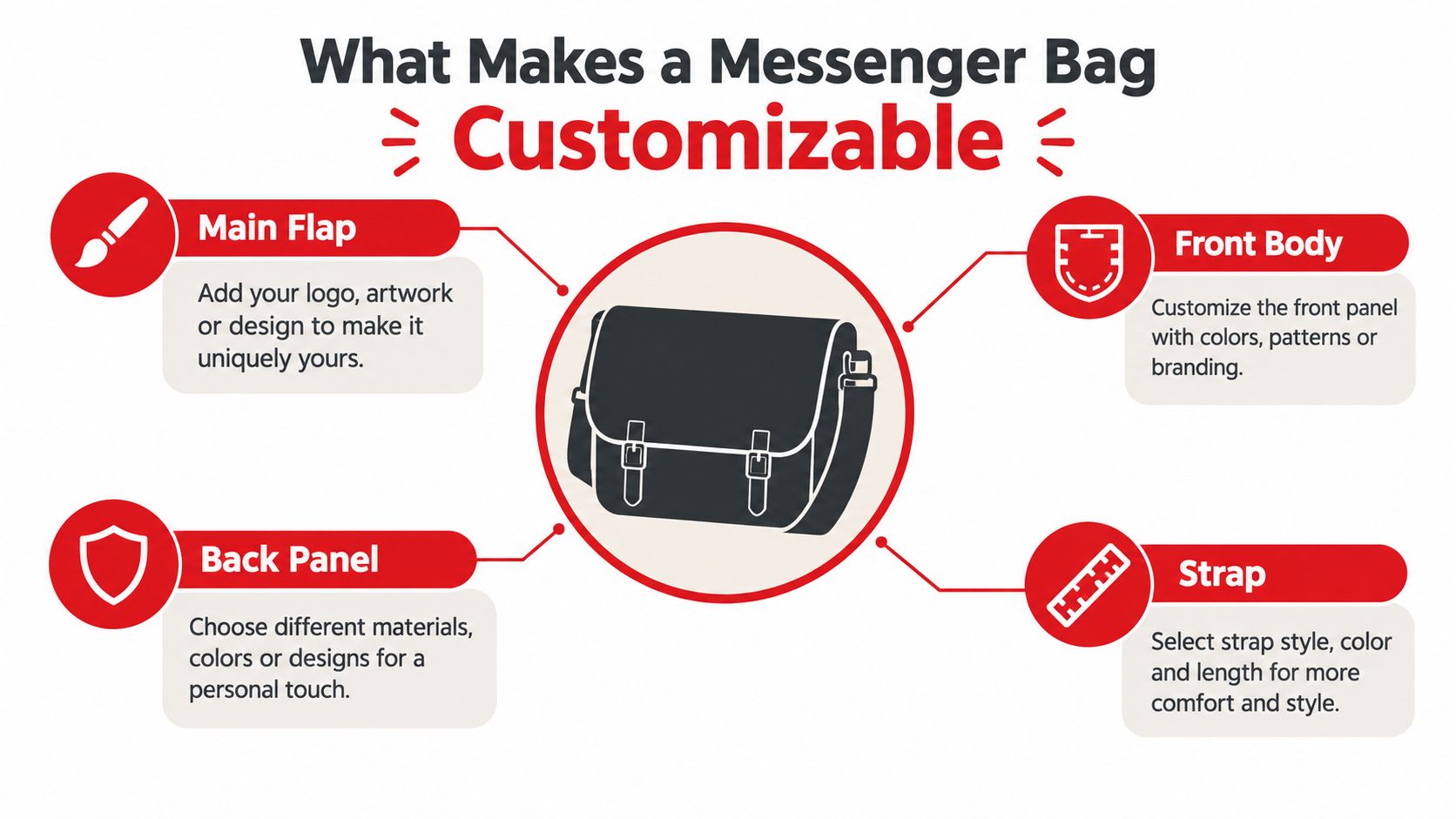
Map the surface before choosing the method
The main flap is usually the prime branding area. It faces outward, presents a broad uninterrupted surface, and can carry a logo, illustration, or campaign graphic. The flap also opens and closes repeatedly, so its decoration must tolerate bending and contact.
The front body panel or lower pocket works well for secondary identification. It suits a smaller logo, department mark, event name, or short message. Pockets introduce seams, zippers, and curved transitions, so the usable print zone is smaller than the visible panel.
The back panel can create strong impact, especially when the bag is worn cross-body, but it may rub against clothing or a chair. Use it for bold artwork that doesn't depend on tiny text. The strap is narrow and exposed to friction, making it a poor location for fine typography. Repeating a simple symbol or short wordmark is safer than placing a detailed illustration there.
Separate the substrate from the surface treatment
Substrate customization means choosing what the bag is made from, such as cotton canvas, polyester, recycled PET, or coated canvas. That decision controls feel, weight, water behavior, and how the material accepts decoration.
Surface customization is what you apply afterward. Options include DTF transfer, screen printing, embroidery, woven patches, PVC patches, and branded hardware. The same logo won't behave the same way in thread as it does in ink. Embroidery adds texture and physical depth, while DTF can reproduce fine lines, gradients, and full-color artwork. A patch creates a separate badge that can feel more intentional on rugged bags and may be easier to standardize across different blanks.
The location tells you where the artwork can go. The material and decoration method determine whether it should go there at all.
Choosing the Right Bag Material
Material selection should happen before final artwork. A design made for absorbent cotton may need a different treatment on smooth polyester, and a coating that repels rain may also interfere with ink adhesion.
Material | Weight | Print Compatibility | DTF Compatibility |
|---|---|---|---|
12 to 16 oz natural cotton canvas | Heavier, substantial hand-feel | Strong for screen printing and detailed surface decoration | Suitable when the supplier controls temperature and adhesion |
600D polyester | Lighter and abrasion-oriented | Strong for DTF, heat transfer, and dye-sublimation | Broadly suitable, especially for detailed full-color work |
Recycled PET, or rPET | Varies by supplier and construction | Depends on fiber and surface finish | Must be tested because print uptake varies |
Coated or waxed canvas | Structured and weather-resistant | May reject some inks without treatment | Requires substrate-specific testing |
Natural cotton canvas is the tactile choice. It feels substantial, accepts detailed print well, and supports a premium merchandise position. The trade-off is weight, staining, and weaker weather behavior. It's a strong fit for studio teams, retail merchandise, school programs, and indoor event use where the bag's feel matters as much as rain resistance.
600D polyester is the practical default for daily commuting and field work. It's lighter than heavy canvas, resists abrasion well, and commonly supports DTF and dye-sublimation. The smooth surface can make small, full-color artwork look clean, but suppliers still need to manage dye migration, curing, and transfer adhesion.
rPET gives the buyer a clear sustainability story, but don't assume every recycled polyester bag prints identically. Ask for a sample of the actual production fabric, not merely a photo of a similar style. Sustainability claims should be evaluated alongside weatherproofing, repairability, print behavior, and expected service life, as discussed in recent messenger bag sustainability market coverage.
Coated or waxed canvas is useful when shedding light rain is more important than a soft print surface. Some coatings reject ink or alter its bond, so pre-treatment and testing are essential.
Ask for three specifications before approving a sample: fabric weight, denier or GSM, and lining fabric. For abrasion-sensitive zones, independent testing guidance recommends asking whether the supplier uses Martindale testing under ISO 12947 or ASTM D4966, or Taber testing under ASTM D3884, and which failure endpoint they report, as outlined in bag fabric abrasion-testing guidance. A heavy hoodie such as the RXB Marlboro Rodeo Hoodie also illustrates why fabric weight and face composition affect how a decorated product feels, even though apparel fleece and bag fabric serve different construction needs.
Matching Decoration Method to Bag and Design
Don't choose decoration by asking which method is most popular. Choose it by asking what the artwork needs and where the bag will take abuse.
Method | Best substrate fit | Detail and color range | Durability on flap and strap | Typical MOQ | Lead-time driver |
|---|---|---|---|---|---|
DTF or heat transfer | Polyester, cotton, non-woven polypropylene, burlap, with testing for coatings | Fine detail, gradients, photo-style color | Strong when properly cured and bonded, but exposed edges need testing | Small runs are practical | Artwork preparation, transfer production, curing, and alignment |
Screen printing | Cotton canvas and bulk promotional bags | Bold spot colors, strong solid coverage | Highly durable on suitable canvas | More efficient as quantity rises | Screens, color separations, setup, and drying |
Embroidery | Structured canvas, polyester, and thicker panels | Thread-based texture, limited by stitch density and small detail | Durable, but can pucker thin panels or rub at stress points | Often less efficient for very small runs | Digitizing, stitch count, machine time, and color changes |
Woven or PVC patch | Canvas, polyester, and rugged shells | Clean badge-style graphics, controlled detail | Strong when stitching or adhesive is appropriate | Low to moderate runs can work | Patch production, attachment, and placement |
Dye-sublimation | Polyester surfaces designed for sublimation | Full-color artwork with strong detail | Best when the design becomes part of the compatible surface | Depends on supplier process | Blank construction, panel printing, and assembly |
Why DTF is often the flexible answer
DTF is broadly suitable for cotton, polyester, non-woven polypropylene, and burlap, and a major bag-printing guide describes it as especially useful for small runs and full-color designs. That guide gives a typical durability range of 30 to 50 or more washes, depending on substrate and care. Messenger bags aren't washed like T-shirts in every use case, so the relevant question is how the transfer handles bending, rubbing, and cleaning on the actual bag.
See the DTF production example as a reference for the kind of detailed artwork DTF can support. On coated nylon, DTF can preserve gradients and fine shapes that would be awkward to reproduce with embroidery, but the supplier must confirm temperature and adhesion settings.
Screen printing wins when the bag is natural-fiber canvas, the design uses bold spot colors, and the quantity justifies setup. The same guide reports that screen printing on cotton canvas can exceed 50 washes, while polyester canvas is generally rated at about 30 to 40 washes and may be spot-clean only.
Embroidery looks sharp on substantial panels, especially for initials, simple emblems, or workwear-style branding. It's the wrong answer for thin flap material, dense photographic art, or a design that will sit directly over a closure. Stitch density can pull the fabric and create puckering.
Patches make sense when the badge is part of the identity. They suit low-minimum projects, swappable designs, and rugged visual systems where a sewn or molded emblem feels more appropriate than a flat print.
Decision rule: Use DTF for detailed, low-volume, full-color work, screen print for bold canvas graphics at scale, embroidery for simple marks on structured panels, and patches when the badge itself is part of the product.
Artwork Placement and File Prep That Actually Prints Clean
A messenger bag's largest visible panel isn't automatically its best print area. Seams, folds, closures, gussets, and strap attachment points can distort the transfer or create pressure during application.
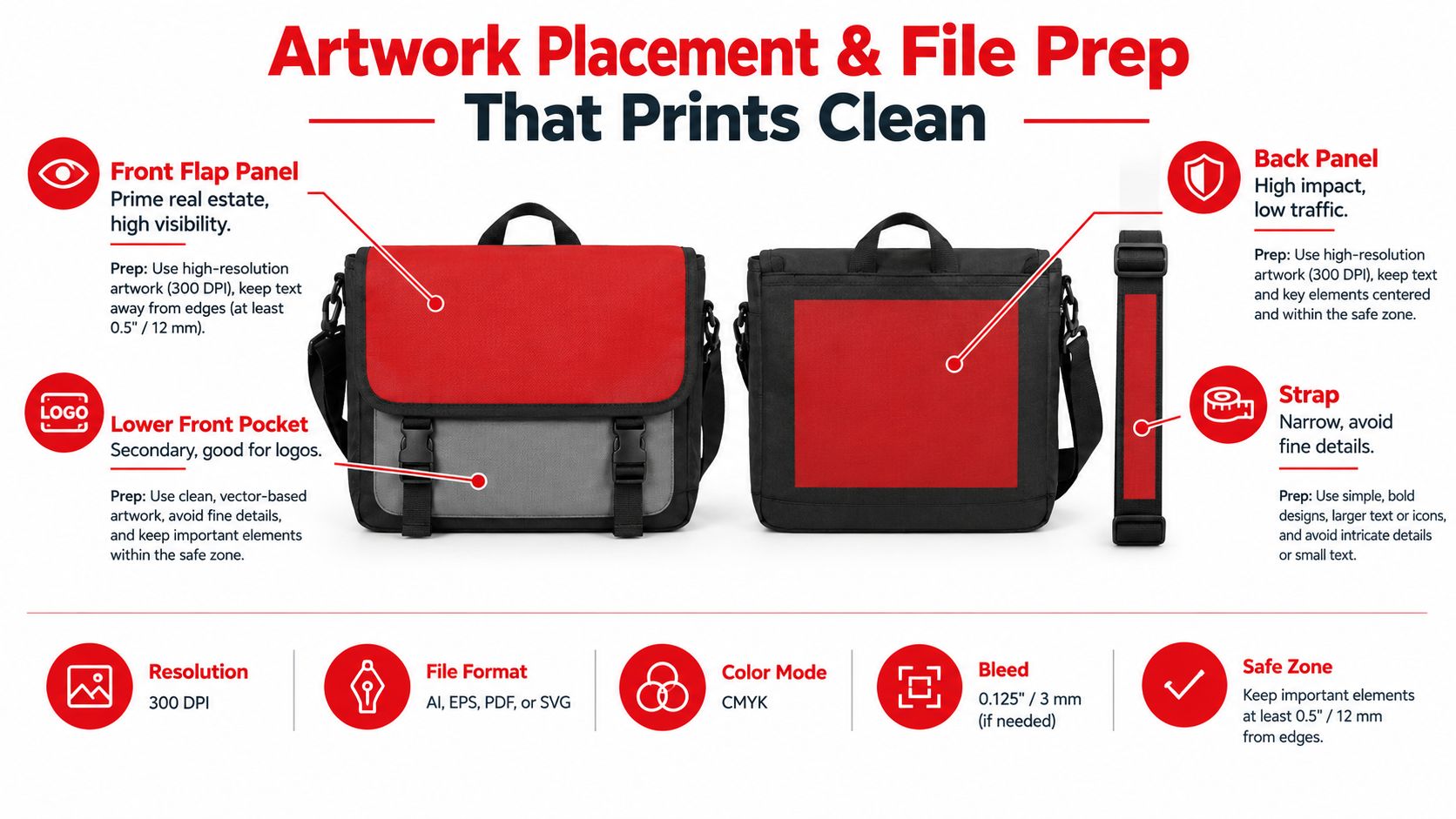
Assign the artwork to the right zone
Use the front flap panel for the primary mark. Keep the design centered on the flat portion and leave padding from the flap edge, closure, and side seams. The lower front pocket is better for a compact logo or supporting message because zippers and pocket openings reduce the clean area.
The back panel gives you a high-impact location with less direct viewing during ordinary carry. Put bold, simple artwork there, not a paragraph of information. On the strap, avoid fine type and narrow strokes. A repeated icon or short wordmark will survive the narrow width better than a detailed lockup.
Ask the supplier for the actual printable dimensions of the selected bag, not a generic messenger-bag template. A common adult messenger bag may offer a front print area in the broad range of a hand-sized to notebook-sized panel, but construction varies enough that the blank sample should decide the final dimensions. Curved, angled, or padded placements complicate DTF alignment, so a flat flap is safer than a rounded side pocket.
Prepare files for the production process
Send vector artwork when possible, with fonts outlined and shapes separated cleanly. If you're supplying a raster file, prepare it at the intended print size at 300 DPI, with a transparent background where the design requires one. Confirm whether the printer wants CMYK values, Pantone references, or a specific RGB workflow before color approval.
Dark bags usually need a white-ink layer beneath colored DTF artwork. That underbase helps the design remain visible, but it can change the hand-feel and makes weak transparency or semi-opaque artwork especially risky. Don't approve color from a screen alone. Review a physical sample when the bag color, coating, or brand color matters.
Run this pre-flight before sending the file:
Bleeds: Confirm whether the transfer needs extra artwork beyond the visible edge.
Safe area: Keep critical type and logos away from seams, closures, and folds.
Stroke weight: Thicken hairlines and fragile outlines that may disappear on textured fabric.
Small text: Read the design at the final size, not while zoomed in on a monitor.
Transparency: Remove unintended background pixels and hidden white rectangles.
Color control: Identify brand colors and accept that fabric tone can affect their appearance.
Placement proof: Request a mockup showing the artwork on the actual bag, at scale.
Pre-flight test: If a person can't read the smallest text on the physical proof while the bag is hanging naturally, the production file is too ambitious.
Durability and Everyday-Carry Performance
A messenger bag fails first where people pull, fold, rub, and set it down. That means the flap edge, strap attachment, base, closure, pocket corners, and bottom panel deserve more attention than a generic claim such as “durable polyester.”
Read fabric specifications as use signals
Cotton canvas offers a natural hand-feel and strong screen-print compatibility, but it absorbs moisture and can show stains. 600D polyester is a more practical choice for commuting, outdoor programs, and general field use because it balances lower weight with abrasion resistance. Ballistic nylon can make sense for more aggressive handling, but it may increase cost and complicate decoration depending on its finish.
Coatings bring their own trade-offs. PU coatings can help the shell repel light rain, while waxed surfaces create a different hand-feel and may resist some inks. A thicker coating can improve wear performance, but it can also affect cold flexibility and transfer bonding. Specify performance by panel zone rather than asking for one fabric claim across the entire bag.
Look for construction details that carry load:
Bar-tacks: Reinforce strap attachment points and other stress areas.
Reinforced bottoms: Protect the base when the bag is placed on rough surfaces.
Quality zippers: Improve access reliability and reduce failure at crowded pockets.
Padded sleeves: Protect laptops and rigid devices during ordinary commuting.
Lining and binding: Reduce exposed seams and improve the bag's finished feel.
Match the build to the carrying environment
A light event giveaway can prioritize clean branding, low bulk, and easy distribution. A commuter bag needs a stable base, reliable closure, device protection, and a strap that doesn't twist under load. A field or courier bag needs stronger attachment points, weather resistance, quick access, and a shell that tolerates repeated contact with bikes, vehicles, and rough surfaces.
Modern commuting demands more than a decorative flap. Recent messenger-bag market analysis identifies padded laptop sleeves, quick-access closures, RFID-blocking compartments, cable management, dedicated 15 to 18 inch laptop compartments, water-repellent shells, e-bike battery-ready construction, and tracking features as relevant product-development directions. Not every order needs all of them, but your specification should identify which functions matter.
DTF can hold up through repeated flap handling when the transfer is properly cured and bonded to the substrate. The supplier still needs to test exposed edges and high-rub areas. Embroidery can last well, but dense stitching on a thin flap may pucker around the closure and make the bag look poorly constructed.
Use the adhesion and transfer reference as a visual reminder that decoration performance depends on the bond, not just the artwork.
Ordering Quantities, Lead Times, and Reorders
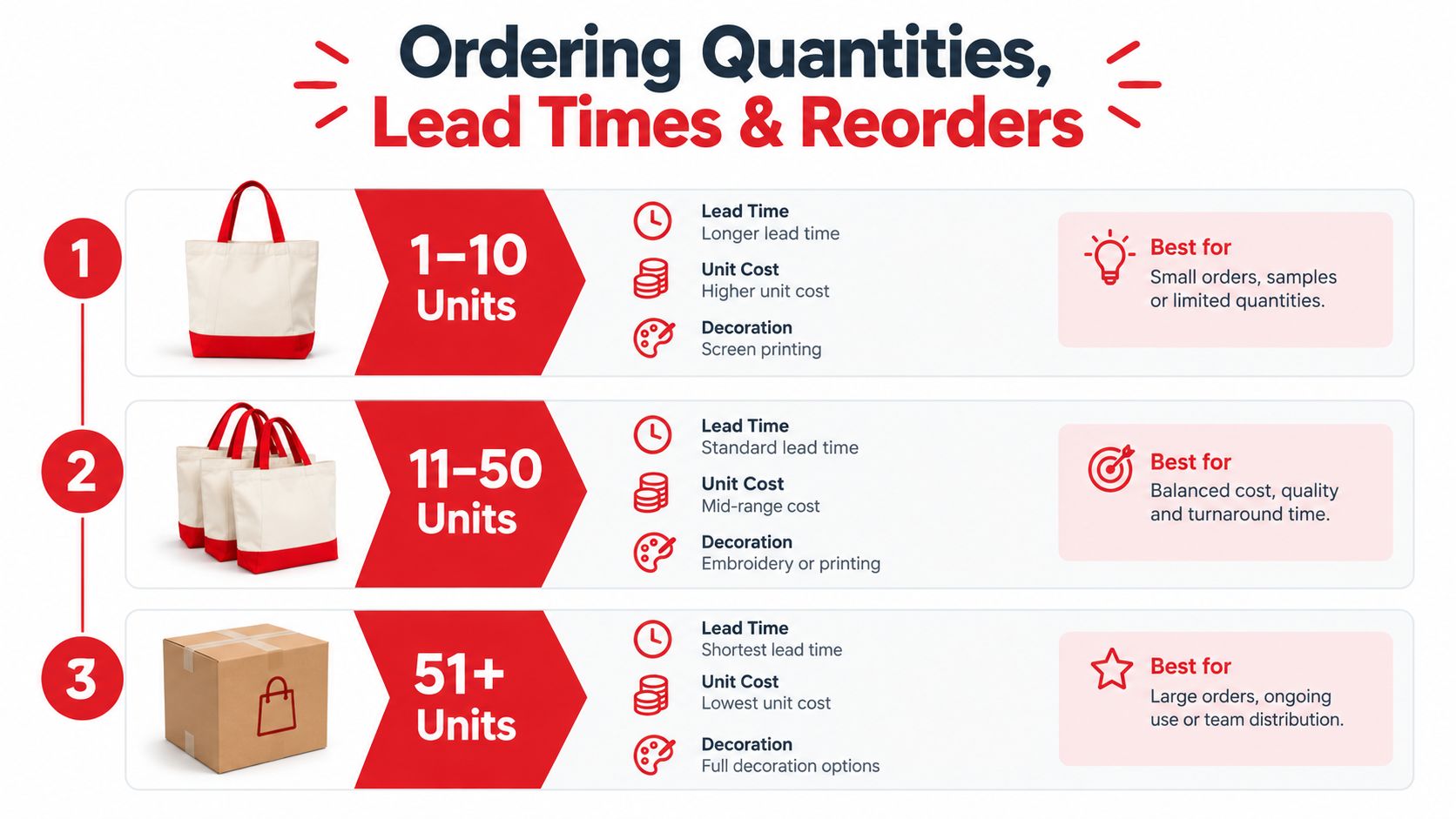
Quantity affects more than unit cost. It determines which decoration methods make economic sense, whether a supplier can source the exact blank, and how much room exists for sampling and correction.
For a small run, DTF is usually the most flexible route because it supports detailed artwork without the setup burden associated with screens. Embroidery may work for a compact logo, but digitizing and machine time can make a small batch expensive. Woven or PVC patches can also suit a limited run when the patch is produced separately and attached to the bags.
As quantity rises, screen printing becomes more attractive for simple, bold artwork on canvas. Don't assume a supplier's standard minimum applies to every bag. Blank-bag sourcing can create the floor, especially for unusual colors, recycled materials, coated shells, custom linings, or special hardware.
Identify what actually controls the schedule
A production partner should separate these timing variables:
Blank inventory: The decoration can't start until the selected bags arrive and pass inspection.
Artwork approval: Every proof round adds communication time, especially when placement changes.
Decoration complexity: DTF transfer production, embroidery digitizing, screen setup, patch attachment, and multi-location decoration each add different work.
Sampling: A physical sample protects the final run but must be planned before the event deadline.
Shipping window: Transit time and receiving time belong in the schedule, not after it.
For reorders, ask whether the production partner stores the approved artwork, retains the decoration specifications, and waives or reduces repeat setup work. A small event order can become a larger corporate program only if the supplier can reproduce the same bag, color, placement, and decoration result. Save the approved proof and material details with your internal purchasing records.
Before sending a deposit, ask:
Can you reserve or confirm blank-bag inventory for the required color and material?
What event date should the schedule work backward from?
Is a physical sample available, and what does it represent?
Which changes trigger a new proof or setup?
How will you handle a material substitution?
Will the approved artwork and production settings remain available for a reorder?
What inspection standard applies to print placement, stitching, closures, and visible defects?
Use this production workflow example to frame the conversation around approvals and execution rather than a single catalog promise.
Pulling It All Together Before You Order
A custom messenger bag order is a chain. Each choice narrows the next one, so start with the environment rather than the artwork.
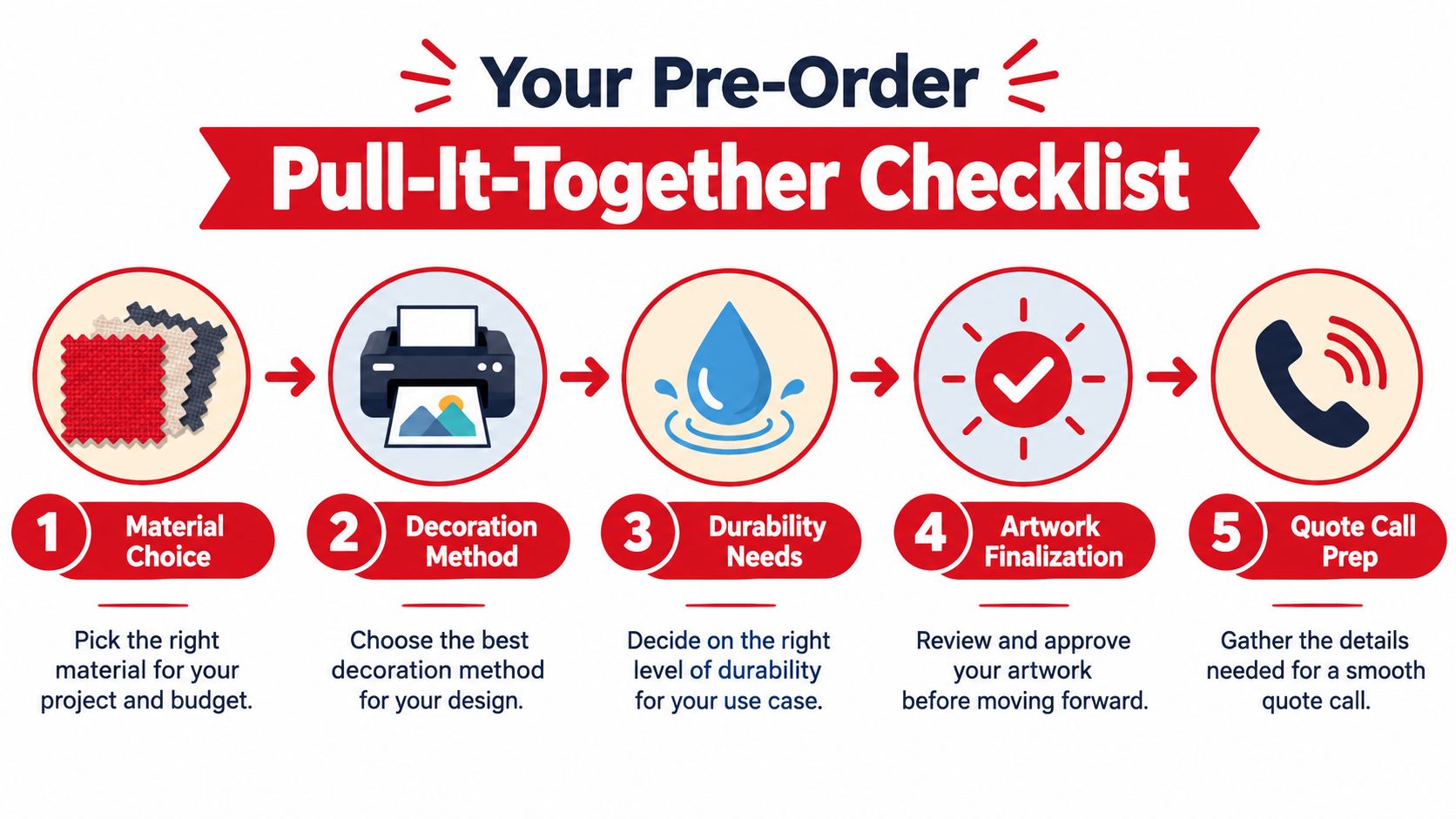
Define the use case. Decide whether the bag is for indoor events, daily commuting, field work, courier use, resale, or gifting. Identify the expected load, weather exposure, and carrying duration.
Choose the substrate. Select canvas for feel and natural print behavior, polyester for lighter abrasion-oriented use, rPET when verified sustainability documentation matters, or coated canvas when weather resistance leads.
Match the decoration. Use DTF for detailed full-color artwork and flexible small runs, screen printing for bold canvas graphics, embroidery for simple marks on stable panels, and patches for badge-style identity.
Lock placement and artwork. Choose the flap, pocket, back, or strap only after checking seams, folds, closure movement, and the printable area. Prepare the file at production size and approve a scaled proof.
Set quantity and schedule. Confirm blank inventory, setup requirements, sample timing, shipping windows, and reorder conditions before committing.
The most common sequencing error is finalizing a logo before selecting the bag. The second is demanding exact color matching from a coated or textured substrate that can't reproduce the color consistently. Choose the construction first, test the decoration on that construction, then finalize artwork against the actual printable surface.
Wear X Apparel, LLC provides custom garment selection, DTF production, artwork intake, print application, quality checks, and made-to-order merchandise support. If you're planning customizable messenger bags or a broader branded merchandise run, visit Wear X Apparel, LLC with your use case, target quantity, artwork, and required in-hands date ready for a production conversation.
Comments