


Custom Ink Alternatives Worth Considering in 2026

You're probably dealing with some version of the same mess. You need a dozen shirts for a team event, maybe a few hoodies for staff, maybe one moisture-wicking option because half the group hates heavy cotton, and you need it soon. You open Custom Ink because everyone knows the name. Then the friction starts. The order works if you accept their workflow, their garment mix, their timeline, and their economics.
That's why people look for Custom Ink alternatives. Not because Custom Ink is unusable. Because a lot of real orders don't fit the clean, bulk cotton T-shirt scenario that online design tools are built around.
The smarter way to choose is simple. Stop asking, “Who's cheapest?” Start asking, “Which production method fits this order?” If you're ordering low quantities, mixing cotton and polyester, running detailed art, or trying to avoid sitting on inventory, the answer changes fast.
Table of Contents
Why Shoppers Look Beyond Custom Ink - The real issue isn't price alone - The recurring pain points
What Custom Ink Does Well and Where It Falls Short - Where Custom Ink is solid - Where the model starts to wobble - My blunt read
The Main Types of Custom Ink Alternatives - Local screen print shops - Online DTG platforms - DTF specialists - Print-on-demand marketplaces - Promo distributors and embroidery-led shops
How Custom Ink Compares Side by Side - Custom Ink vs. Top Alternatives at a Glance - Where Custom Ink still wins - Where alternatives pull ahead
When a DTF Specialist Beats the Big Names - The sweet spot for DTF - Where DTF clearly wins - Where DTF loses
Questions to Ask Any Vendor Before You Order - Send these before you pay
Matching the Right Provider to Your Order - Four common buyer profiles - The ordering path I'd actually use
Why Shoppers Look Beyond Custom Ink
You need 12 matching shirts in two weeks. Two people want tri-blends. One wants a hoodie. A few need larger sizes. Your logo has a gradient that looks fine on screen but won't behave the same across every print method. That's the point where a lot of buyers realize they're not shopping for a website. They're shopping for a production fit.
The real issue isn't price alone
Custom Ink works best when your order looks clean on a spreadsheet. Standard garment. Standard placement. Decent quantity. No weird fabric requests. No last-minute edits.
A lot of small teams don't order that way.
The common frustration isn't just cost. It's that the ordering logic rewards bigger, simpler runs. If your job is small, mixed, or deadline-sensitive, the workflow starts to push back. You'll feel it in garment availability, in method limitations, and in the lack of clarity around what will print well.
Practical rule: If your order has mixed fabrics, detailed artwork, or fewer pieces than a typical team bulk order, compare vendors by production method first and checkout experience second.
The recurring pain points
Buyers usually leave Custom Ink for one of a few reasons:
Small-run math gets ugly: The platform makes more sense when setup is spread across a larger order. Smaller jobs tend to feel overpriced fast.
Method transparency is limited: Many buyers don't know whether their art is best for screen print, DTG, or DTF, and they don't get much help until after they've already started building the order.
Urgent orders get awkward: If you're under a deadline, every approval step matters. A clean website doesn't fix production bottlenecks.
Mixed-fabric jobs expose the cracks: Cotton is easy. Poly blends, tri-blends, and performance fabrics separate flexible vendors from rigid ones.
Sampling is weak or inconvenient: If you care about hand feel, color behavior, or stretch recovery, mockups won't answer the question.
There's also a bigger market shift behind this. Buyers increasingly expect short-run and made-to-order apparel, not only old-school bulk ordering. One major estimate values the global print-on-demand market at USD 10.8 billion in 2025, projecting USD 13.1 billion in 2026 and USD 57.5 billion by 2033, with a 23.6% CAGR from 2026 to 2033 according to Mordor Intelligence's print-on-demand market outlook.
That demand doesn't automatically mean print-on-demand is right for your order. It does mean buyers now expect lower minimums, faster experimentation, and less inventory risk than the old custom-order model offered.
What Custom Ink Does Well and Where It Falls Short
Custom Ink earned its position for a reason. It's built for group ordering, easy art setup, and straightforward coordination. If you're ordering standard cotton shirts for a school event, fundraiser, office outing, or company merch drop, it's familiar and usually manageable.
Where Custom Ink is solid
The strongest part of the platform is workflow. The design lab is easy to use, the garment catalog is broad enough for common jobs, and the group-order setup removes some of the admin pain when multiple people are involved.
For buyers who don't want to think too hard about production, that convenience matters.
Custom apparel demand also isn't a niche anymore. One industry summary reported that North America held 40% of the custom apparel market in 2023, custom T-shirts made up 35% of the market, and 68% of purchases were for personal use versus 32% for gifting according to WorldMetrics custom apparel industry statistics. That same summary estimated 7 to 14 days for custom apparel lead time compared with 21 to 30 days for off-the-shelf alternatives. The broader point is clear. Buyers expect customization to be normal, not exceptional.
Where the model starts to wobble
Convenience hides trade-offs.
Custom Ink tends to make the most sense when the job is standard. Once you move into short-run, mixed-fabric, or artwork-heavy territory, the platform's simplicity starts working against you. You're often fitting your order into their production lane instead of choosing the best lane for the order.
Here's where that matters most:
Print method fit: Great for conventional group orders. Less convincing when you need a low-minimum method for blended or performance fabrics.
Low-quantity flexibility: Better than old-school contract shops, but not built around nimble one-off or ultra-short-run production.
Fabric consistency: Standard cotton garments are usually the safe path. Results get less predictable when the run includes tri-blends or slicker performance pieces.
Rush execution: The process is organized, but organization isn't the same thing as speed when approvals and garment substitutions start stacking up.
Cost visibility: Buyers often understand the total at checkout, but not always why that total moved.
My blunt read
Custom Ink is a workflow company first and a production-fit company second. That's fine for mainstream jobs. It's not ideal for jobs that need a decorator to think.
If your order is mostly about coordination, Custom Ink is useful. If it's mostly about print method, fabric behavior, or low-minimum flexibility, look elsewhere first.
That distinction is what separates a smooth order from a frustrating one.
The Main Types of Custom Ink Alternatives
Not all Custom Ink alternatives compete in the same lane. Some win on speed. Some win on durability. Some win because they let you test designs without carrying inventory. If you lump them together, you'll pick the wrong vendor for the wrong reason.
For a quick visual on on-demand custom apparel workflows, this on-demand apparel production graphic is a useful reference point.
Local screen print shops
Local screen printers still win plenty of jobs. If you need hand feel, strong ink deposit, local pickup, and direct communication, they're hard to beat. They also handle reorders well when the design and garment stay consistent.
Their weak spot is flexibility. Small runs can be inefficient, color counts can create friction, and mixed garments often make the setup less attractive.
Best fit: events, staff shirts, school orders, straightforward logos, larger uniform runs.
Online DTG platforms
DTG works when you need low minimums and artwork with lots of detail on cotton garments. Photographic graphics and multi-color designs are where it makes sense. You can usually test fast without committing to a large run.
The downside is that DTG is less forgiving on fabric mix and can be underwhelming if your order includes performance wear or garments that don't like pretreatment and direct ink application.
Best fit: cotton tees, art-heavy creator merch, one-offs, ecommerce testing.
DTF specialists
A lot of buyers should be looking here first and don't.
DTF specialists are built for the ugly middle ground that many real orders live in. Short runs. Mixed fabrics. Dark garments. Detailed art. Faster setup. Cleaner execution on jobs that don't justify screens but still need stronger versatility than standard DTG.
The category is growing fast. One market report notes DTF value estimates ranging from $2.72 billion in 2024 to $2.89 billion in 2025, projected to $3.92 billion by 2030, and another view cited in the same coverage says more than 7.2 billion DTF prints were produced globally in 2024, up almost 30% year over year, according to Images Magazine's DTF market report coverage.
Best fit: low minimums, polyester blends, team drops, creator merch, event orders with artwork complexity.
Print-on-demand marketplaces
Printful, Printify, and Gooten are fulfillment systems more than traditional decorators. They're useful if you sell online and want made-to-order production with shipping baked into the operation.
They're weaker when you need hands-on control, exact garment coordination, or local deadline management.
Best fit: ecommerce brands, test launches, low-risk merch stores, ongoing online sales.
Promo distributors and embroidery-led shops
If your order is logo-first and presentation matters more than full-front graphics, promo distributors and embroidery shops deserve a hard look. Polos, quarter-zips, caps, and company apparel often land better here than on a T-shirt-centric platform.
Their limits show up when you need design complexity or broad experimentation.
Best fit: uniforms, client gifts, staff kits, branded corporate apparel.
How Custom Ink Compares Side by Side
Here's the fast read. Custom Ink isn't the automatic wrong choice. It's just rarely the best choice for every order type.
Custom Ink vs. Top Alternatives at a Glance
Criterion | Custom Ink | DTF Specialist | Local Screen Shop | Print-on-Demand Marketplace | Wholesale Decorator |
|---|---|---|---|---|---|
Best use case | Group orders and standard team apparel | Low-minimum mixed-fabric jobs and detailed graphics | Bulk local event and staff runs | Online selling without inventory | Repeat branded programs and larger account work |
Typical production methods | Screen print, DTG | DTF, sometimes paired with embroidery or other decoration | Screen print, sometimes embroidery | DTG, DTF, embroidery depending on provider | Screen print, embroidery, transfer-based decoration |
Small-run flexibility | Fair | Strong | Usually limited | Strong | Usually limited |
Mixed fabric handling | Moderate | Strong | Varies by shop | Moderate | Good if garment program is established |
Artwork complexity | Good for standard layouts | Strong for gradients and detail | Best on simpler spot-color art | Good for marketplace-ready art | Good for logo programs |
Turnaround feel | Structured but not always nimble | Often faster on short runs | Fast if local shop has capacity | Convenient but tied to fulfillment queues | Stable for planned orders |
Reorder ease | Good inside platform | Good if files and garments are documented well | Good with consistent shop records | Good for online stores | Strong for repeat business accounts |
Customer service style | Guided ecommerce | Production-led, consultative | Direct with shop staff | Platform support | Account-based |
Hidden friction | Low-volume economics, fabric fit, rush complexity | Need to vet cure quality and transfer consistency | Setup sensitivity and color limitations | Provider variation and less hands-on control | Less friendly for tiny test orders |
Where Custom Ink still wins
The interface is cleaner than most local decorators. The group-order flow is also easier than what you'll get from many independent shops. If your team needs a familiar system and your artwork is simple, there's real value there.
That matters for low-drama jobs.
Where alternatives pull ahead
A DTF specialist is the better play when your garments are mixed, your quantity is awkward, or your art needs fine detail. A local screen printer wins when durability and local coordination matter more than online convenience. A print-on-demand marketplace wins if you're building a store, not placing a one-time group order. A wholesale decorator makes more sense once you've moved into repeat programs and account-level purchasing.
For buyers comparing premium garment construction across methods, this garment detail reference image helps show why substrate and construction details matter before you choose a print path.
A good example of a garment where construction details matter is the RXB Marlboro Rodeo Hoodie. It's described as a RanchX Branded Hoodie with a three dimensional velvety chest logo, built from an 8.5 oz./yd² (US) 70/30 ring-spun cotton/polyester blend 3-end fleece with a 100% cotton face, plus a fleece lined hood, split stitch double-needle sewing, and WRAP-certified manufacturing. A garment like that raises the right production question immediately. Are you decorating for texture, for durability, for exact logo feel, or for reorder consistency?
The wrong vendor choice usually starts with the wrong question. Buyers ask who can print it. They should ask who can print this garment, with this artwork, under this deadline.
When a DTF Specialist Beats the Big Names
Your order is due next week. Half the team wants cotton tees, a few people want lightweight performance shirts, and the design has gradients that won't survive a cheap shortcut. That is the point where a DTF specialist usually beats the big generalist shops.
The deciding factor is production fit, not headline price. DTF works best when you need low minimums, mixed fabric types, and faster setup without forcing the whole order into one garment or one decoration method. It also solves a problem buyers miss until it is too late. You need to know how the print will feel, how it will hold up, and whether the transfer materials are documented for the compliance standards your organization cares about.
The sweet spot for DTF
DTF is a strong choice for orders that sit between one-off print-on-demand and a full screen print run. It handles cotton, poly blends, tri-blends, and many performance fabrics with less friction than methods that get picky about pretreatment or fabric matching. If you are outfitting a small staff, testing merch for a creator brand, or producing event apparel with several garment options, that flexibility matters more than saving a little on unit cost.
Durability still needs a straight answer. Print Technology's durability comparison of DTF and screen printing reports that plastisol screen prints commonly last longer through repeated washing, while DTF typically gives a shorter wash-life range depending on fabric and application. That trade-off is acceptable for promo runs, drops, staff shirts, and short-cycle merch. It is a weaker fit for uniforms or programs that need heavy repeat wear.
Where DTF clearly wins
Choose a DTF-focused vendor when your order has these traits:
Low quantities with detailed art. Full color graphics, gradients, and image-heavy designs are easier to run without screen setup dragging the job.
Mixed garment types. Tees, hoodies, and athletic pieces can stay in one order instead of being split across decoration methods.
Dark blanks and color variety. DTF is usually easier to standardize here than methods that become more temperamental based on substrate prep.
Fast turnaround. Less setup helps when the deadline is real and the artwork is already approved.
Testing before scale. Small teams, event organizers, and creator brands can validate demand before committing to a larger screen print run.
One provider path in this category is Wear X Apparel, LLC, which offers custom apparel and merchandise production with a stated focus on DTF printing and made-to-order project intake.
For a quick visual reference, review this DTF print example on apparel.
Where DTF loses
DTF should not be your default for every job.
If you are ordering a larger run with simple artwork on a stable garment, screen printing is usually the better production choice. It tends to win on long-term wash durability, consistency across reorders, and ink feel for straightforward designs. It also gives buyers a more established testing and compliance track record, which matters for school programs, workwear, and any order that may trigger questions about wash fastness, color consistency, or restricted chemical documentation.
Use DTF when the order is small, the garments are mixed, and the art is complex. Use screen print when the run is larger, the artwork is simpler, and durability has to carry the decision.
Questions to Ask Any Vendor Before You Order
Most bad apparel orders don't fail because the vendor was evil. They fail because the buyer never pinned down the production details in writing.
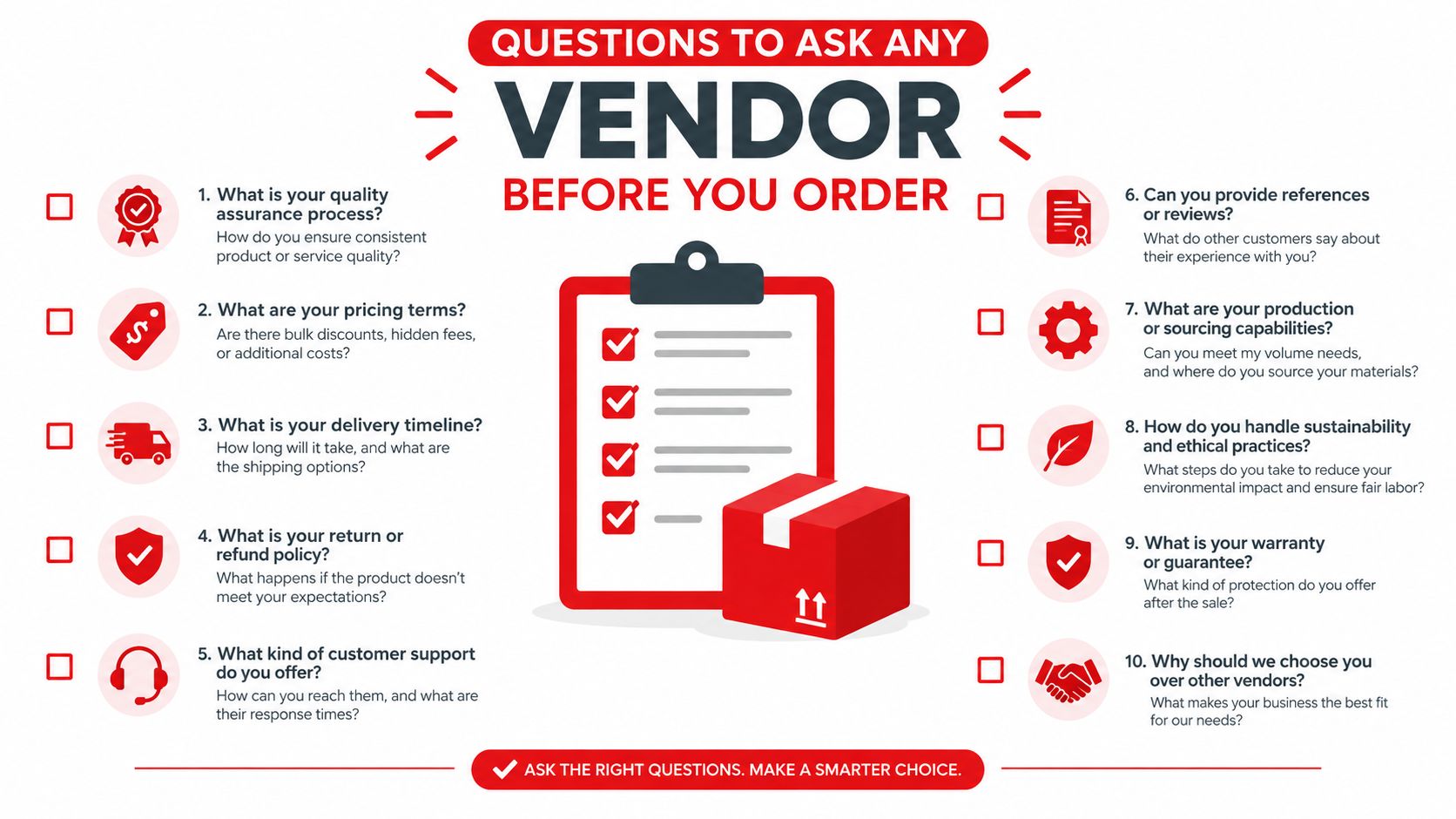
Send these before you pay
What proof do I get before production? You need to know whether they send a digital mockup, a physical strike-off, or just an approval email. That affects color expectations and revision risk.
What file format do you need? Vector art, transparent backgrounds, and color setup matter. A good vendor will tell you what reduces cleanup time.
Are minimums per style, per size, or total order? This changes your math fast on mixed garment runs.
Who sources the garments? If they stock blanks, ask which brands. If you have to ship garments in, ask who owns shrinkage and spoilage risk.
What extra charges show up later? Screen setup, art cleanup, rush fees, and shipping upgrades need to be explicit before approval.
How do you handle color matching? Ask whether they work from Pantone references, CMYK builds, or visual approximation.
What durability claims can you back up? Don't accept “high quality” as an answer. Ask what method was used and how they evaluate wash performance.
What counts as a defect? Ink variance, placement shift, pinholes, garment substitutions, and size shortages should all be defined.
What is production time versus shipping time? Those are not the same thing.
What happens on reorders? Ask whether setup carries forward or gets rebuilt.
Vendors who answer these clearly and quickly are usually the ones who can actually run your job cleanly.
Matching the Right Provider to Your Order
Sticker price is the noisiest signal in custom apparel, and usually the least useful. The right choice depends on what kind of order you're placing.
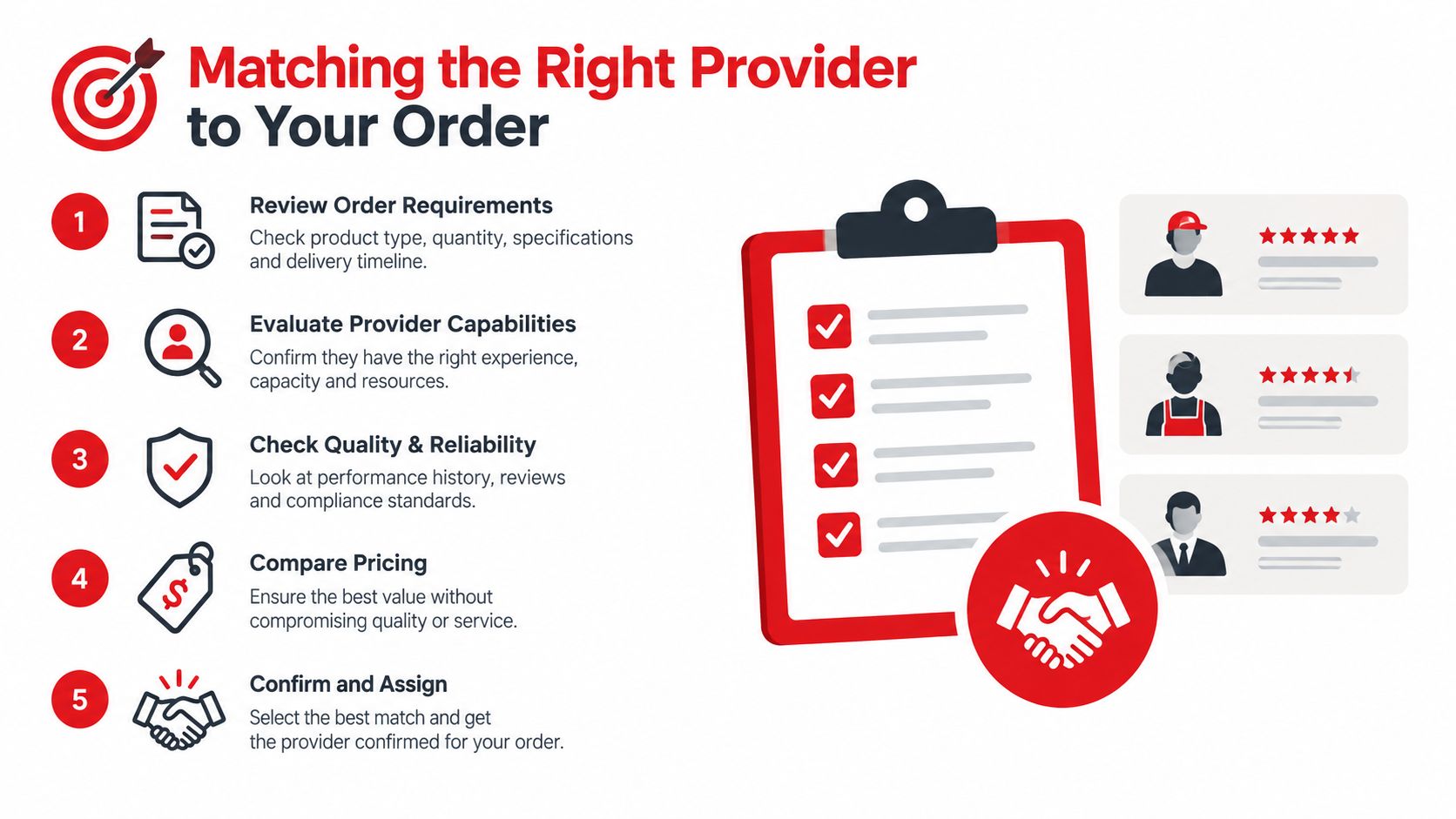
Four common buyer profiles
A creator brand selling a handful of units each week should usually go with a print-on-demand marketplace or a DTF-driven small-batch partner. The reason is simple. You need low inventory risk and easy design testing. The risk is inconsistency if you don't order samples first.
A nonprofit that needs event tees on a hard deadline should usually go with a local screen printer if the art is simple, or a DTF specialist if the garments are mixed and the quantity is awkward. The risk is approval lag. Small organizations often burn time internally before production even starts.
A startup ordering polos, hoodies, and mixed decorated apparel should lean toward a wholesale decorator or a capable shop that can coordinate multiple methods. The risk is forcing one decoration style across every garment just to simplify billing.
A corporate buyer asking for compliance paperwork and safety clarity should prioritize vendors that can speak clearly about certifications, ink chemistry, and garment documentation. Market coverage in 2025 noted that suppliers emphasized ECO PASSPORT/OEKO-TEX certification and CPSIA-compliant, non-toxic inks for garment applications in DTF-related buying decisions, as discussed in PMarketResearch coverage of the DTF printer market. The risk is choosing a shop that can print well but can't document anything.
The ordering path I'd actually use
Don't jump from quote to full run.
Buy a small paid sample order. You need something real in hand.
Check ink feel, stretch recovery, and placement consistency. Don't evaluate from photos only.
Run a small pilot before the full order. That catches garment substitutions, sizing issues, and art problems before they get expensive.
This is how buyers avoid the classic mistake of selecting a vendor for convenience and then discovering the production method was wrong the whole time.
Quick Answers Before You Place an Order
Most buyers don't need more options. They need cleaner decisions.
If you need one-offs or very low minimums, look at print-on-demand or a DTF specialist. If you need simple artwork on a larger run, call a screen printer. If you need polos, hats, and logo-heavy staff gear, use an embroidery-led shop or wholesale decorator.
For artwork, send the cleanest file you have. Screen print jobs usually benefit from vector art and simplified color separation. DTF jobs can handle more detail, but that doesn't mean you should send a messy file and hope the shop fixes it for free.
Rush timelines are always vendor-specific, so don't trust the headline promise alone. Ask for production time and shipping time separately. Then ask what happens if the garment goes out of stock mid-order.
Reorders usually get easier if the vendor documents your garment, placement, art file, and method properly. If they can't tell you how they handle repeat jobs, that's a warning sign.
The short version is this. Choose the provider whose workflow matches your order's constraints. Don't choose the one with the prettiest order builder or the lowest advertised starting price.
Wear X Apparel, LLC handles custom apparel and merchandise production with a clear emphasis on DTF, plus garment selection support for teams, events, creators, and small businesses that need low-minimum flexibility. If your order sits in that mixed-fabric, short-run, detailed-art zone where many Custom Ink alternatives either overcomplicate the process or push you into the wrong print method, it's worth reviewing Wear X Apparel, LLC.
Comments