


What Is DTF Printing on Shirts: A 2026 Guide

More than 7.2 billion DTF prints were produced globally in 2024, nearly 30% higher than the prior year, which tells you direct-to-film printing is no longer a niche shop experiment. On shirts, DTF means your design is printed onto PET film, coated with hot-melt adhesive powder, then heat-pressed onto fabric at about 300 to 320°F for roughly 15 seconds before the carrier film is peeled away.
That scale changes how you should think about the question, what is DTF printing on shirts. This isn't some trendy substitute for “real” printing. It's a mainstream production method that moved from experimental development in the late 2010s into broad textile use in the 2020s, after decades of screen printing dominance, as outlined in this history of DTF transfers.
Most articles stop at “DTF is versatile and durable.” That's only half useful. Buyers usually need a more practical answer. They need to know how DTF works, where it performs well, and why one shirt might still look solid after heavy wear while another starts failing much earlier.
That gap matters because durability claims for DTF are all over the place. The method can be a smart choice, but only if the garment, press work, and care habits line up with the job.
Table of Contents
Why DTF Printing Is Everywhere Right Now - Why shops adopted it so quickly
How DTF Printing Actually Works Step by Step - Step 1 printed film comes first - Step 2 powder creates the bond - Step 3 heat press finishes the shirt
DTF Compared to DTG Screen Printing and Heat Transfer - Quick comparison - Where DTF wins - Where other methods still win
Which Fabrics DTF Prints Best and Where It Struggles - Fabrics that usually behave well - Fabrics that need more caution - Where I'd slow down before ordering
What Durability to Expect and How to Make It Last - Why durability claims vary so much - What shortens print life - Care habits that usually help
Real Use Cases Where DTF Shirts Make the Most Sense - Good fits for DTF - When I'd choose something else
Frequently Asked Questions About DTF Printing - Do DTF prints look good on light-colored shirts - What's the minimum order for DTF shirts - Can you tumble-dry DTF shirts
Why DTF Printing Is Everywhere Right Now
The easiest way to understand DTF's rise is to think like a busy apparel shop.
A customer wants twelve black shirts for a team, six gray hoodies for staff, and a few extra youth sizes with the same full-color logo. Screen printing can still be the right answer for some jobs, but short mixed orders like that are where DTF feels built for real life. You can keep the artwork detailed, print dark garments without stripping the design down to a few spot colors, and avoid the setup burden that often comes with older methods.
That practical advantage lines up with the market data. Grand View Research reported that the global direct-to-film printing market was estimated at USD 2.72 billion in 2024 and projected to reach USD 3.92 billion by 2030, with a 6.0% CAGR from 2025 to 2030. The same source says the T-shirt segment dominated the DTF printing market in 2024, and Europe accounted for 36.0% of the overall market that year.
Why shops adopted it so quickly
DTF didn't replace every other decoration method. It solved a specific set of production headaches.
Short runs got easier: Shops could produce full-color shirt designs without the setup pattern that makes some traditional methods less convenient for small quantities.
Dark garments became simpler: The white underbase helps color stay visible on black, navy, and other deep shades.
Mixed fabric orders became more manageable: Cotton, blends, and many synthetic garments can all fit into the same DTF workflow.
DTF grew because it fits the way many people actually buy custom shirts now. Smaller runs, more design variation, and faster turnaround.
There's also a timing factor. DTF arrived in a market already shaped by e-commerce, creator merchandise, event apparel, and smaller batch ordering. It wasn't just a technical upgrade. It matched a newer production rhythm.
How DTF Printing Actually Works Step by Step
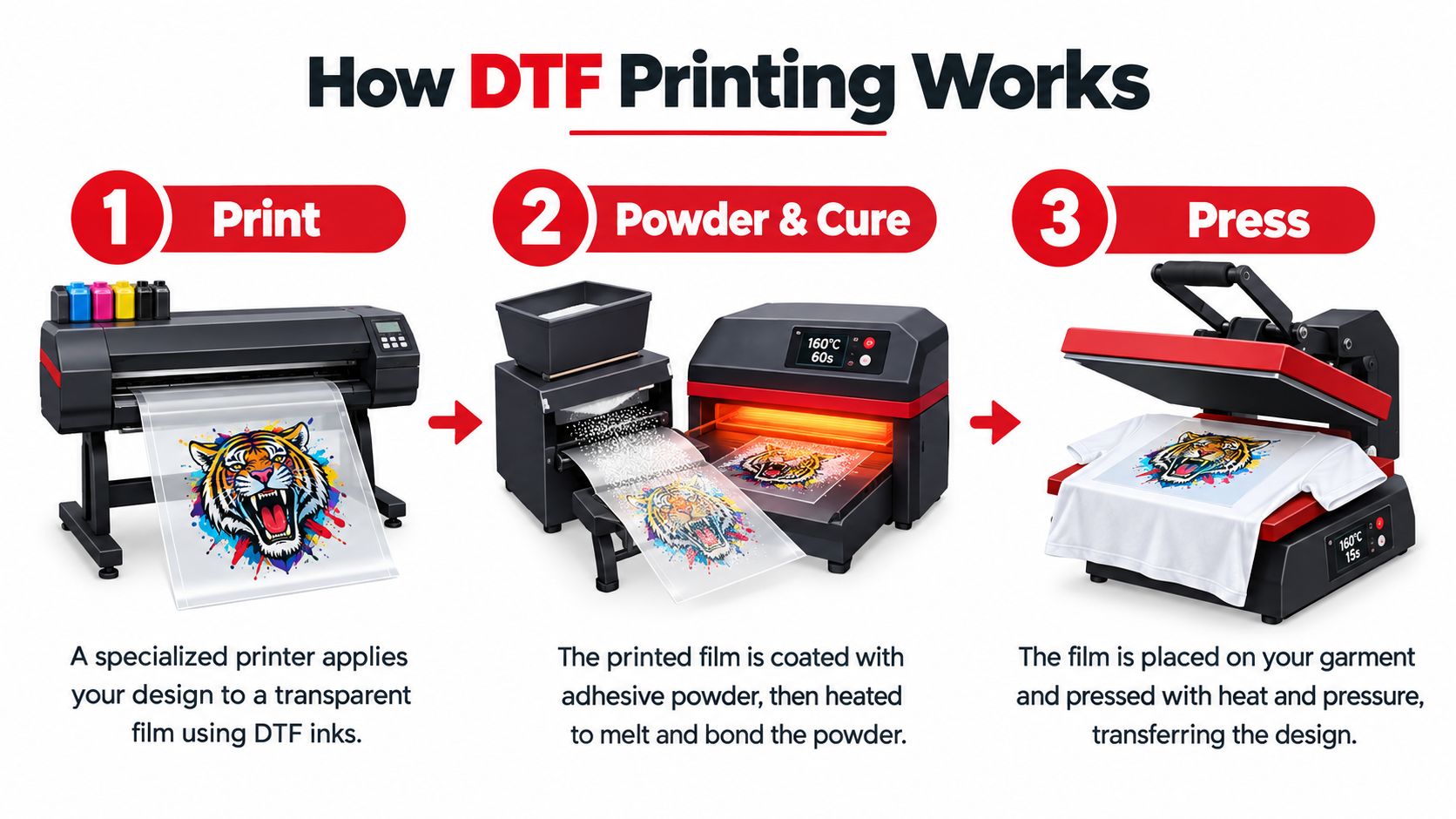
DTF is a transfer process, not a direct print onto the shirt itself. According to this print durability overview, the method has three main stages: printing onto PET film with water-based pigment inks, applying hot-melt adhesive powder while the ink is still wet, and heat-pressing the transfer onto fabric at about 300 to 320°F for roughly 15 seconds before peeling away the PET carrier.
Step 1 printed film comes first
The printer lays the artwork onto a clear PET film instead of onto the shirt.
That matters because the film becomes the transfer carrier. It holds the design in place until you press it onto the garment. DTF also uses a white ink underbase, which is what helps bright colors show up on dark shirts instead of disappearing into the fabric.
If you've ever seen a design that looked strong on black cotton but weak on dark polyester, underbase handling was probably part of the story.
Step 2 powder creates the bond
While the ink is still wet, hot-melt adhesive powder is applied over the printed image.
This is the step new buyers often misunderstand. The powder isn't a side detail. It's the bonding layer. If powder coverage is uneven, the transfer can look fine when it's fresh off the press and still fail early because parts of the print never bonded cleanly.
A visual reference for the adhesive layer helps if you're trying to picture that build. This DTF adhesive product image shows the kind of material that creates that bond.
After powdering, the transfer is cured so the adhesive is ready for pressing.
Here's a short process view in motion:
Step 3 heat press finishes the shirt
The cured transfer is placed on the garment and pressed with heat and pressure.
Then the PET carrier peels away, leaving a thin printed layer bonded to the textile. When the press settings are right, the result feels flexible rather than stiff. When the settings are wrong, defects usually show up as poor edge adhesion, glossy overpressing, or a print that starts cracking or lifting earlier than it should.
Practical rule: If you want to understand DTF quality, don't just ask what printer was used. Ask how the transfer was pressed.
DTF Compared to DTG Screen Printing and Heat Transfer
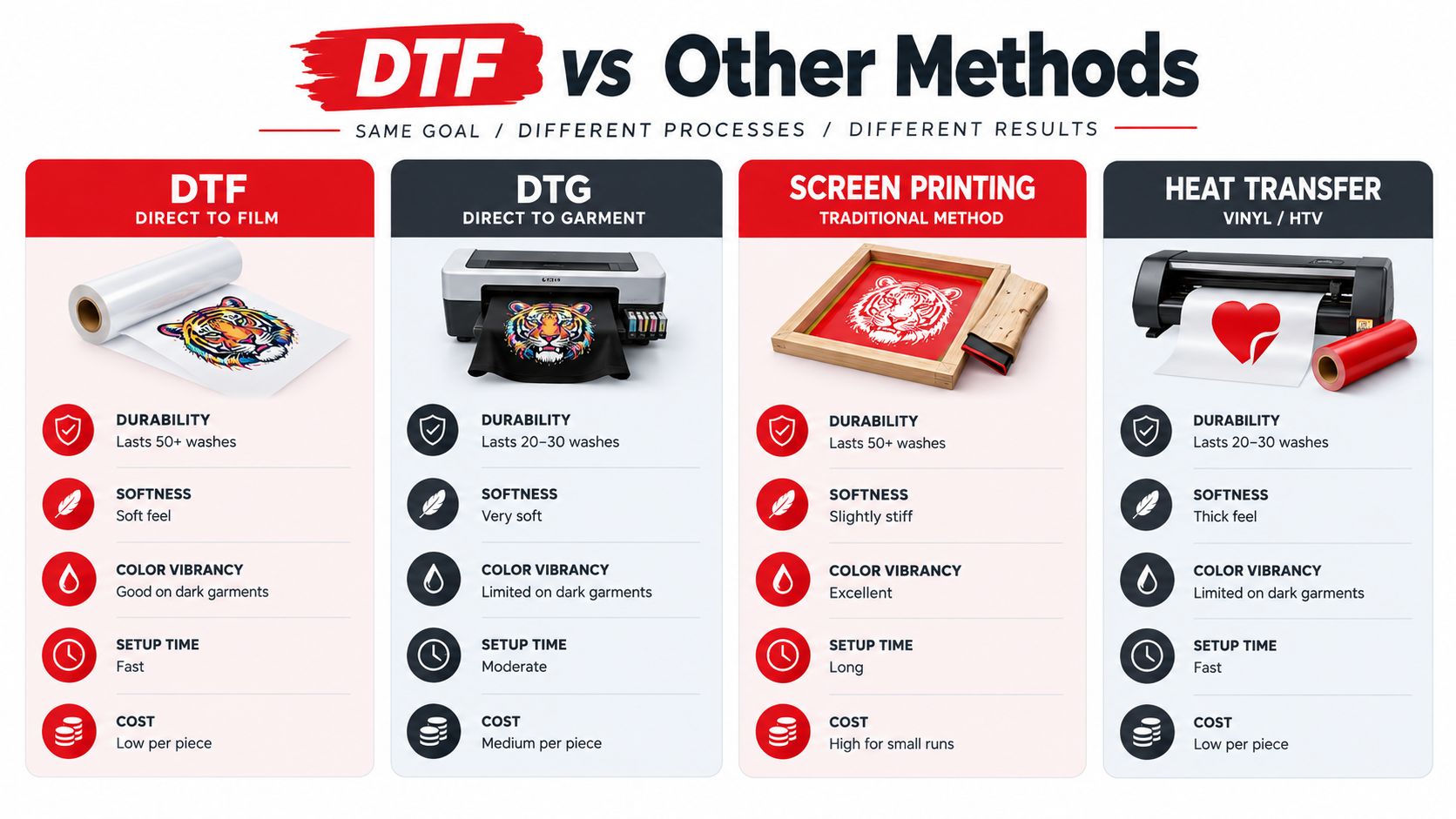
Most buyers aren't choosing DTF in isolation. They're choosing between DTF, DTG, screen printing, and heat-transfer vinyl. The right question isn't “Which one is best?” It's “Which one fits this order?”
Quick comparison
Method | Best For | Minimum Order | Detail Level | Durability |
|---|---|---|---|---|
DTF | Mixed garments, small batches, full-color logos on dark shirts | Often flexible | High detail and strong opacity on dark garments | Can support 50 or more wash cycles when applied and cared for correctly |
DTG | Soft-feel prints on cotton shirts | Often flexible | High detail | Varies by garment and print conditions |
Screen Print | Larger runs of the same design | Usually less practical for very small orders | Excellent, especially for simpler repeat graphics | Strong long-term performance when done well |
Heat Transfer Vinyl | Simple names, numbers, and basic graphics | Often flexible | Lower for complex full-color art | Works for some jobs, but not ideal for detailed artwork |
Where DTF wins
DTF usually makes the most sense when the order combines low quantity, full color, dark garments, and mixed fabric types.
A shop can print a detailed transfer once, then press it onto tees, hoodies, or other compatible pieces without rebuilding the job around separate screens or simplifying the art. That's why it keeps showing up in team apparel, creator merch, and short-run business branding.
This apparel graphic example is the kind of artwork style that often suits digital transfer production well.
Where other methods still win
DTG still has a place when the buyer cares most about a soft print feel on cotton. Because the ink goes directly into the shirt, the surface feel is often lighter than a transfer-based print.
Screen printing still earns its spot for larger repeat orders. If you're printing the same design across a substantial run, it's often the more natural production choice.
Heat-transfer vinyl works for straightforward graphics such as names and numbers, but it isn't the method I'd choose for artwork with fine gradients or a lot of color shifts.
A good decorator doesn't push every job into the same machine. They match the order to the method.
Which Fabrics DTF Prints Best and Where It Struggles
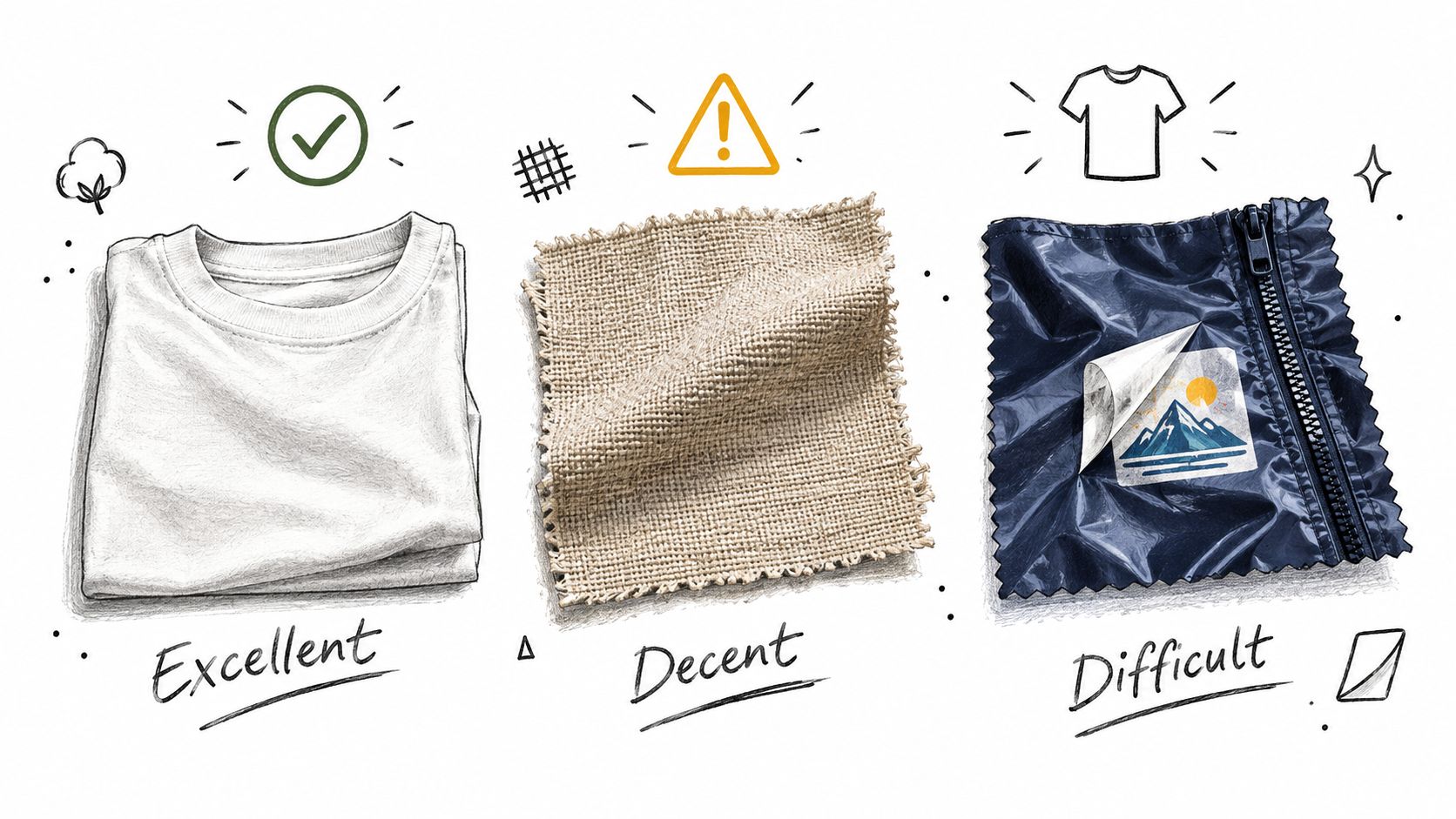
People often hear that DTF “works on everything” and take that too literally. A better way to think about it is that DTF works across many fabrics, but not every fabric behaves the same under heat, pressure, and adhesive bonding.
Fabrics that usually behave well
Cotton is friendly. Cotton-poly blends are also strong candidates. Those fabrics usually give you a clean press result with a flexible hand feel when the transfer is built and applied correctly.
A garment like the RXB Marlboro Rodeo Hoodie is a useful example to evaluate on paper. It uses a 70/30 ring-spun cotton/polyester blend 3-end fleece with a 100% cotton face, which is the kind of construction that often gives decorators workable surface consistency for printed graphics, while the heavier fleece build still calls for careful pressing because thick garments don't always absorb pressure the same way lightweight tees do.
Fabrics that need more caution
Polyester can print well with DTF, but it's not automatic. Performance fabrics, slick synthetic surfaces, and some high-heat-sensitive garments can react differently than basic tees or fleece.
The trouble isn't always obvious at press time. A transfer may look good at first and still develop issues later if the fabric resists adhesion or reacts poorly to the pressing conditions.
Where I'd slow down before ordering
These are the garments I'd test instead of assuming:
Textured surfaces: Fleece with heavy loft, terry, and uneven textures can reduce clean adhesive contact.
Technical outerwear: Coatings and specialty finishes can interfere with bonding.
Mixed-material orders: If one order includes several garment types, expect some variation unless the shop adjusts press settings by fabric group.
Grouping an order by material type is one of the easiest ways to reduce surprises. One transfer method can cover a lot of categories, but the garment blank still matters.
What Durability to Expect and How to Make It Last
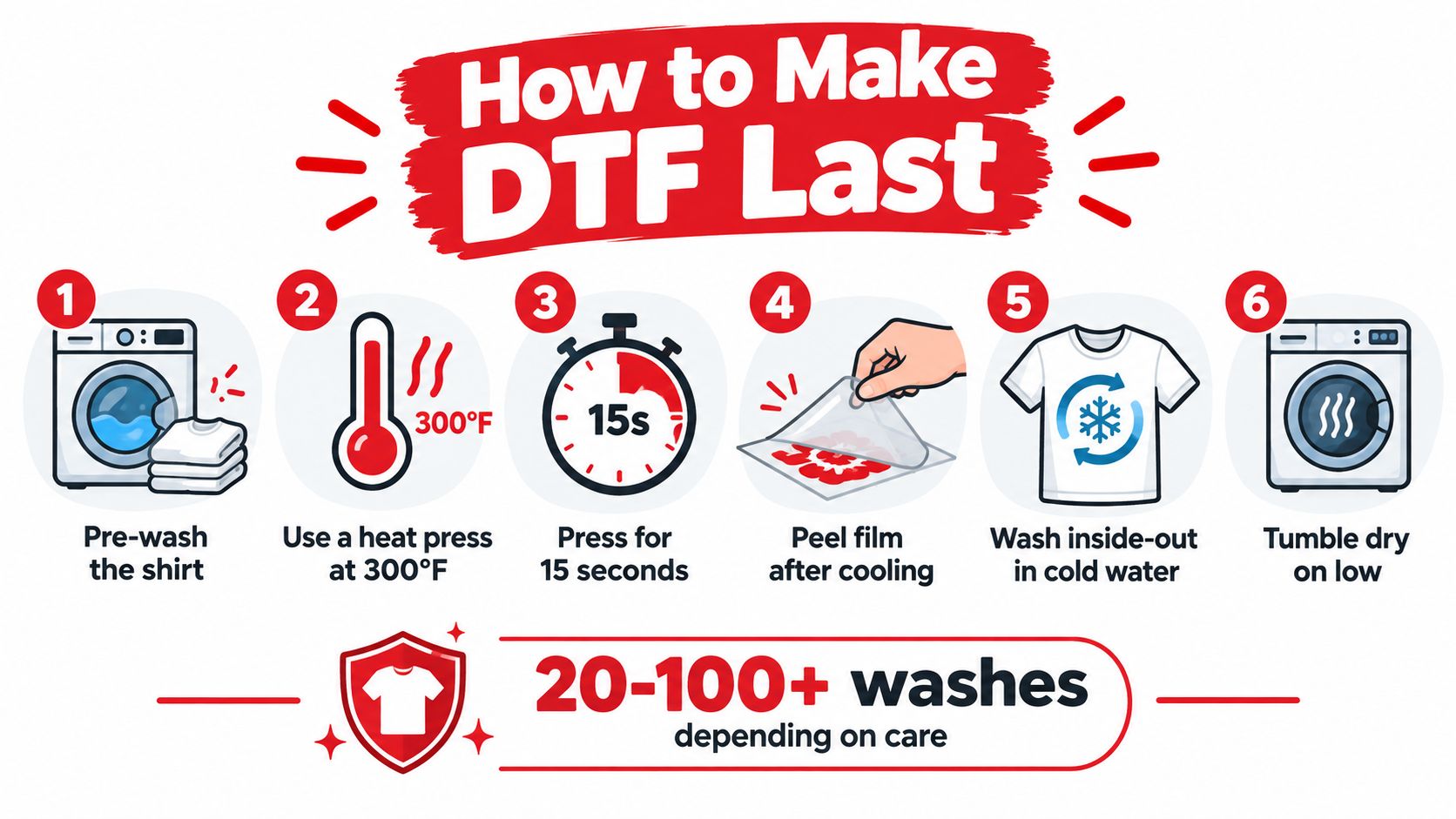
Most DTF articles get too neat. They throw out one durability number and leave. Real-world results aren't that tidy.
A more honest summary appears in this technical quality guide for DTF printing. It says print quality and durability depend on film-ink compatibility, adhesive-powder coverage, curing, press temperature, pressure, and dwell time. It also notes that correctly applied DTF transfers support 50 or more wash cycles, with some guides citing 50 to 100 cycles under proper care, and explains that the white underbase drives opacity on dark garments while the adhesive fuses into the textile structure for wash resistance.
Why durability claims vary so much
There isn't one single DTF lifespan because too many variables affect the outcome.
A good transfer on the wrong garment can underperform. A good garment with weak press technique can also underperform. Then the laundry routine enters the picture and changes it again.
Another durability-focused overview highlights the confusion clearly. This DTF wash-life discussion notes that claims often range from 50+ washes to 50 to 100 washes under proper conditions, while outcomes can swing from 20 to 40 washes up to 80+ washes depending on quality and care. That's exactly why buyers shouldn't treat one blanket number as a guarantee.
What shortens print life
Poor press control: Wrong temperature, uneven pressure, or bad dwell time weakens the bond.
Fabric mismatch: Some garments don't give the adhesive the same foothold.
Aggressive laundering: Hot washing, harsh detergents, and rough drying wear transfers faster.
Heat from ironing: Direct contact on the print can damage the surface.
Durability isn't just “about the print.” It's the combination of transfer quality, garment choice, and what happens in the laundry room.
Care habits that usually help
Wash inside out: This reduces abrasion against the printed surface.
Use cooler wash settings: Less heat usually means less stress on the transfer.
Dry on lower heat when possible: High dryer heat is rough on most decorated apparel.
Avoid ironing directly on the print: Put a barrier between the iron and the graphic, or avoid that area entirely.
If you're buying shirts for workwear, event staffing, or team use, ask the printer how the garment was tested. That's a much better question than asking for one universal wash number.
Real Use Cases Where DTF Shirts Make the Most Sense
DTF earns its keep when convenience and flexibility matter as much as pure print feel.
Recent market coverage points in that direction. This 2026 DTF and DTG market summary describes continued growth tied to customized apparel, digital textile printing, online customization, sportswear, and promotional merchandise demand. The useful takeaway isn't just that the market is growing. It's that growth appears tied heavily to personalization and short-run production needs.
Good fits for DTF
Small business uniforms: If a business needs a modest run across shirts, hoodies, or mixed sizes, DTF often fits the job cleanly.
Event apparel: Staff tees, volunteer shirts, and participant garments usually benefit from lower setup friction.
Creator merch: Frequent artwork changes are easier when you don't have to build production around long repeat runs.
Ranch and workwear branding: Full-color logos on darker garments are a common DTF use case.
Team orders with size variety: Orders with youth, adult, and a few extras don't always justify methods that favor long identical runs.
A made-to-order workflow like this on-demand apparel graphic reflects why DTF fits modern custom ordering so often.
When I'd choose something else
I'd lean away from DTF when the top priority is the softest possible print feel on cotton, or when the order is a larger repeat run that naturally fits screen printing better.
I'd also be cautious with garments that are unusually textured, highly technical, or exposed to demanding wash and heat conditions unless the decorator has already tested that exact blank.
Wear X Apparel, LLC is one example of a company built around DTF garment printing for custom designs on T-shirts, hoodies, and other apparel, along with garment selection support and production workflow guidance. That's useful if you're comparing providers that offer both print application and help choosing the right blank for the job.
Frequently Asked Questions About DTF Printing
Do DTF prints look good on light-colored shirts
Yes. DTF can look very vibrant on light garments.
The white underbase is especially valuable on dark shirts, but it also helps keep color shape and opacity consistent on lighter blanks when the transfer is built correctly. On some light garments, the print can appear especially crisp because the shirt color isn't fighting the design.
What's the minimum order for DTF shirts
That depends on the shop, not the process alone.
DTF is well suited to low-quantity work because it doesn't require the same setup logic as methods built around longer repeat runs. Some shops will print a single item. Others set minimums based on labor, garment sourcing, or order flow rather than technical limits.
Can you tumble-dry DTF shirts
You usually can, but lower heat is the safer choice.
Heat and friction are what wear decorated garments down over time. If you want the print to hold up longer, wash inside out and use gentler dryer settings when possible. If the shirt matters to you, don't treat it like a shop rag.
If you're deciding whether DTF is the right method for shirts, hoodies, or mixed-garment orders, Wear X Apparel handles custom garment selection and DTF production with a practical, order-by-order approach. You can review options or start a project through Wear X Apparel, LLC if you want help matching artwork and garment type to the right print method.
Comments