


Combed Ringspun Cotton: The Complete Material Guide

You've chosen the artwork, approved the colors, and lined up the production schedule. Then the first printed shirt arrives and the design looks less precise than it did on screen. Fine details appear soft, the surface feels uneven, or the garment doesn't feel like the premium product your customer expected. The blank wasn't a minor purchasing decision. It shaped the finished piece before the transfer ever reached the heat press.
For custom apparel brands, combed ringspun cotton is worth understanding because its yarn construction creates a smoother foundation for both wearing comfort and decoration. It isn't automatically the right choice for every garment, but it gives DTF printers a more refined textile surface to work with when print definition, hand-feel, and perceived quality matter.
Table of Contents
Why Fabric Choice Matters for Custom Apparel - What changes when the blank changes
The Two-Stage Production Process Explained - First comes combing - Then ring spinning builds the yarn
Tactile and Performance Characteristics - What you can assess by hand - Where the trade-offs appear
DTF Printing Compatibility and Best Practices - Build a repeatable decoration check
Best Apparel Use Cases and Applications - Match the construction to the buyer
Why Fabric Choice Matters for Custom Apparel
A brand owner can make every visible design decision correctly and still end up with a disappointing garment. The artwork may have clean edges, the transfer may be produced properly, and the press operator may follow the intended process. If the blank has a coarse, irregular surface, the finished print can still look less polished than expected.
That's why fabric selection belongs in the production conversation from the start. Customers experience the garment as a combination of print appearance, softness, fit, surface texture, and performance after wear. A vivid graphic on a rough shirt may satisfy a short-term event need, but it can undermine a retail brand that wants customers to wear the item repeatedly.
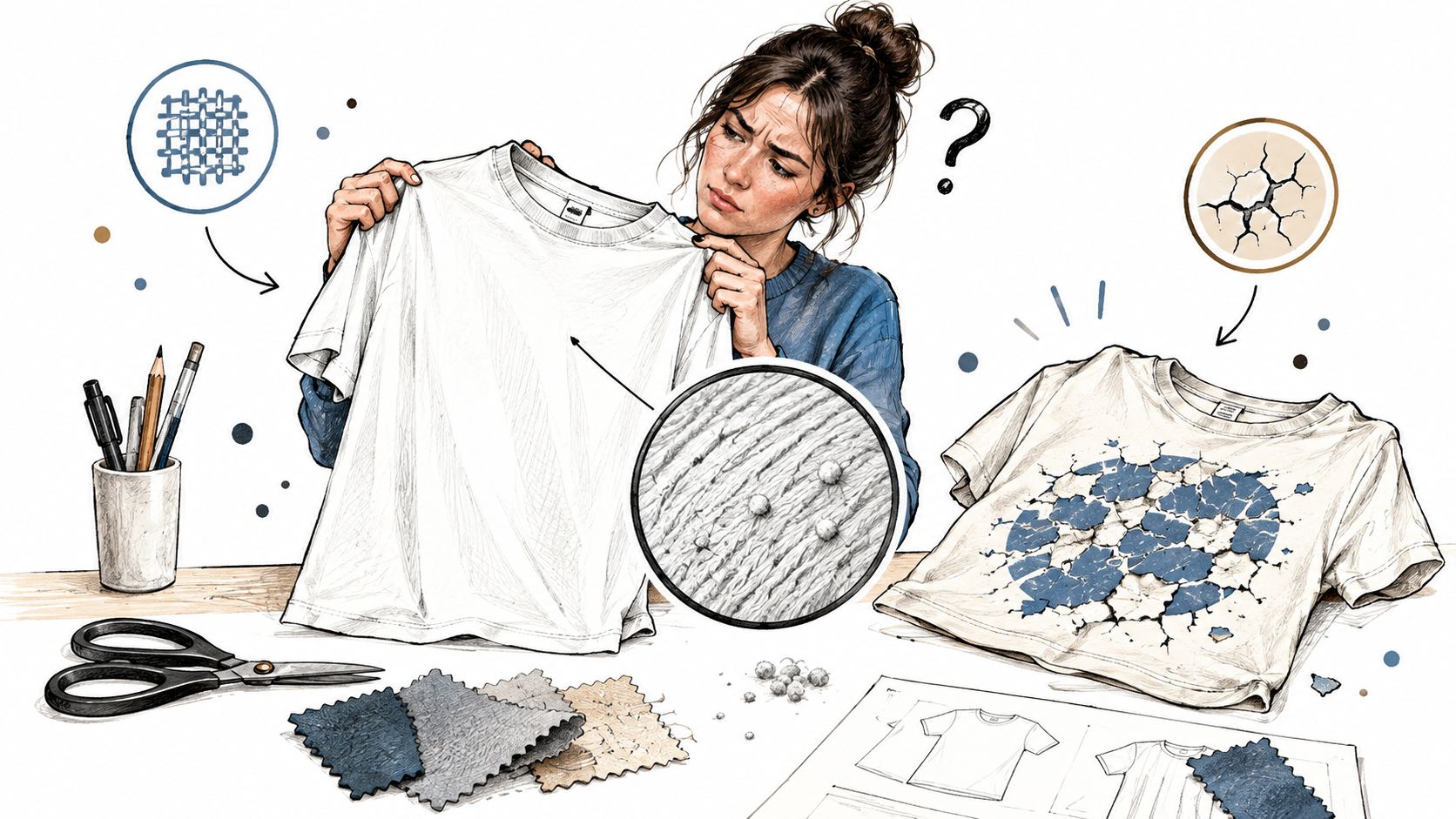
What changes when the blank changes
Consider two common ordering situations:
A company orders branded shirts for a single outdoor event. The priority may be straightforward sizing, dependable decoration, and sensible budget control.
A creator launches a small apparel collection. The customer will judge the product as merchandise, not just as a printed giveaway. The hand-feel and surface quality need to support the selling price and brand promise.
The same DTF artwork can produce different customer reactions on those garments. A smoother knit gives the transfer a more consistent base, while the wearer notices the difference when the shirt touches the skin. That doesn't mean every project needs the most refined cotton available. It means the garment should match the role it plays.
Practical rule: Choose the blank based on the customer's expected experience, not only on the artwork and decoration cost.
A useful sourcing brief should identify the intended use, expected wear, preferred hand-feel, color, fit, and print complexity before anyone orders blanks. Resources such as this apparel production visual can support that evaluation, but a physical sample remains essential.
A sample lets you inspect the knit under normal light, feel the surface, test the transfer, and assess the finished garment after laundering. That process prevents a common mistake in custom apparel, treating softness or “premium” as a label instead of evaluating the textile construction behind it.
The Two-Stage Production Process Explained
Combed ringspun cotton gets its name from two separate yarn-making operations. Combing refines the fiber bundle, and ring spinning converts the prepared fibers into yarn through drafting and twisting. The two processes solve different problems, so one shouldn't be used as a substitute for the other.
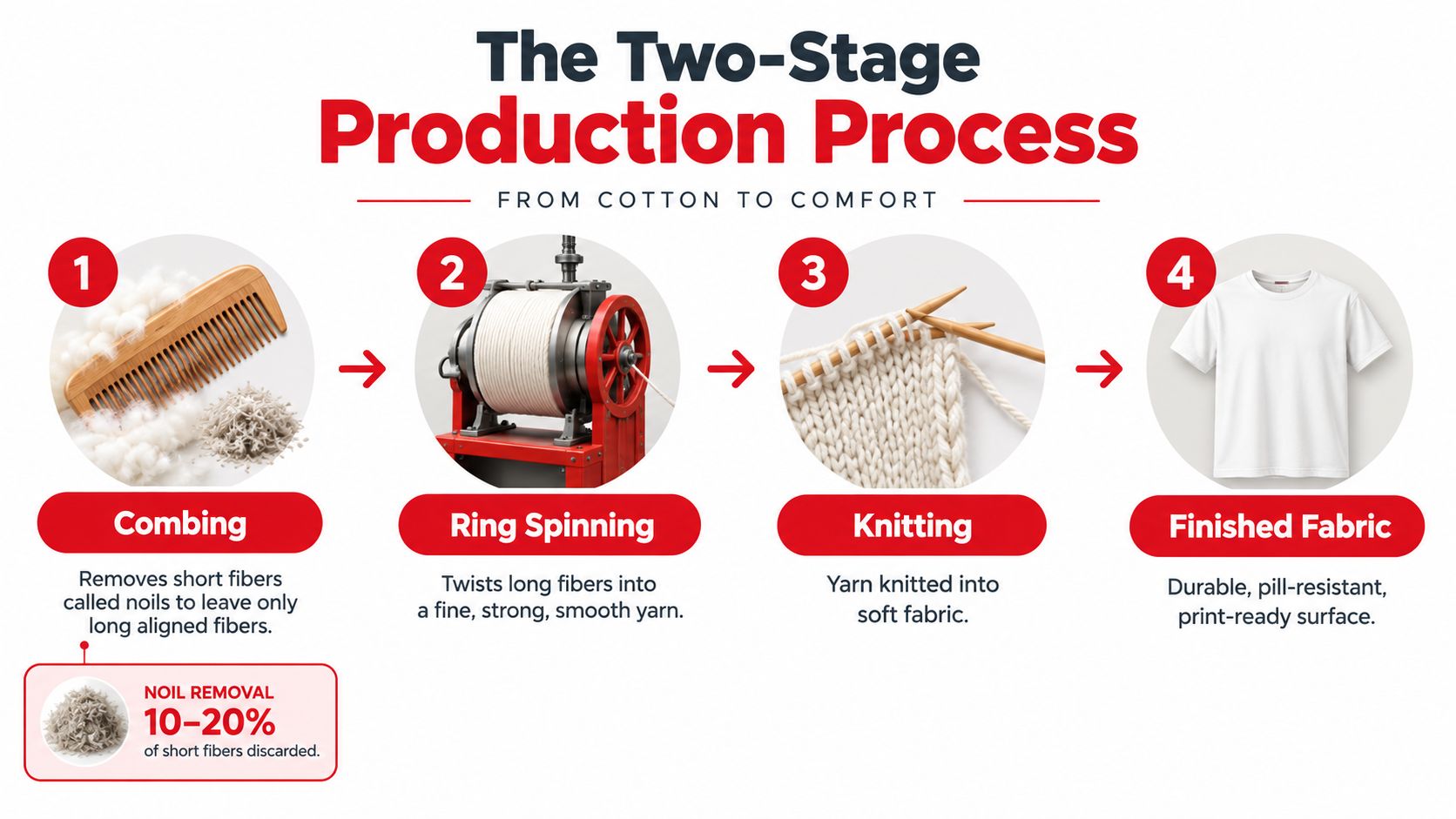
First comes combing
Cotton fibers don't arrive as a perfectly uniform row of parallel strands. Carding begins the alignment process, but combing takes the preparation further. Fine combs separate out shorter fibers, called noils, while aligning the longer fibers that remain.
The result is a more uniform fiber supply for spinning. According to the Cotton Counts history of spun and woven cotton, combed cotton is further processed to remove shorter fibers and align the remaining fibers before spinning. That sequence sits within a broader manufacturing chain that includes carding, drawing, roving, and spinning.
This refinement matters because short fibers can create more loose ends at the yarn surface. Removing them gives the spinner a better starting material for fine, even yarn. The process also involves a yield trade-off. Technical sourcing guidance on combed ring-spun cotton describes the combing stage as removing roughly 12 to 20% of short-fiber noil before spinning.
Then ring spinning builds the yarn
Ring spinning drafts the prepared fibers, draws them into a finer strand, and adds twist. That twist holds the longer fibers together in a tighter structure, producing yarn with a smoother surface and a more consistent profile.
The historical importance of this process is substantial. Ring spinning was first patented in the United States in 1828 by J. Thorpe and later became the dominant continuous spinning system in cotton manufacturing, as documented by the Cotton Counts source above. Earlier mechanized cotton spinning in England dates to 1730, helping establish the industrial yarn-production chain that eventually supported modern combed ringspun products.
Think of combing as sorting and aligning quality building materials, then think of ring spinning as turning those materials into a stable cord. Knitting or weaving comes afterward. The fabric can still vary by yarn count, knit structure, finishing, weight, and garment construction, so the yarn name alone doesn't guarantee a particular result.
A relevant example is the RXB Marlboro Rodeo Hoodie, which uses a 70/30 ring-spun cotton/polyester blend, three-end fleece, a 100% cotton face, and 32-singles construction. Its specification illustrates an important sourcing point: a ring-spun blend with a cotton face is not the same material as a 100% combed ringspun cotton jersey, even though both may offer a smooth decoration surface.
Tactile and Performance Characteristics
A premium DTF print can look uneven when the garment surface is rough, fuzzy, or inconsistent. Combed ringspun cotton gives the print a smoother starting surface by removing shorter fibers and applying controlled twist. The result is a cleaner fabric face and a more refined hand-feel, especially in fine jersey constructions.
That surface quality matters during DTF application. A more even textile base helps support sharper edges and more consistent coverage across the transfer. It does not replace accurate artwork, a reliable transfer, or correct pressing conditions, but it reduces avoidable variation between garments.
What you can assess by hand
Product descriptions are useful, but a blank garment should still pass a practical inspection:
Run your palm across the face: Look for a consistent, low-fuzz texture rather than roughness or irregular patches.
Inspect the knit under light: A uniform appearance usually provides a more predictable decoration area.
Check recovery at seams and collar: Yarn quality contributes to performance, while rib construction and sewing affect shape retention.
Compare the front and back: A cotton face or special finish may make one side more suitable for decoration.
Handle a printed sample: The unprinted blank shows only part of the result. Review the transfer after pressing and after washing.
Combed ringspun cotton is commonly chosen for finer yarn counts and premium tees because its smoother structure supports a refined hand-feel. Its tighter yarn structure can also limit loose surface fibers, helping the garment keep a cleaner appearance. These are useful advantages, but they do not justify an unlimited durability promise.
Where the trade-offs appear
Cotton comfort depends on more than fiber content. Yarn structure affects thermal conductivity, air permeability, wicking, and moisture vapor permeability, while knit structure, garment weight, fit, finishing, and climate also shape the wearing experience. “Soft” describes the initial touch, not the complete performance of the garment.
Combed ringspun cotton is not automatically the strongest option in every technical category. Compact-spun fabrics can outperform regular ring-spun and combed yarn fabrics in tensile strength, tearing strength, and pilling resistance. The practical sourcing point is clear: combed ringspun cotton is a premium choice for smoothness and print surface, but it isn't automatically the top performer in every technical category.
A refined yarn improves the starting point. It does not replace fabric testing, garment engineering, or a realistic understanding of the end use.
For fashion tees, creator merchandise, and branded garments worn close to the body, smooth hand-feel and clean DTF presentation can justify the choice. Customers notice both the print surface and the way the garment feels in use. Demanding workwear, abrasive environments, and applications focused on maximum resistance to pilling or tearing may call for another yarn or blend. Evaluate the finished garment, not just the fiber label.
Comparing Cotton Types for Your Project
The right comparison isn't “premium cotton versus cheap cotton.” It's which construction supports the customer's use case without paying for properties the project doesn't need.
Standard carded cotton can make sense for event quantities, basic promotional garments, and projects where the shirt's service life is limited or the decoration is simple. It generally uses a less-refined fiber preparation route, so the surface may feel coarser and look less even than combed ringspun cotton.
Polyester blends introduce a different set of priorities. They can offer useful performance characteristics for active or work-oriented garments, but they may require closer attention to dye migration, garment color, heat sensitivity, and the specific transfer system. A blend with a cotton face can be a strong compromise, but it shouldn't be marketed or assessed as identical to a 100% cotton surface.
Fabric Type | Softness | Durability | Print Surface | Cost |
|---|---|---|---|---|
Combed ringspun cotton | Smooth, refined hand-feel | Strong and comfortable, though application-dependent | Even surface suited to detailed decoration | Higher than basic carded options |
Standard carded cotton | Functional, often more textured | Practical for general use | More variable and potentially coarser | Generally lower |
Cotton/polyester blend | Depends on the blend and finish | Useful for selected wear and care needs | Can be consistent, but requires process validation | Varies by construction |
Compact-spun cotton | Smooth and technically robust | Strong pilling and tear performance in the cited research | Suitable for projects prioritizing technical performance | Depends on specification |
The market context also shows why ring spun combed yarn is treated as an industrial category rather than a niche feature. One ring spun combed yarn market forecast valued the global market at US$3.45 billion in 2023 and projected US$4.92 billion by 2030, with a projected CAGR of 5.2%. The same source presents another forecast of US$3.72 billion in 2024 reaching US$6.15 billion by 2032, with a projected CAGR of 6.4%. Those are forecasts, not guarantees, and the differing estimates reinforce the need to treat market figures as directional.
Pay more for combed ringspun cotton when the garment itself is part of the product experience. Choose a simpler carded blank when price, scale, or short-term use dominates. Choose a blend or compact construction when moisture behavior, technical strength, or care performance outweighs the smoothest cotton hand.
DTF Printing Compatibility and Best Practices
A DTF transfer shows every weakness in the blank beneath it, so combed ringspun cotton earns its place through surface quality. Its refined yarn gives the printer a more uniform print-facing surface, which matters because DTF sits on top of the garment instead of relying on the same absorption behavior as some direct-to-garment processes.
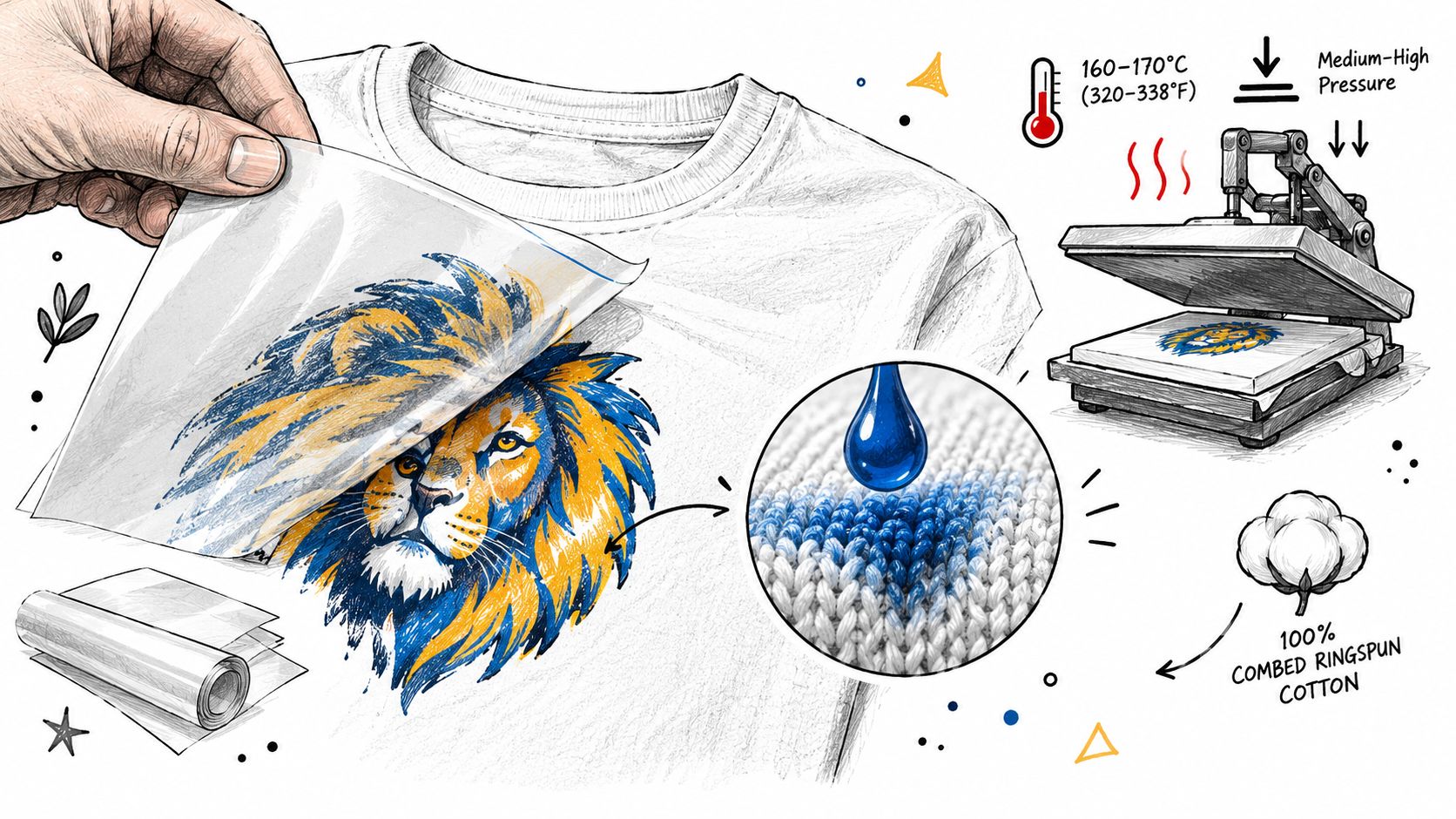
Longer, aligned fibers and a tighter yarn structure reduce surface irregularity. In production, that usually supports cleaner edges, steadier small details, and a print that feels more integrated with the garment. It does not create color accuracy by itself. Artwork setup, film, powder, curing, press settings, pressure, and operator control still decide whether the transfer succeeds.
Build a repeatable decoration check
Start with an actual blank, not a catalog description. Confirm the fabric content, color, face construction, and garment finish. Then run a sample transfer that includes the parts of the design most likely to expose limits, such as fine lettering, narrow lines, gradients, and large solid areas.
A controlled check is straightforward:
Prepare the garment: Make sure the print area is clean, dry, and free from lint, wrinkles, or seams that could interrupt pressure.
Confirm the transfer: Inspect the film for incomplete coverage, loose powder, or visible defects before pressing.
Follow the transfer supplier's settings: Temperature, dwell time, pressure, peel method, and post-press steps vary by system.
Check the finished surface: Look for incomplete adhesion, lifting edges, uneven texture, or distortion after cooling.
Test laundering before scaling: A sample that looks good right after pressing still has to meet wear and care expectations.
The historical overview of cotton spinning explains the textile side of the story well. Combing removes shorter fibers and aligns the remaining ones, then ring spinning forms the yarn through drafting and twisting. That is why the smoother print surface comes from fabric preparation long before decoration begins.
Use the garment as a system, not just a blank. A lightweight jersey, a heavyweight fleece, and a cotton-face blend can all accept DTF, but they will not feel or move the same. Stretch the printed area gently, inspect the edges, and compare the transfer with the garment's drape and knit recovery. For buyers who need a visual reference, the DTF production reference visual helps explain the workflow from film to finished print.
Combed ringspun cotton is the right foundation when the design depends on a smooth face, fine detail, and a premium hand. It will not rescue a poor transfer or bad press control, and it is not the only construction worth testing. The trade-off is simple. Pay for the cleaner base when print quality and customer perception matter most, and choose a different blank when another performance need deserves priority.
Care Instructions to Maintain Quality
A premium blank and a well-applied DTF transfer still need sensible care. Cotton fibers respond to heat, agitation, detergent, and drying conditions, while printed areas can suffer from unnecessary abrasion or direct heat.
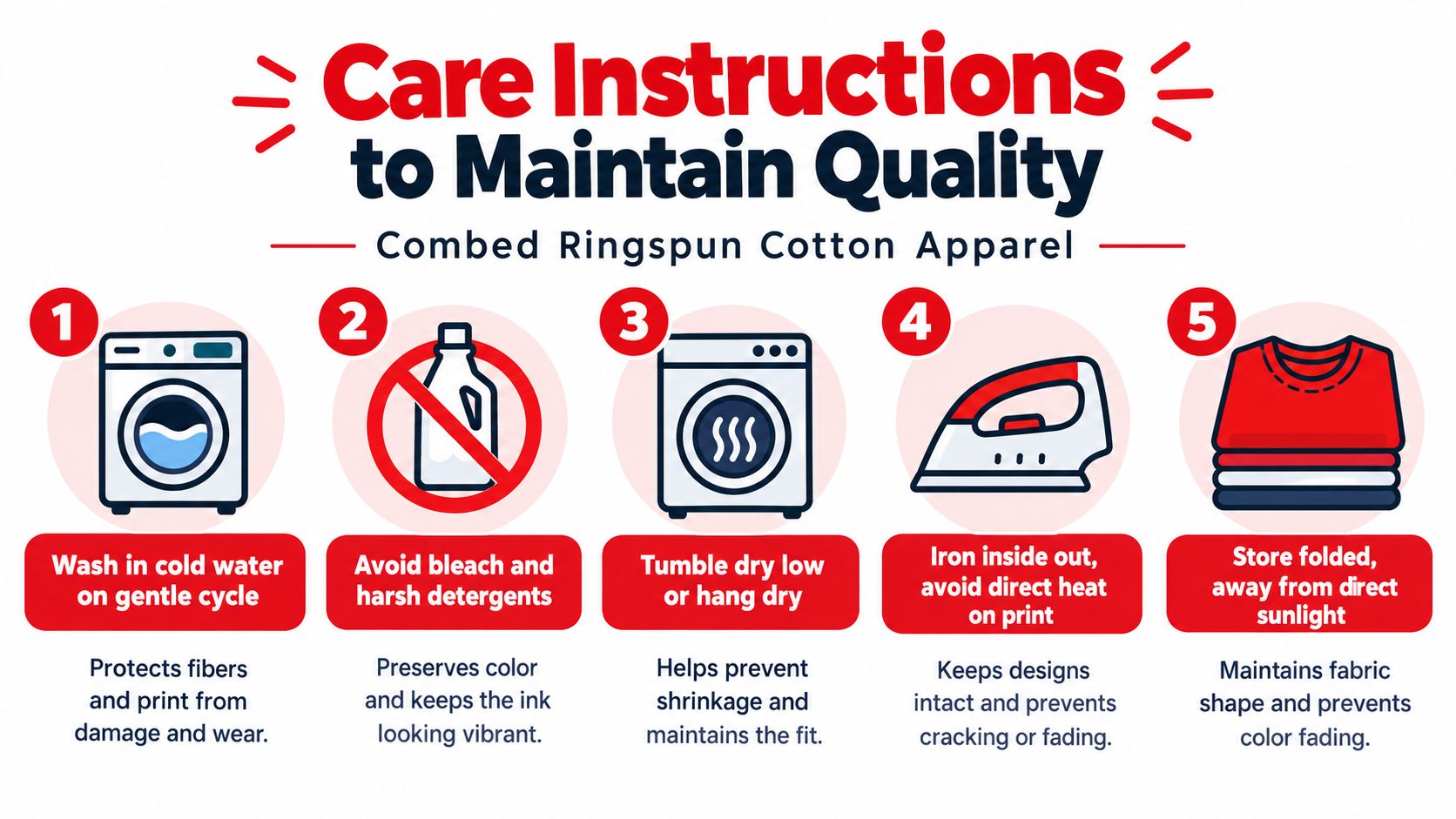
Give customers instructions that are simple enough to follow:
Wash inside out: This reduces direct rubbing against the printed face during laundering.
Use cold water and a gentle cycle: Lower agitation and temperature help protect the fabric and decoration.
Skip bleach and harsh detergents: Aggressive chemistry can affect color, fibers, and the appearance of the print.
Dry on low heat or hang dry: Excessive heat can contribute to unwanted shrinkage and a rougher hand over time.
Iron from the inside: Keep direct heat away from the transfer, and avoid pressing directly over the design.
Store folded away from strong sunlight: Folding helps preserve the garment's shape, while shaded storage helps protect color.
Care instructions should match the actual garment and transfer supplier guidance. A cotton jersey may need different handling from a fleece blend, and a garment-dyed item may have its own recommendations.
Customer handoff: Put the care guidance on the product page, order insert, or packaging. Customers can't preserve a print they weren't told how to treat.
Before sending a large order, wash a decorated sample using the instructions you plan to publish. Inspect the print while the garment is dry and after it has been handled. If the result doesn't meet your standard, revisit the blank, transfer, or pressing process before blaming customer care.
Best Apparel Use Cases and Applications
Combed ringspun cotton fits projects where the garment needs to feel like a finished product, not merely a carrier for a logo. Premium T-shirts, creator merchandise, boutique collections, and customer-facing brand apparel are strong candidates because buyers notice the surface against their skin and judge whether the garment feels worth keeping.
It also works well for detailed DTF designs where a clean textile face supports crisp visual presentation. Logos with small lettering, illustrated artwork, and retail-style graphics can benefit from the smoother foundation, provided the transfer and press process are validated on the chosen blank.
Match the construction to the buyer
For a small business ordering staff apparel, the decision may depend on how often employees wear the garment and whether the shirt represents the company in front of customers. For an event organizer, standard carded cotton may be entirely reasonable when the priority is broad distribution and simple identification. For a designer building a repeatable line, consistency from blank to blank matters more, making sample approval and documented sourcing important.
Hoodies and fleece require separate evaluation because their surface, weight, and construction differ from fine jersey. A cotton-face fleece can offer a suitable decoration area, but the blend, nap, fit, and thickness influence the finished result. Don't assume that a ring-spun label means every garment in a supplier's range will perform identically.
This apparel selection and production visual reflects the practical sequence brands should follow: select the garment, align it with the intended use, approve the decoration, and check the finished piece.
The best recommendation is conditional. Choose combed ringspun cotton when hand-feel, print surface, and premium presentation carry real value. Choose another construction when technical strength, moisture behavior, cost control, or specialized care performance matters more than the smoothest cotton experience.
Wear X Apparel, LLC provides custom garment selection, DTF printing, and production support for T-shirts, hoodies, team apparel, event garments, and branded merchandise. Visit Wear X Apparel, LLC to discuss a suitable blank, submit a design, or explore ready-to-buy apparel.
Comments