


Custom Apparel Printing Process Explained

You've approved the artwork, selected the shirts, and scheduled the launch. Then the finished order arrives with cracked graphics, lifted corners, or colors that look nothing like the proof. The problem usually didn't begin when the heat press closed. It began earlier, when someone treated custom apparel printing as a file-upload task instead of a controlled production process.
Digital textile printing is now a substantial production category. One industry estimate placed the global market at approximately USD 5.8 billion in 2024, with a projection of about USD 11.6 billion by 2030, but those figures are directional commercial estimates rather than exact accounting totals. Grand View Research's digital textile printing market analysis connects that expansion with short runs, e-commerce, faster design changes, and made-to-order production. Those are the same conditions that make DTF useful, provided the thermal variables are controlled.
Table of Contents
Why Most Custom Print Runs Fail Before Production - The JPEG is not the production plan
Preparing Artwork and Selecting the Right Garment - Prepare the artwork for the physical result - Match the blank to the use case
The Science of DTF Printing and Thermal Bonding - Heat is only one variable
Navigating the Approval Cycle and Production Workflow - Approve the visual decisions first - Keep the production handoff specific
Quality Checks and Durability Testing Protocols - Test the bond, not just the appearance
Verifying Sustainability and Supply Chain Transparency - Ask for evidence at product level
Fulfillment Logistics and Tips to Avoid Rework - Use a final release checklist
Why Most Custom Print Runs Fail Before Production
A failed run often looks simple from the customer's side. The logo was uploaded, the garment color was selected, and the order was approved. Yet a transfer can fail because the artwork was prepared against the wrong color expectation, the garment surface changed the bond, the powder coverage was uneven, or the press applied heat across a seam instead of a flat panel.
The visible defect appears at the end, but the cause may have entered the workflow much earlier. A dark shirt can make a design appear more saturated on screen than it looks after a white ink layer is applied. A fleece hoodie can absorb pressure differently from a smooth cotton shirt. A transfer may look clean immediately after pressing and still lift after laundering because the adhesive never fused properly.
Production rule: A clean-looking print is only an acceptable result after the artwork, garment, adhesive, heat, pressure, and inspection records all agree.
The JPEG is not the production plan
A JPEG can communicate the idea, but it doesn't necessarily provide a reliable production file. The operator needs to know the intended print dimensions, transparency, color handling, placement, and garment type. Without that information, the shop has to make assumptions, and assumptions create rework.
DTF production is especially flexible because it supports detailed graphics and small quantities without the same setup logic as a large conventional screen-printing run. That flexibility doesn't remove the need for process discipline. It increases the number of garment and artwork combinations that must be evaluated.
A professional workflow treats each order as a series of checkpoints:
Artwork check: Confirm the file, transparency, scale, and color intent before printing.
Garment check: Match fabric composition, surface texture, construction, and heat sensitivity to the transfer.
Thermal check: Record temperature, pressure, and dwell time instead of relying on the press display alone.
Bond check: Inspect the cured adhesive and the pressed edges before releasing the batch.
Wash check: Test a representative garment when durability, uniformity, or customer risk justifies it.
That system protects more than the print. It protects the event schedule, the team's appearance, the customer's budget, and the production capacity that would otherwise be consumed by replacing defective garments.
Customization is also no longer a narrow tailoring category. A commercial market estimate reported more than 1.4 billion apparel pieces with some level of customization in 2024, while online channels accounted for nearly 48% of global custom-clothing orders in that estimate. The custom clothing market estimate includes printed, personalized, and custom-fit garments, so it should be read as market context rather than a precise count of DTF products. The practical takeaway is clear: buyers need a repeatable process because more organizations are ordering personalized apparel through digital channels.
Preparing Artwork and Selecting the Right Garment
The strongest DTF job starts before ink reaches PET film. A production-ready file gives the operator a defined target, while a suitable blank gives the adhesive a surface it can bond to.
Prepare the artwork for the physical result
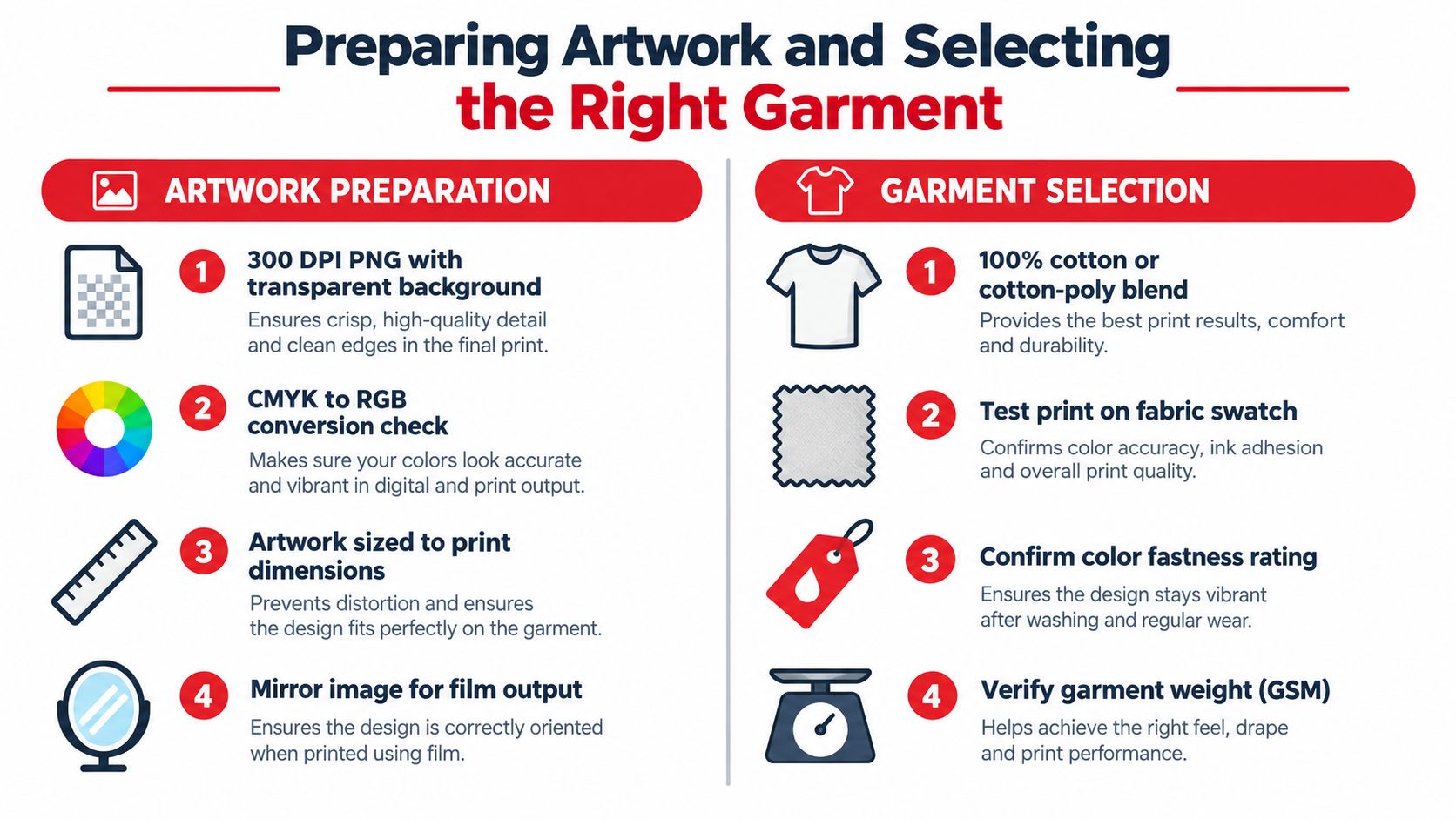
Start with a high-quality raster file or suitable vector artwork. For detailed raster graphics, a 300 DPI PNG with a transparent background is a useful working standard, but the file still needs to be checked at its intended print size. A small image enlarged for a large chest print may contain soft edges that look acceptable on a monitor and poor on fabric.
Check these points before approval:
Remove unintended backgrounds. White boxes, faint halos, and stray pixels can become visible once the design is transferred.
Confirm the color workflow. Screen colors, RGB files, CMYK conversions, white ink, and the garment color can produce different visual results. Agree on whether the proof represents a visual approximation or a color-critical target.
Set the physical dimensions. A design that is technically sharp can still be too large for a pocket area or too small for a hoodie front.
Review fine details. Thin strokes, small lettering, and narrow gaps need enough separation to survive printing, powder application, curing, and pressing.
Mirror the film output when required. The transfer must be positioned with the adhesive side toward the garment, so output orientation should be checked before production.
Match the blank to the use case
Fabric changes the thermal equation. Cotton, polyester, fleece, and blends respond differently to heat, pressure, and dwell time. A performance garment may be heat-sensitive, while a textured fleece can make it harder for the press to apply even contact across the entire design. Seams, ribbing, pockets, and heavy transitions can also create low-pressure zones.
For a heavyweight ranch or event hoodie, the RXB Marlboro Rodeo Hoodie uses an 8.5 oz./yd² US 70/30 ring-spun cotton/polyester three-end fleece blend with a 100% cotton face, a fleece-lined hood, and reinforced seam construction. Those details help define the garment surface and construction, but they still don't replace a transfer test on the specific blank.
Ask for a garment selection review when the order will be worn for work, outdoor activity, repeated washing, or public-facing events. The right decision considers color, fit, fabric weight, surface smoothness, heat sensitivity, and the location of seams. A design can be technically printable and still be a poor match for the garment's construction.
The Science of DTF Printing and Thermal Bonding
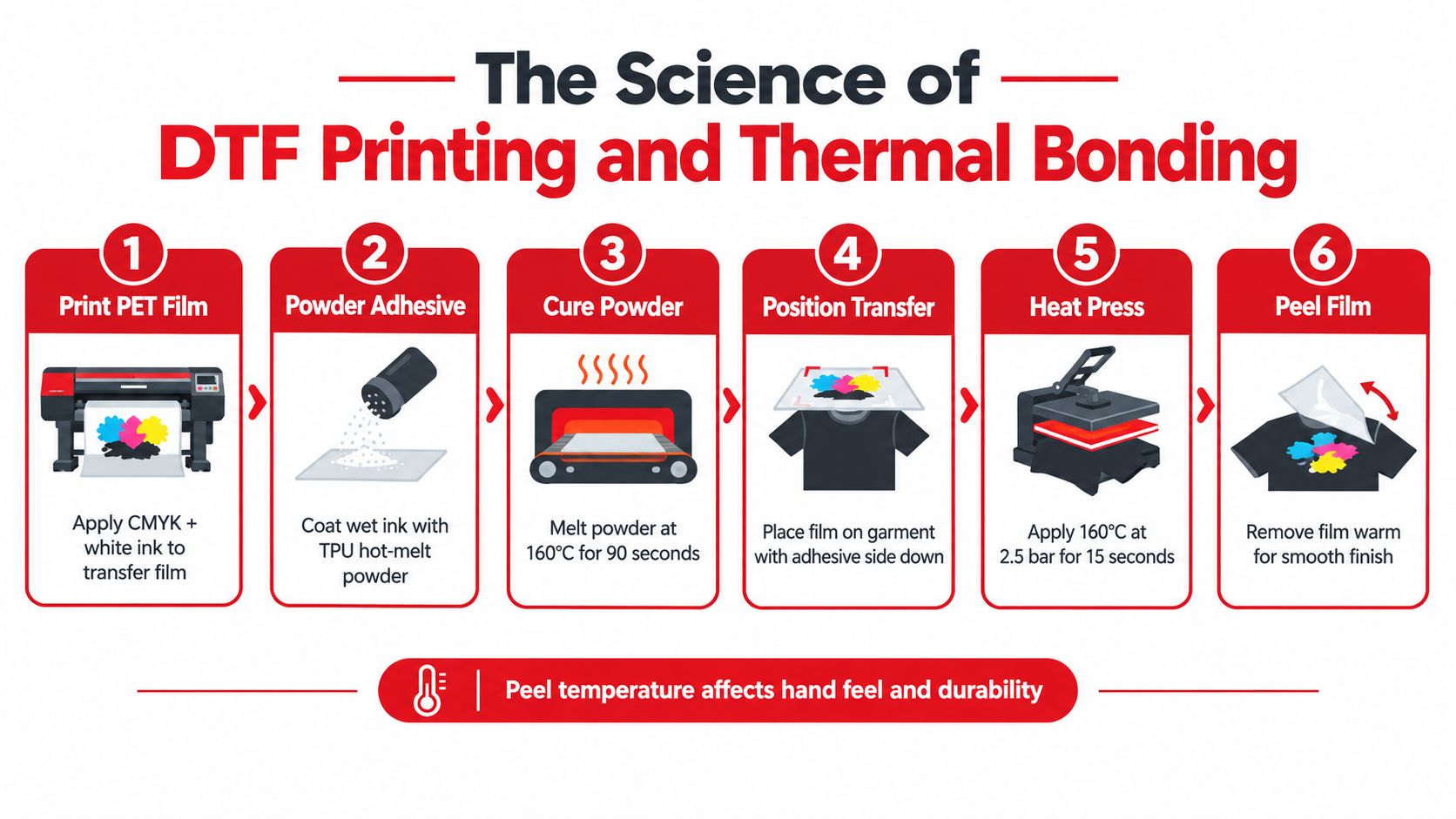
DTF is not a decorative sticker applied by pressing harder. It's a thermal-bonding process in which a TPU hot-melt powder becomes the adhesive layer between the printed transfer and the textile.
The sequence matters:
Print the CMYK and white ink onto PET film.
Apply TPU powder while the ink is still wet.
Remove loose powder so it doesn't create a gritty edge or unwanted adhesive spots.
Cure the powder until it forms a continuous adhesive layer.
Position the transfer on the garment.
Apply controlled heat and pressure with the press.
Heat is only one variable
A color-consistency optimization study identified 170°C for a 10-second press dwell as a setting that minimized measured color change, black-density loss, and white-layer contamination across the tested TPU materials. The technical color-consistency study provides a useful benchmark, not a universal recipe.
The operator still needs to validate the setting on the actual cotton, polyester, fleece, or blend. A garment's heat sensitivity and texture can change adhesion. An independent temperature probe can reveal a platen that reads correctly at the control panel but runs unevenly across its surface. Pressure matters just as much. If a thick seam, pocket, hood, or ribbed section interrupts contact, the transfer may receive less effective pressure even though the press closes normally.
The infographic's process values are another example of why customers should ask which settings apply to their specific equipment and materials. Curing and pressing are separate thermal events, and the transfer must be evaluated as a complete system rather than by copying a number from a different powder, film, or garment.
A production record should include the textile, ink and film combination, ambient conditions, temperature, pressure, and dwell time. That record gives the operator a way to investigate color drift, edge lift, cracking, or premature wear instead of guessing after the customer complains.
For a closer visual reference to the finished transfer and bonding approach, review this DTF production example.
Navigating the Approval Cycle and Production Workflow
The approval cycle should eliminate uncertainty in stages, not place every decision into one final approval email. A digital proof confirms the concept, but it doesn't prove how the print will look on the chosen garment.
Approve the visual decisions first
Start with the mockup. Confirm the garment color, design placement, approximate scale, orientation, and the number of print locations. Check whether the graphic sits over a pocket, seam, zipper, drawstring, or other construction detail. A proof that shows a centered design on a blank rectangle can hide a problem that becomes obvious on a real hoodie.
Color approval also needs plain language. A screen proof is useful for visual direction, but it can't guarantee that a monitor, printed transfer, and textile will display color identically. If the brand color is critical, define the reference and agree on the acceptable variation before the order enters production.
A physical sample becomes more valuable when the garment is unusual, the artwork contains fine detail, the order supports a major event, or the customer hasn't used the blank before. It gives the team a chance to inspect hand feel, placement, contrast, and stretch behavior before the full batch is pressed.
Keep the production handoff specific
Once the proof is approved, the production file should travel with the order details. The handoff needs the garment style, color, size breakdown, print locations, artwork version, placement instructions, and any approved sample reference. Clear file names reduce the chance that an outdated design reaches the printer.
The workflow should then move in a deliberate sequence:
Intake: Confirm the artwork and garment requirements.
Preflight: Check transparency, size, orientation, and color intent.
Test: Print or press a representative transfer when the material combination needs validation.
Batch production: Apply the approved settings consistently and record meaningful changes.
Inspection: Review the print, garment, placement, and bond before packing.
Customers should also read the supplier's shipping, return, and custom-work policies before approving production. Custom goods require different expectations from ordinary retail purchases, particularly when a design has been made specifically for one organization or event.
Approval discipline: If a change affects artwork, garment, placement, or material, treat it as a new approval decision. Don't assume an earlier proof covers it.
Quality Checks and Durability Testing Protocols
Resolution gets attention because it's easy to describe. Adhesive fusion determines whether the print remains attached. A sharp transfer can still fail if the powder wasn't applied evenly, the adhesive wasn't cured correctly, or the press didn't deliver consistent heat and pressure.
A cured film should feel smooth rather than gritty. The operator should inspect the adhesive layer before pressing, verify platen temperature with an independent probe, confirm consistent pressure and dwell, and avoid pressing directly across seams or thick garment transitions whenever possible.
Test the bond, not just the appearance
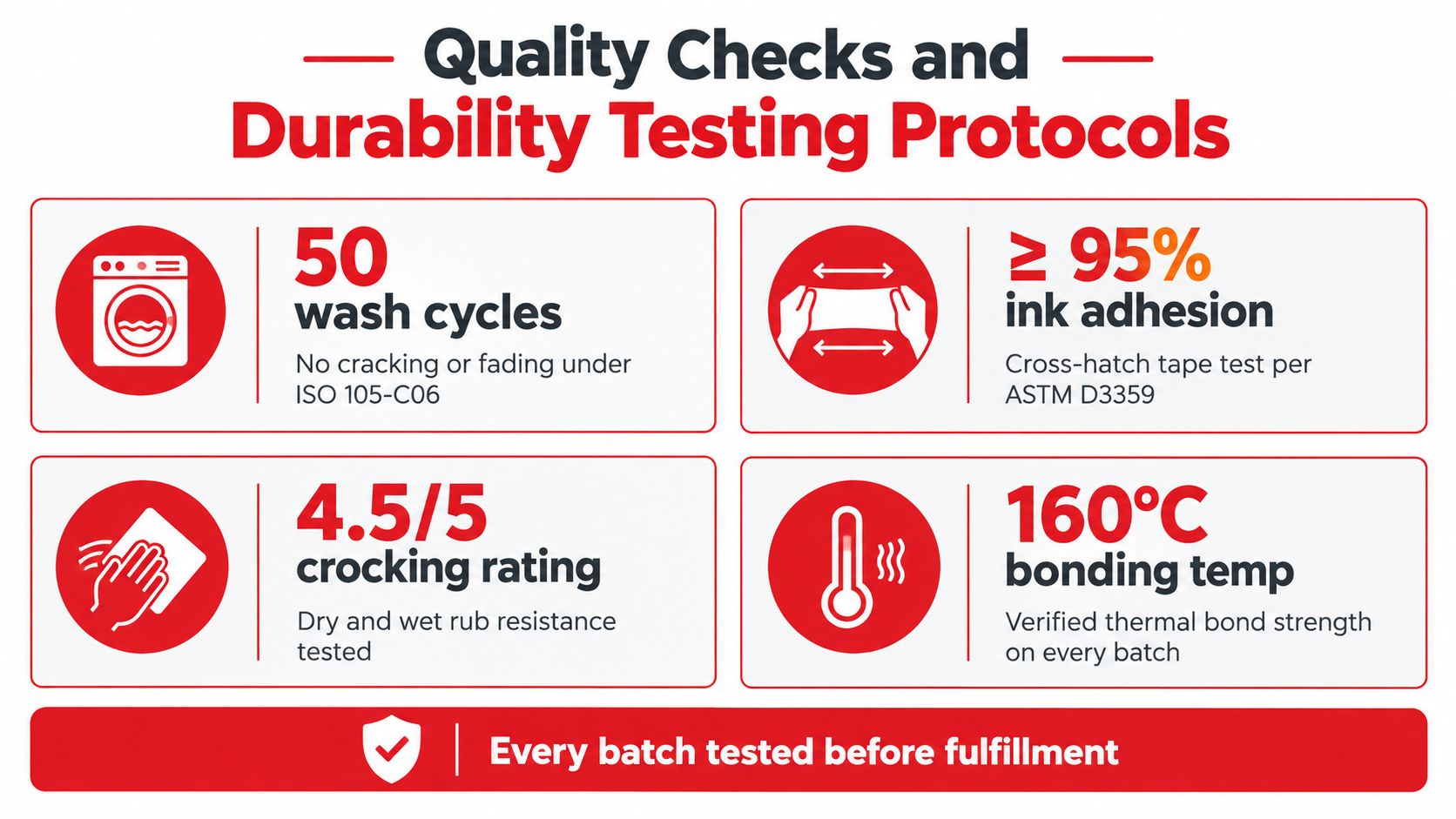
A practical release sequence includes a stretch inspection after pressing, followed by a standardized wash test for each new garment and transfer combination. Allowing the garment to rest before laundering helps the team assess the finished bond under consistent conditions rather than handling it immediately after pressing.
The AATCC TM61-2A accelerated method can screen durability. One 45-minute cycle at 49°C with detergent and steel balls is commonly treated as approximately five home launderings, according to the DTF durability guidance on washing, stretching, and wear. That method is a screening tool, not a promise that every garment will experience the same wear in daily use.
Controlled results reported in that guidance indicate that correctly applied transfers can retain acceptable color fastness at roughly Grade 4 or better on a five-point gray scale after approximately 50 home-wash equivalents. Heavy fleece or high-abrasion use may reduce practical life to about 30 to 40 washes. Those figures should guide testing and care instructions, not become a universal lifespan guarantee.
Inspect the same failure points after each defined interval:
Edges: Look for lifting, curling, or delamination.
Fine details: Check small lettering, narrow lines, and internal gaps.
Surface: Look for cracking, brittleness, or a gritty feel.
Color: Compare drift against the approved reference.
Stretch response: Pull the fabric gently and check whether the print returns without visible damage.
Under-curing can let detergent and water weaken the adhesive. Over-curing can make the transfer brittle and increase cracking during stretch. Neither issue is solved by increasing printer resolution.
For a visual example of a tackier adhesive layer and its role in transfer production, see this adhesive transfer reference. Care instructions should reflect the tested garment and transfer, including washing inside out and avoiding unnecessarily harsh treatment.
Verifying Sustainability and Supply Chain Transparency
“Eco-friendly printing” is too broad to be useful unless the supplier can explain what the claim covers. DTF may support made-to-order production and reduce unsold inventory, but that alone doesn't make the complete product low-impact. The blank garment, transportation, chemistry, energy use, packaging, durability, and end-of-life handling all belong in the assessment.
The European Union has identified textiles and apparel as a priority product group under its 2025 to 2030 Ecodesign working plan. Textile-specific Digital Product Passport requirements are still being developed, and the EU framework is intended to provide trustworthy product information through a data carrier such as a QR code at the point of sale or on the product. The European Commission's textile and apparel Digital Product Passport page is the appropriate place to monitor the framework as details evolve.
Ask for evidence at product level
A buyer evaluating a supplier should request information that can be checked, not broad environmental language:
Fiber composition: Confirm the actual materials in the blank garment.
Recycled content: Ask whether recycled fibers are used and how that content is documented.
Production locations: Identify where key garment and decoration stages occur.
Chemistry and ink documentation: Request relevant certifications or technical documentation where available.
Care instructions: Verify that the supplier provides practical instructions tied to the garment.
Durability expectations: Ask how the transfer was tested and what conditions affect wear.
Packaging and disposal: Understand how the order is packed and what guidance exists at end of life.
This approach may feel less polished than a simple green label, but it gives corporate buyers, ranch operations, teams, and event organizers something they can explain to their own customers. Traceability also reduces the risk of making a claim that depends on an unfinished regulatory definition.
A transparent supplier won't describe one production method as automatically sustainable. It will show which decisions reduce waste, which impacts remain, and which information still needs verification.
Fulfillment Logistics and Tips to Avoid Rework
A finished press run still needs protection. Prints can crease when garments are compressed incorrectly, and a correct production result can become a customer-service problem if the wrong size or color is packed.
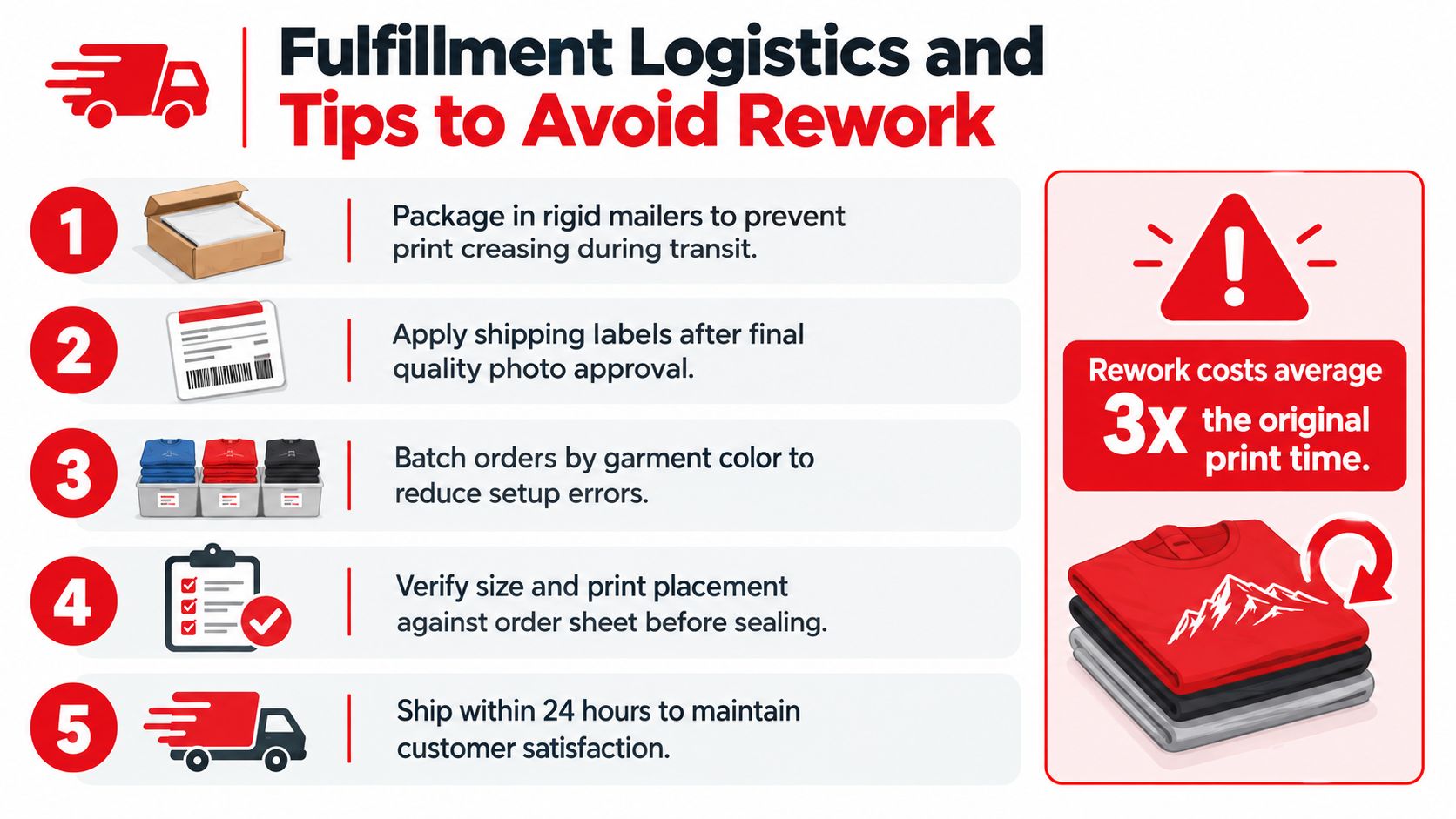
Before sealing a shipment, compare each garment with the order sheet. Confirm size, garment color, print location, and quantity. Photographing the approved result can also create a useful internal record before labels are applied.
Use a final release checklist
Name files clearly: Include the customer, garment, print location, and approved revision in the production filename.
Set expectations early: Discuss quantity requirements, garment options, turnaround, color references, and approval deadlines before pressing.
Group related work: Batch garments by color and material so setup changes are visible and controlled.
Inspect before packing: Check print placement, edges, fine detail, size, and garment condition against the order sheet.
Protect the finished goods: Use packaging that keeps garments from excessive folding or compression during transit.
A shipping method should match the event date and the supplier's published policies. Custom work also needs a clear understanding of return handling because a correctly produced personalized garment may not be treated like standard inventory.
For a visual example of an on-demand production and fulfillment workflow, review this apparel fulfillment reference.
The most reliable order is the one that needs no rescue. Prepare the artwork, select the garment for its real use, approve the physical result when risk is high, record the thermal settings, test the bond, and inspect every piece before fulfillment. Wear X Apparel, LLC provides garment selection, DTF production, and quality-check support for custom T-shirts, hoodies, team orders, events, and made-to-order merchandise. Start your next project by visiting Wear X Apparel, LLC and submitting the artwork and garment details for a production-focused review.
Comments