


Printful Alternatives: Top Options for Custom Apparel Brands

Most advice on Printful alternatives starts in the wrong place. It asks which platform has the biggest catalog or the cheapest blank, then treats every provider like a slightly different version of the same machine.
That's not how custom apparel works in real operations.
A shop selling one-off creator merch through an automated storefront has different needs from a ranch brand that cares about garment weight, print hand, and repeatability on hoodies. An event organizer trying to outfit staff fast has a different risk profile from a small business ordering branded workwear in rolling batches. If you compare all of them by base price alone, you'll pick the wrong partner for half of those jobs.
The better way to judge Printful alternatives is by production method and operating model. Some alternatives are marketplace-style POD networks. Some are apparel-focused shops built around DTF or DTG production. Some are local printers that trade automation for direct oversight. Those differences matter more than the logo in the website header.
Table of Contents
Why Printful Alternatives Need a Better Decision Framework - What most comparison lists get wrong - The real question to ask
Three Categories of Printful Alternatives Explained - POD marketplaces - Specialized printers - Local printers and hybrid operators
Feature-by-Feature Comparison Across Alternatives - Print methods and output consistency - Speed, integrations, and shipping trade-offs - Where each option usually breaks down
Real-World Scenarios for Different Business Types - Small business workwear - Event apparel and deadline-driven orders - Creator drops and apparel-first brands - Outdoor, ranch, and western labels
Decision Checklist for Choosing Your Alternative - Start with the order pattern - Then pressure-test your real constraints - Quick matching guide
How to Test and Validate Your Alternative Choice - Order samples that expose weaknesses - Test the workflow, not just the print - Use a scorecard
Cost and Turnaround Analysis by Order Size - Single-item orders - Small batches and short runs - Larger runs and repeat demand - The cost you should actually watch
Why Printful Alternatives Need a Better Decision Framework
A bigger catalog does not fix a bad production fit.
The print-on-demand market is large enough now that "best Printful alternative" has become a weak question. Industry forecasts put the global category at roughly USD 10.8 billion to USD 12.2 billion in 2025, with long-range projections rising sharply into the next decade, according to Grand View Research print-on-demand market projections. In practical terms, that means there are plenty of legitimate options. The hard part is sorting them by how they operate, not by who bought the most Google ads.

What most comparison lists get wrong
A lot of roundups treat every provider like the same service with different pricing. That approach breaks down fast once apparel quality, reprint consistency, or delivery windows start affecting customer retention.
I have seen brands switch providers over a $1 shirt difference, then give that savings back through slower remakes, weaker print feel, or garments they would never have approved in person.
The better filter is operational fit. Marketplace POD platforms are built for convenience and automation. DTF-focused shops are usually stronger when the priority is print durability, color pop, or flexibility across garment types. Local or regional printers can make more sense for rolling workwear orders, event merch, or any account where a phone call solves problems faster than a ticket queue.
Here is where bad comparisons usually miss the decision points.
Garment control: Blank selection matters if your brand depends on fleece weight, fit, shrink behavior, or fabric surface.
Decoration method: Some graphics hold up better through DTF workflows than through standard marketplace DTG.
Fulfillment geography: If most customers are in one region, production location affects transit time and replacement speed.
Output consistency: A broad catalog helps less if sizing, placement, and color vary from run to run.
Practical rule: If apparel is the product, choose the production model first. Choose the software and catalog second.
The real question to ask
The useful question is simpler. Which fulfillment model matches the way the business sells?
A store testing designs with low volume and broad product variety may fit a marketplace-based POD provider. A small apparel brand trying to build repeat customers usually needs tighter control over blanks, print method, and final hand feel. A business ordering staff gear in batches may get better results from a local or regional production partner, even if the ordering system is less automated.
That is the decision framework that holds up in real operations. Price still matters. So do integrations. But production method usually decides whether the relationship works after the first 50 orders.
Three Categories of Printful Alternatives Explained
Comparing Printful alternatives by feature list usually leads people to the wrong vendor. The better split is by operating model. A marketplace POD platform solves a different problem than a DTF-focused apparel printer, and both behave differently from a local shop that also fulfills online orders.
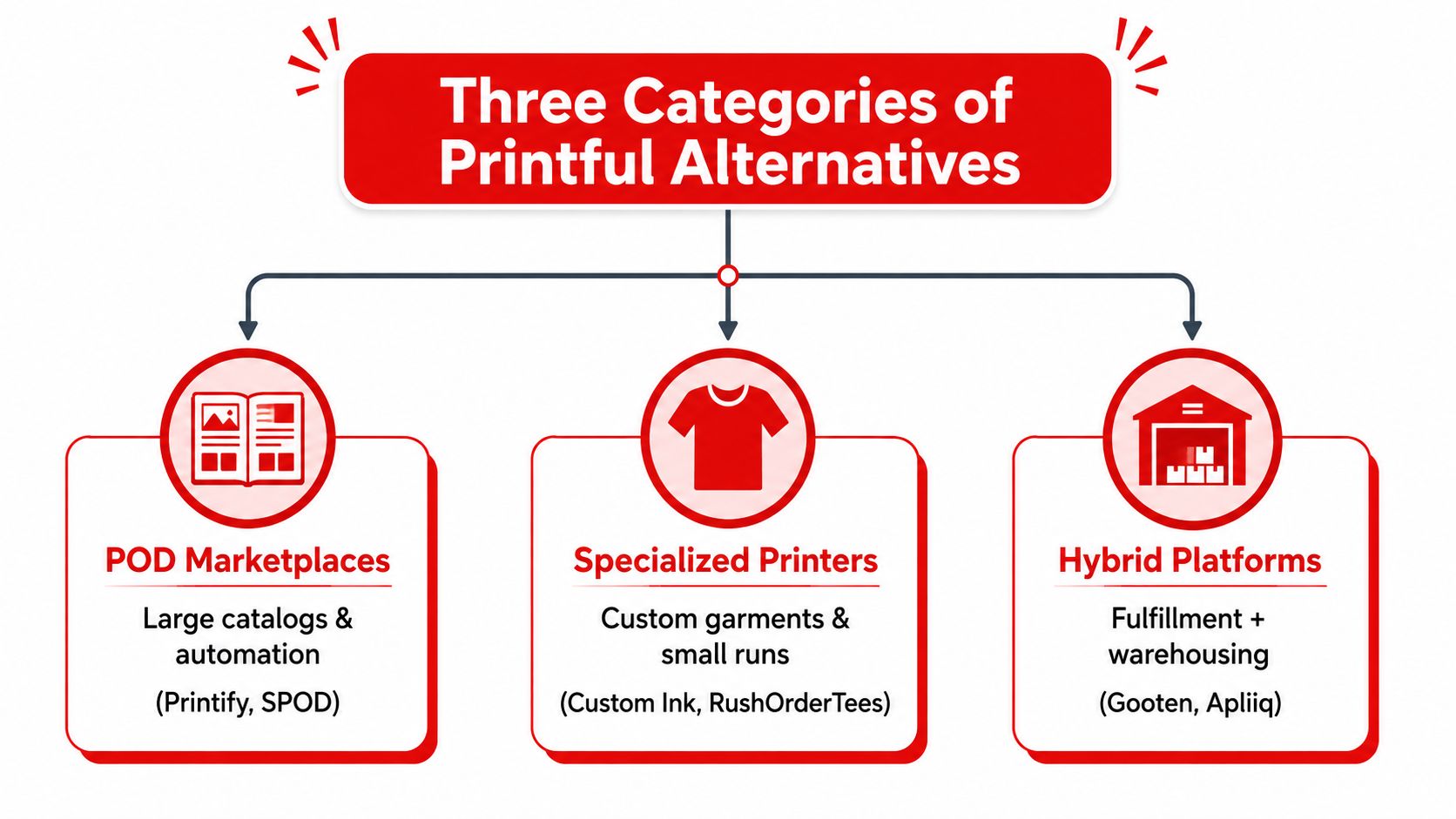
POD marketplaces
Marketplace-based POD providers are built around automation, catalog breadth, and easy store connections. They work well for sellers testing lots of designs across many product types, especially when order volume is still uneven and speed of setup matters more than precise garment control.
Printify is a clear example. It gives merchants multiple print-provider options, broad SKU coverage, and a pricing structure that can work for stores watching margins closely. One comparison from WiserReview's Printful alternatives breakdown cites a Bella+Canvas 3001 base price of $11.29 on the free plan and $9.04 on Printify Premium, with Printify Choice routing described as averaging 1.6 days fulfillment and shipping from $3.99.
SPOD sits in the same category, but the appeal is different. Its reputation is speed. For stores selling novelty tees, seasonal items, or broad catalogs where fast routing matters more than blank consistency, that can be a practical advantage.
The trade-off is familiar to anyone who has managed repeat apparel orders. You get convenience and variety, but less control over how a shirt feels, how a print lays down on different fabrics, and how consistent the output stays as orders scale.
Specialized printers
Specialized printers narrow the offer and tighten the process. That usually means fewer product types, more attention to garment selection, and more predictable apparel results.
This category matters because many small brands are not looking for “more POD.” They are looking for a production method that fits the product they sell. DTF-focused shops often make more sense than marketplace POD providers when the core business is tees, hoodies, and fleece, especially when designs need strong color, flexible placement, and low minimums across singles and short runs. Analysts at Research and Markets in its DTF market report project continued growth in DTF and DTG, which matches what apparel operators have already seen on the ground. Buyers are sorting vendors by print result, not just by app integration.
A garment like the RXB Marlboro Rodeo Hoodie shows the difference. It's described as a heavyweight hoodie with a three-dimensional velvety chest logo, a 70/30 ring-spun cotton/polyester blend 3-end fleece with 100% cotton face, fleece lined hood, generous fit, and WRAP-certified manufacturing, designed and produced in South Dakota, USA. That is an apparel decision first. The blank, the fabric face, and the decoration approach all affect whether the finished piece feels worth the price. This DTF product workflow image gives a useful visual of that apparel-first workflow.
Local printers and hybrid operators
The third category is local printers and hybrid fulfillment operators. These shops often combine decorated apparel production with lighter ecommerce support, manual ordering help, or regional fulfillment.
They are rarely the slickest option from a software standpoint. They can be the best operational fit for school programs, staff uniforms, fundraising apparel, event merch, and brands that reorder the same pieces over and over.
Direct communication is the advantage. If sizing is off, a fleece is backordered, or a placement needs approval before production, a local or hybrid partner can often solve it faster than a ticket-based platform. The trade-off is more hands-on management from your side and, in some cases, less polished automation.
Buyers usually regret choosing a vendor with the best app if the finished hoodie feels wrong, ships late, or prints inconsistently.
Feature-by-Feature Comparison Across Alternatives
Price tables flatten the wrong details. The harder question is how each alternative handles production once an order is live, because that is where small brands feel the difference.
Printful Alternative Comparison Matrix | |||||
|---|---|---|---|---|---|
Category | Best For | Min Order | Avg Turnaround | Quality Control | Integration Depth |
POD marketplaces | Store owners who need automation and broad catalogs | Usually low or no minimums | Varies by provider and routing | Variable, depends on network or facility consistency | Strong |
DTF specialists | Apparel brands that care about garment choice and print handling | Often flexible for singles through batches | Often faster and more predictable for apparel-only work | Higher hands-on oversight | Moderate |
Local printers | Regional workwear, events, clubs, and repeat orders | Often flexible but quote-driven | Strong for local deadlines | Highest direct oversight | Limited to moderate |
Print methods and output consistency
Print method drives more of the customer experience than the platform name does. Two sellers can both use print on demand and still deliver very different shirts if one relies on a broad provider network and the other runs a tighter apparel workflow.
Marketplace POD wins on assortment and convenience. You can launch faster, connect to more storefronts, and test product categories without much setup. The trade-off shows up later in hand feel, color consistency, blank substitutions, and placement tolerances. Those issues matter less for novelty products than for brands trying to build repeat apparel sales.
DTF-focused operators usually perform better when the product mix stays centered on tees, hoodies, and workwear. A narrower catalog often means fewer production variables, better control over the blanks, and fewer surprises between the sample and the fiftieth reorder. That production-first model is easier to see in this on-demand apparel workflow diagram.
Speed, integrations, and shipping trade-offs
Fast fulfillment is only useful if the output stays consistent. Some marketplace providers are strong here. SPOD is a common example because its operating model is built around speed and straightforward store integrations, as noted earlier in the Ecommerce Platforms comparison. If your store loses sales when delivery estimates get too long, that matters.
Printify usually enters the conversation for a different reason. It gives sellers more options to manage base cost and supplier choice. That flexibility can help margins, but it also adds vendor-management work. If you do not keep track of which provider is producing which SKU, quality drift can creep in.
Local printers sit at the other end of the spectrum. Integration depth is often weaker, but communication is better. For orders with fixed dates, repeat staff uniforms, or approvals that need a real person, that trade can be worth it.
Where each option usually breaks down
POD marketplaces start causing problems when your brand depends on a specific blank, a consistent print hand, or repeat customers noticing small quality changes.
DTF specialists become limiting when you want a huge non-apparel catalog or fully automated routing across dozens of product types.
Local printers become inefficient when your business depends on self-serve ecommerce automation and national-scale fulfillment.
Shop-floor takeaway: If apparel is the core product, choose the operation that can repeat the same result reliably, not the one with the longest catalog.
Real-World Scenarios for Different Business Types
Platform comparisons usually get abstract fast. Actual buying decisions do not. The better question is how your orders arrive, what can go wrong in production, and whether you need automated fulfillment or tighter control over the garment and print method.
Small business workwear
A plumbing company, landscaping crew, or HVAC shop rarely needs hundreds of lifestyle products. It needs shirts that hold up, logo placement that stays consistent, and a reorder process that does not start from zero every season.
That usually pushes the decision away from marketplace POD and toward a local shop or apparel specialist. The reason is operational, not aesthetic. Workwear buyers often need darker garments, heavier fleece, size runs that make sense for crews, and someone who will catch problems before the order goes to press.
Marketplace providers can still work for simple staff shirts. They become less useful when the job includes repeat uniform programs, employee-by-role kits, or approval steps from an office manager who wants one point of contact.
Event apparel and deadline-driven orders
Event orders are deadline orders. If the shirts arrive late, the rest of the discussion does not matter.
For that type of job, the production model matters more than the catalog. A speed-oriented POD platform can fit standard tees with simple artwork and direct ecommerce routing. A local printer or DTF-focused supplier often fits better when the event needs batch coordination, last-minute quantity changes, or a real person confirming art and ship dates.
Recent roundups show that alternative providers position themselves around different fulfillment footprints and production speeds, as discussed in POD Vector's Printful alternatives comparison. The useful takeaway is straightforward. Ask where the order will print, how it will ship, and who owns the timeline if part of the order slips.
Teams changing vendors for event work should also watch an actual production discussion before making the switch.
Creator drops and apparel-first brands
Small creator brands usually start with marketplace POD because setup is fast and store integrations are easy. That is a reasonable starting point for one-off orders.
The pressure shows up later. Returns start clustering around fit, the print feel is not what buyers expected, or the same design lands differently across suppliers and blanks. At that stage, the comparison is not Printful versus another app. It is automated marketplace fulfillment versus a more controlled apparel workflow.
Apparel-first brands often do better with a specialist that can keep the blank, print method, and finishing approach more stable from drop to drop. That usually matters more than adding another mug or phone case to the catalog.
Outdoor, ranch, and western labels
These brands tend to be harder on garments and pickier about them. Buyers notice fabric weight, collar shape, print feel, and how the graphic sits on darker or heavier blanks.
A DTF specialist or hands-on apparel shop is usually the better fit because the job is more apparel-specific than platform-specific. Wear X Apparel, LLC is one example in that lane. It offers DTF garment printing, garment selection support, and made-to-order custom apparel services for single items and batch orders through its custom apparel services.
That model fits brands that care about the shirt as much as the artwork. It is less about having the widest product menu and more about getting repeatable results on the garments customers wear.
Decision Checklist for Choosing Your Alternative
Choosing among Printful alternatives gets easier when you reduce it to a handful of operational questions.
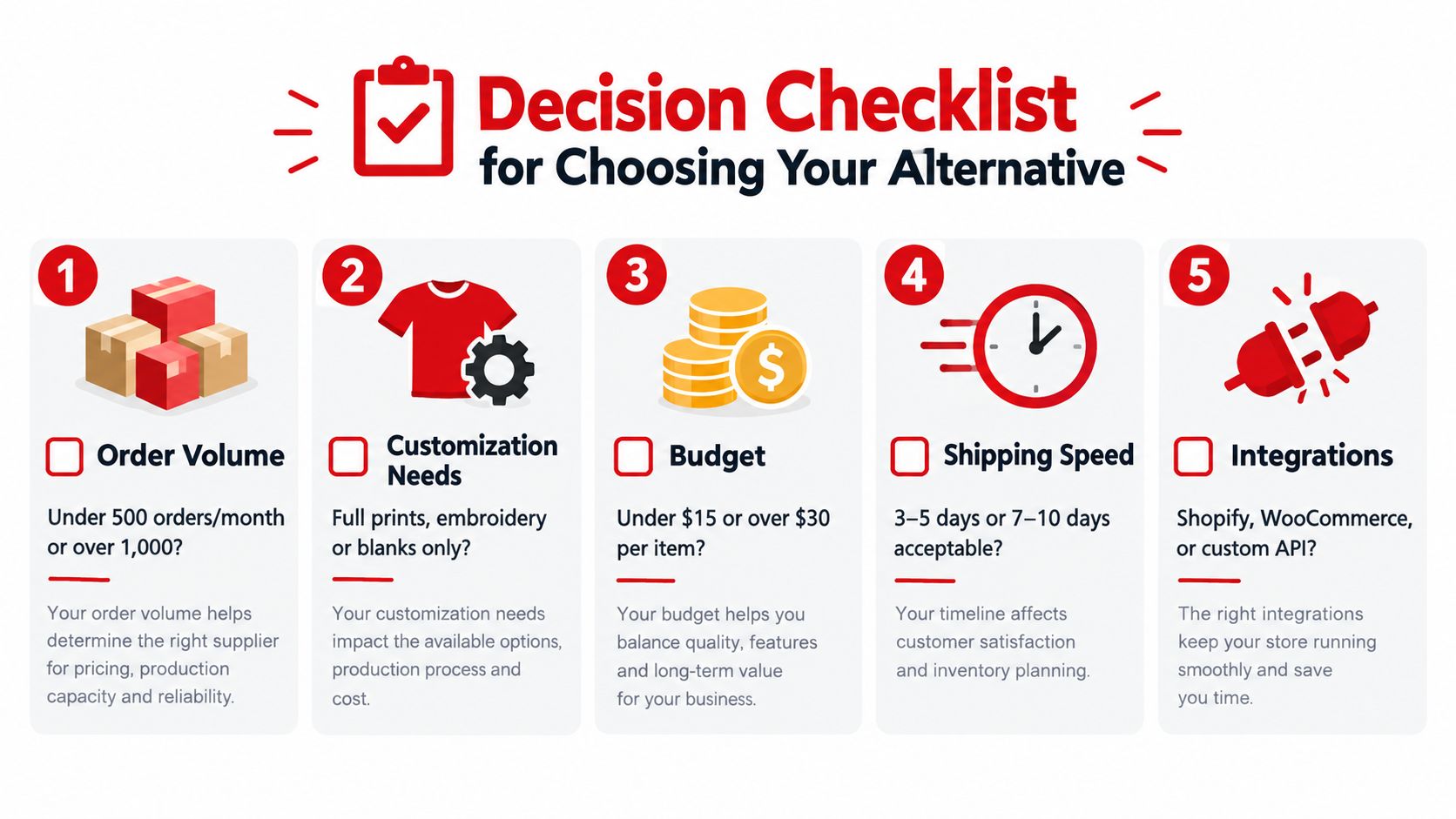
Start with the order pattern
If most of your business is one-off ecommerce sales, a marketplace POD platform is still the default place to start. If your business comes in batches, repeat team orders, staff kits, or event apparel, specialist or local production often fits better.
Ask yourself:
Do orders arrive one at a time or in waves?
Is garment choice part of the product value or just a carrier for the logo?
Do customers care more about speed, feel, or brand presentation?
Then pressure-test your real constraints
Some decisions look technical but are brand decisions.
Customization needs: If you need control over print feel, garment face, or specific blanks, broad POD platforms get less attractive.
Shipping expectations: If buyers need predictable regional delivery, local or region-focused options usually beat global breadth.
Integration depth: If you need store sync, automated routing, and minimal manual handling, marketplaces still have an edge.
Support style: If your team wants a person who can discuss garments and artwork, specialist shops usually handle that better than software-first platforms.
Choose the vendor that solves the complaint you already have, not the feature you think you might need later.
Quick matching guide
Choose a POD marketplace if convenience, integrations, and product breadth come first.
Choose a DTF or apparel specialist if print quality, garment selection, and lower-friction custom runs matter most.
Choose a local printer if deadlines, local communication, and recurring regional orders drive the business.
How to Test and Validate Your Alternative Choice
Never switch a fulfillment partner based on a comparison article alone. Test it like a production manager, not like a shopper.
Order samples that expose weaknesses
Don't order only your easiest design. Order the jobs most likely to fail.
That usually means:
A dark garment with strong contrast
A detailed graphic with small elements
A heavier fleece item if hoodies matter to your store
A standard tee you'd reorder
You're checking for placement, opacity, edge quality, fabric compatibility, and how the print feels in the hand. On hoodies, pay attention to how the decoration sits over thicker fabric and whether the garment itself matches the positioning shown in the mockup.
Test the workflow, not just the print
Good samples can hide a weak operation. Run a store test too.
Create a small batch of private listings and submit orders through the same path you'd use in production. Watch for:
Catalog sync issues
Variant mapping problems
Shipping notification timing
Tracking clarity
Support response quality
If the platform forces too much manual cleanup, that labor cost will catch up with you later.
Use a scorecard
A simple yes-or-no reaction isn't enough. Use a written scorecard for each vendor.
Rate each one on:
Garment accuracy
Print quality
Production reliability
Packaging and presentation
Support responsiveness
Store integration fit
A strong sample means very little if reorders drift in quality or if support goes quiet when a customer order goes wrong.
If you can, run two vendors in parallel for a limited period. Route a narrow product set through the new provider first. That lets you compare print consistency, customer feedback, and internal workload without risking the whole store.
Cost and Turnaround Analysis by Order Size
Many businesses make bad decisions. They compare single-item base prices and ignore how the order type changes the economics.
Single-item orders
For true one-off selling, marketplace POD providers usually make the most sense. The convenience is the product. You get automated routing, easy integrations, and no need to manually touch each order.
That doesn't mean they're cheapest in every practical sense. It means the workflow often justifies the higher per-unit friction because the system handles fulfillment for you.
Small batches and short runs
At the batch level, the gap starts to close. If you're ordering for a team, club, work crew, or event, apparel specialists often become more competitive because they're built around garments first, not broad multi-category catalogs.
That's also where DTF starts making more operational sense for many brands. The production conversation shifts from “What's the cheapest shirt online?” to “What print method and garment combination gets me the fewest problems?”
A useful visual reference for this kind of apparel-specific order path is this custom production garment image.
Larger runs and repeat demand
Once you get into larger runs or repeat replenishment, local and specialist providers often pull ahead because communication, consistency, and garment continuity matter more than app polish.
Here's the practical pattern I see most often:
For single ecommerce orders, POD marketplaces usually win on simplicity.
For short branded runs, specialists often win on control.
For repeat operational apparel, local printers often win on coordination and accountability.
The cost you should actually watch
The most expensive vendor isn't always the one with the highest shirt price. It's often the one that creates hidden costs through reprints, customer complaints, split shipments, or artwork issues.
A cheaper blank doesn't help much if the print feels wrong on arrival. A broad catalog doesn't help if customers only buy three core products and one of them keeps generating fit complaints.
That's why “landed cost” for apparel should include more than production and shipping. It should include your time, your support burden, and the odds that the order gets replaced.
Final Recommendations and Next Steps
Choose the provider that matches how you operate, not the one with the broadest catalog or the lowest advertised shirt price.
That usually means starting with production method, then working outward. Marketplace POD providers make sense if your business depends on app integrations, automated routing, and a wide product menu. DTF-focused and apparel-specialist partners make sense if you sell a narrower set of core garments and care about print hand, placement consistency, and reorders landing the same way month after month. Local and regional printers still earn their place when deadlines are tight, approval cycles involve real people, and somebody needs to answer the phone when an event order goes sideways.
A practical framework is simpler than most comparison charts:
Choose marketplace POD if software convenience matters more than garment control.
Choose a DTF or apparel specialist if print quality and repeatability drive customer retention.
Choose a local or regional printer if service, oversight, and deadline coordination carry the most risk.
The next step is a controlled test. Move three to five SKUs, not your whole store. Pick the products that represent your real volume, your common decoration needs, and the garments customers complain about when quality slips. Then place sample orders, run one live sales cycle, and track what happens after checkout.
Watch the points that create work. Did the print match the mockup closely enough? Did the garment feel right for the price? Were there avoidable support tickets, address issues, or remake requests? Those answers will tell you more than any platform feature page.
The best Printful alternative is the one that fits your order mix, your quality bar, and your tolerance for fixing vendor mistakes.
If your business needs an apparel-first partner rather than a generic POD dashboard, Wear X Apparel, LLC provides DTF-based custom apparel production, garment selection support, and made-to-order merch services for single pieces and batch runs. As noted earlier, it is one option for brands, teams, and organizers that need tighter control over apparel outcomes.
Comments