


Short Sleeve T Shirt Styles, Fabrics, and Fit Guide

Your merch coordinator approved the artwork, placed an order for 250 tees, and then lost a week to misprints. The logo looked centered on the proof but crowded the sleeve seam on the finished shirts. A few transfers lifted from the performance fabric, while the lightweight blanks made the graphic look heavier than expected.
That kind of rework usually starts before the heat press. A short sleeve t shirt isn't just a blank canvas. Style controls the usable print area, fabric controls adhesion and hand-feel, and fit controls where the decoration lands on the body. Choose those variables first, then set your DTF process around the garment instead of forcing every blank through the same settings.
Table of Contents
Why Short Sleeve T Shirt Choices Matter Before You Press Print - The three checks that prevent expensive rework
Short Sleeve T Shirt Styles and What Each One Signals - Choose the surface before the artwork - Seams are part of the design brief
Short Sleeve T Shirt Fabrics and How They Wear - Cotton gives you the easiest starting point - Blends are the practical middle ground
Short Sleeve T Shirt Fit and Sleeve Geometry - Read the cut through the sleeve - Request the measurements that expose fit risk
DTF Printing Implications Across Styles and Fabrics - Match artwork size to the garment geometry - Run the production checks in order
Sustainability, Durability, and Cost Tradeoffs - Judge sustainability by the entire program
Choosing the Right Short Sleeve T Shirt for Your Order - Workwear needs consistency - Events need sweat control - Limited merch drops sell through feel
Why Short Sleeve T Shirt Choices Matter Before You Press Print
A tee can pass artwork approval and still create rework at the press. Sleeve length, fabric weight, and fit change the usable print area, how a DTF transfer behaves, and whether the finished graphic looks balanced after washing. Set those variables before you approve production art.
Start with the garment's construction. A crew neck leaves a stable frame for a centered graphic. A Henley placket breaks the middle of the shirt, while raglan seams and performance panels create boundaries that artwork must avoid. Short sleeves also limit side-chest and sleeve placements when the opening sits close to the graphic. Check the collar, shoulder seams, sleeve length, and panel layout before sizing the design.
Fabric weight changes both appearance and handling. Lightweight knits can make a dense transfer look visually heavy and may show more distortion across the body. Heavier fabric gives the print a steadier surface but can change the hand-feel and the amount of pressure needed during pressing. Polyester is widely used for moisture management because it wicks and dries quickly, while cotton provides a softer, more absorbent hand-feel. Textile references distinguish moisture behavior through wicking, air permeability, vapor transfer, and moisture-in-textiles testing, including ASTM D2654 and related textile evaluation methods. Fiber content and surface texture should guide film temperature, peel timing, pressure, and post-press handling.
Fit determines where the approved placement sits on a moving body. A slim tee compresses the chest and brings the sleeve opening nearer to a left-chest logo. An oversized tee creates more horizontal room, but the same artwork can look undersized. Longer sleeves, wider openings, and different body proportions also shift the visual relationship between the print and arm seam.
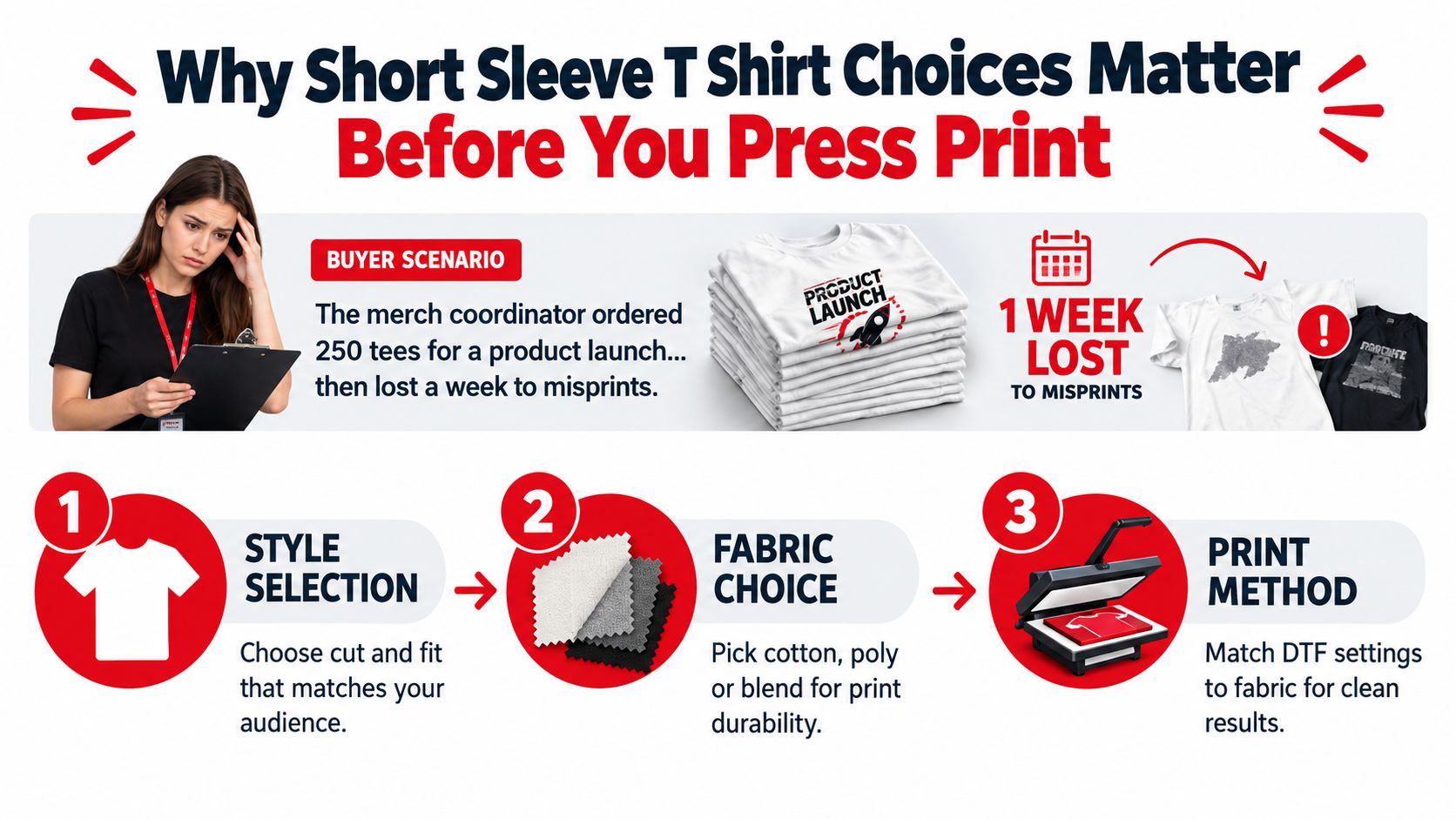
The three checks that prevent expensive rework
Style: Confirm neckline, shoulder construction, seams, panels, placket, and usable chest space.
Fabric: Record fiber content, fabric weight, surface texture, and moisture-control features.
Fit: Review chest width, body length, sleeve length, sleeve opening, and unisex or gender-specific specifications.
Order a physical sample when placement matters. A mockup cannot show a sleeve hem cutting into the print's balance, heathered yarn softening color, or a transfer crossing a seam. Wash-test the chosen blank and transfer together. The press only reveals decisions made earlier.
Short Sleeve T Shirt Styles and What Each One Signals
A neckline communicates audience and use case, but it also changes the print map. The table below treats each style as both a clothing choice and a production surface.
Style | Print-Area Behavior | Best Use Case |
|---|---|---|
Crew neck | Provides the most predictable full-chest canvas and a clean frame for centered graphics. | Broad merch drops, company apparel, clubs, and general event wear |
V-neck | Pushes the visual print zone lower and makes the upper center narrower. | Retail-leaning apparel and fashion-focused designs |
Scoop neck | Broadens the collar line, leaving less visible space above a tall graphic. | Soft lifestyle collections and relaxed fashion programs |
Henley | The placket interrupts centered artwork and creates a natural boundary through the chest. | Left-chest, sleeve, or heritage-inspired branding |
Raglan | Contrast panels and diagonal seams divide the garment, so artwork must avoid the seam intersection. | Sport programs, baseball-inspired merch, and event teams |
Performance cut | Stretch panels, shaped side seams, or dropped hems can distort tall artwork when the wearer moves. | Athletic events, active uniforms, and outdoor programs |
Choose the surface before the artwork
The crew neck remains the safest default when you need a repeatable full-front or center-chest print. It gives decorators a consistent reference from the collar and side seams, and it works across a wide audience without making the garment feel overly fashion-specific.
A V-neck can look sharper, but a center print needs more careful vertical placement. Keep the design low enough to clear the neckline without making it look like it's falling toward the stomach. For left-chest work, the sloping collar can make a normally balanced mark feel too close to the neck or too far from the centerline.
Scoop necks and Henleys need restraint. A scoop neck reduces the amount of visual canvas above a graphic, while a Henley can make a centered logo compete with the placket. Use simpler artwork or shift the decoration to the left chest, sleeve, or back.
Seams are part of the design brief
Raglan panels aren't just color accents. They create hard transitions that can make a transfer look crooked even when the artwork is perfectly square. Keep important text, faces, and fine outlines away from the seam path.
Performance cuts demand the same caution. Stretch fabric and dropped hems may cause a tall design to look compressed when the shirt is worn, particularly if the artwork spans a shaped torso. For a western or ranch-oriented visual reference, the Cowboy and Cowgirl apparel graphic illustrates why garment proportions matter when artwork carries a strong silhouette.
A heavyweight hoodie such as the RXB Marlboro Rodeo Hoodie uses an 8.5 oz./yd² 70/30 ring-spun cotton/polyester fleece blend with a 100% cotton face, a generous fit, and a three-dimensional velvety chest logo. It isn't a short sleeve tee, but its construction is a useful reminder that fabric face, garment weight, and fit all affect how decoration reads.
Short Sleeve T Shirt Fabrics and How They Wear
A shirt can feel excellent in the hand and still create rework at the press. Fiber content, fabric weight, and knit surface control how the blank moves under heat, how the DTF film sits, and whether the finished graphic looks integrated or pasted on. Choose the blank with the decoration method already in mind.
Fabric | Hand-Feel & Weight | Moisture Behavior | DTF Ink Uptake |
|---|---|---|---|
100% cotton | Soft, absorbent, and available from light to substantial weights. Ringspun versions usually offer a smoother print surface. | Holds moisture longer than polyester and may shrink if it hasn't been pre-shrunk. | Usually provides even adhesion and a soft, matte-looking result when properly pressed. |
100% polyester | Smooth, resilient, and commonly used in lightweight performance jerseys. | Wicks and dries quickly, making it practical for active use. | Can produce bright color, but temperature and peel timing need tighter control. |
Cotton-poly blend | Balances cotton softness with polyester resilience and faster drying. | More balanced than either fiber alone, depending on the blend ratio and knit. | A practical high-volume choice, but test the blend because surface behavior varies. |
Tri-blend | Light drape, heathered appearance, and a soft hand from cotton, polyester, and rayon or modal-type fibers. | Comfortable for lifestyle wear, though the lighter knit may not feel substantial. | Texture and stretch can make adhesion and color saturation less predictable. |
Recycled polyester and cotton blends | Similar general handling to comparable virgin-fiber blends, with possible batch variation. | Depends on the blend and knit structure rather than the recycled label alone. | Often prints similarly to virgin fibers, but approve a sample from the actual production batch. |
Cotton gives you the easiest starting point
For general merch, ringspun cotton is the forgiving choice. Its smoother surface supports clean transfer placement, and its absorbent hand keeps a DTF graphic from feeling overly slick. The tradeoff is moisture retention and possible dimensional change when the shirt is not pre-shrunk or receives aggressive care.
Cotton also gives a graphic a stable, familiar appearance across common short sleeve fits. Confirm the garment's shrinkage before approving a large front print. A slight change in body dimensions can alter the apparent placement after washing, especially on a fitted blank.
Polyester handles sweat better. Product specifications and textile references commonly describe it as wicking and quick-drying, which explains its use in performance tees instead of cotton alone. It can make colors appear vivid, but dye migration and heat sensitivity can turn careless pressing into a visible defect.
Production rule: Do not copy cotton settings onto polyester. Confirm the blank's fiber content, then validate temperature, dwell, pressure, and peel timing on a sample.
Blends are the practical middle ground
A cotton-poly blend suits large merch programs that need comfort, durability, and faster drying in one blank. It will not behave exactly like either parent fiber, so treat every supplier's version as a separate production test. The blend ratio, knit density, and surface finish can all change adhesion and wash results.
Tri-blends work well when softness, light drape, and a vintage appearance matter more than maximum opacity. Their lighter, textured surfaces can make a transfer feel less uniform, particularly across heathered areas. Recycled options require the same technical review as virgin fabrics. The recycled content alone doesn't tell you how the shirt will press. Knit structure, surface finish, fabric mass, and batch consistency matter more.
Fabric weight changes the final look even when fiber content stays constant. A 5.0 to 5.75 oz short sleeve tee in polyester or poly-cotton jersey is typically selected when sweat dispersion, quicker drying, and lower cling matter more than cotton's softer absorbent feel, as described in performance tee and short specifications. Lighter fabric drapes around a transfer and can expose uneven edges, while heavier fabric gives large graphics a firmer foundation and a more structured appearance.
Short Sleeve T Shirt Fit and Sleeve Geometry
A size label isn't enough for production. Chest width, body length, sleeve length, and sleeve opening determine whether a printed shirt looks intentional after it leaves the press.
Short sleeve measurements vary across styles and sizes. One market listing shows a small adult tee with a sleeve length around 12.8 inches and a body length near 26.8 inches in its product measurements. A separate measurement guide lists short-sleeve lengths around 20.5 to 25 cm across S to 4XL, while another standard tee table shows sleeve measurements ranging from 38.42 to 63.50 cm. Those figures aren't interchangeable sizing systems. They prove that “short sleeve” describes a category, not a fixed arm position.
Read the cut through the sleeve
Fit | Chest Width Range | Sleeve Length Range | Print Area Impact |
|---|---|---|---|
Slim | Narrower body with a closer sleeve opening. | Usually a closer, more fitted arm position. | Compresses left-chest space and can push artwork toward the arm seam. |
Classic | Balanced body and sleeve proportions. | Moderate coverage with predictable placement. | The safest choice for repeatable logos across a size run. |
Relaxed | More room through chest and torso. | Often a more open sleeve with easier arm movement. | Provides comfortable decoration space without the exaggerated scale of oversized cuts. |
Oversized | Broad chest and dropped shoulder construction. | Sleeve can extend farther down the upper arm. | Allows larger front art, but standard logo dimensions may look undersized. |
Sleeve geometry changes the way a left-chest print is perceived. A narrow sleeve opening brings the arm seam closer to the decoration, while a dropped shoulder can make the same print look farther toward the side. A tall graphic also moves vertically when body length changes, so centering by collar distance alone isn't enough.
Request the measurements that expose fit risk
Ask suppliers for sleeve-cap height, shoulder-seam drop, and body length before placing a DTF order. Sleeve-cap height affects how quickly the sleeve rises from the shoulder. Shoulder-seam drop changes the apparent width of the upper torso. Body length determines whether a full-front graphic sits at the chest or drifts toward the midsection.
Unisex and women's specifications remap the print zone differently. A women's cut may narrow through the waist and reshape the armhole, while a unisex cut usually maintains a straighter body. Don't grade artwork from one sample size without checking the full size chart.
Placement check: Lay the smallest and largest garment flat, mark the intended print boundaries, and photograph both before production. If the logo only works on the middle size, the placement plan isn't finished.
The short sleeve measurement guide reinforces the point with product tables that show meaningful variation in sleeve dimensions across sizes and styles. Fit precision prevents complaints that a shirt is “the wrong size” when the issue is a sleeve hem, shoulder seam, or print position that doesn't match the wearer's proportions.
DTF Printing Implications Across Styles and Fabrics
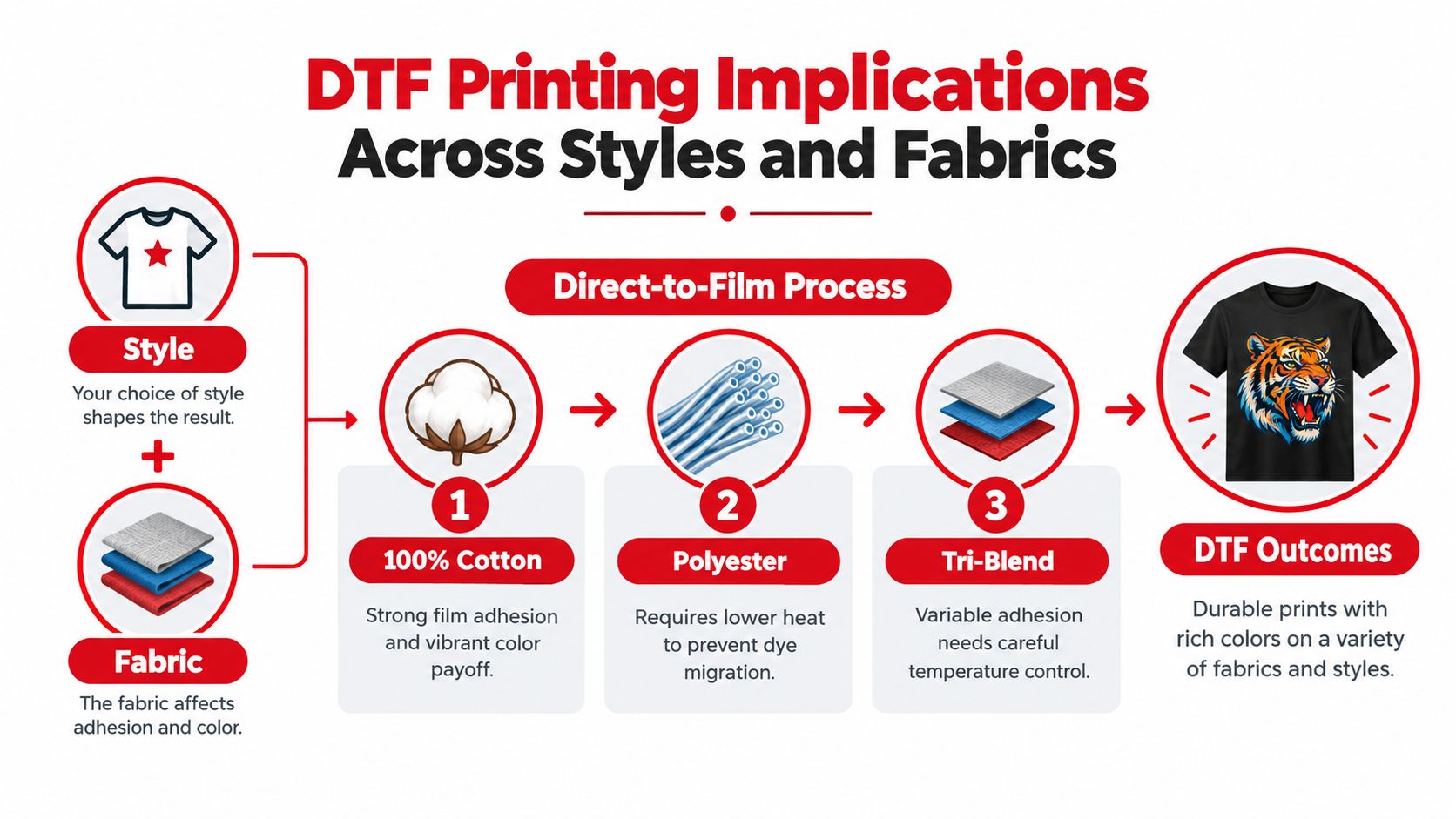
DTF works well across many short sleeve t shirt constructions, but it isn't a universal setting. Cotton, polyester, blends, and textured tri-blends each present a different surface, and the correct press profile depends on the actual blank in front of you.
Cotton usually gives strong film contact and dependable color payoff. Ringspun cotton with a smooth face is particularly straightforward because the transfer has fewer surface irregularities to bridge. Polyester needs more caution. High heat can encourage dye migration, and the wrong dwell or peel sequence can leave weak adhesion, a changed surface sheen, or unwanted color contamination.
Tri-blends combine several variables at once. Rayon contributes drape, polyester changes heat response, and the knit may be thin or visibly heathered. The transfer can look softer, but saturation and edge definition may vary. An adhesion promoter can help on some performance knits, but don't apply it automatically. Ringspun cotton usually doesn't need that extra step, and unnecessary chemistry can change hand-feel.
Match artwork size to the garment geometry
A standard 4-inch left-chest mark can crowd a narrow sleeve opening or sit too close to the arm seam on a slim cut. Drop to approximately 3.5 inches when the garment's chest and sleeve geometry leave insufficient clearance. That isn't a universal rule for every brand, but it is a sensible starting point when the decoration looks cramped on the smallest size.
Full-front designs need a different review. Check the smallest garment first, then compare the largest. Oversized blanks may need a larger graphic for visual balance, while slim blanks may need a narrower design to preserve side clearance.
Use the supplier's recommended process as the starting point, not a guarantee. Polyester often requires a lower heat approach than cotton to reduce dye migration, and hot-peel timing can change whether the finished surface reads more matte or glossy. If the first press looks acceptable but the film lifts at the edge, the issue may be pressure, dwell, cooling, or surface contamination rather than artwork.
A short tutorial can help teams review the mechanics before running samples:
For a visual reference on a DTF production setup, review this DTF printing example alongside the actual garment sample.
Run the production checks in order
Test print: Press the final artwork on the exact blank, color, and size that will represent the order.
Wash test: Wash the sample according to the intended care instructions and inspect film edges, cracking, color migration, and garment shrinkage.
Cure verify: Confirm that the transfer has bonded correctly and that the press profile is repeatable before releasing the bulk run.
A sample wash won't eliminate every production variable, but skipping it guarantees that the first real wash happens in the customer's hands.
Sustainability, Durability, and Cost Tradeoffs
The cheapest cotton tee isn't automatically the worst environmental choice, and a recycled or polyester-heavy tee isn't automatically the most durable. The right comparison is construction, expected wear, print life, and use case together.
Lifecycle research places cotton T-shirt carbon footprints in a broad range of around 2 to 7 kg CO2-eq per item, with scenario estimates ranging from 1.51 to 7.68 kg CO2-eq depending on production choices and overproduction assumptions in the 2025 lifecycle analysis. That spread is large enough to reject simple fiber-based arguments. Farming, spinning, dyeing, manufacturing, transport, inventory decisions, and garment life all influence the result.
Durability also complicates the usual cotton-versus-synthetic story. A 2025 consumer durability study found that four of the top ten most durable shirts were 100% cotton, challenging the assumption that synthetic or blended fabrics automatically last longer. A shirt that stays wearable and keeps its print presentable can be a better purchase than a lower-impact blank that gets discarded quickly.
Judge sustainability by the entire program
Fabric Tier | Unit Cost | Wash Cycles to Visible Fade | Carbon Footprint | Cost Per Wear |
|---|---|---|---|---|
Conventional cotton baseline | Varies by blank and order | Must be verified through a sample wash | Scenario-dependent | Depends on actual use life |
Recycled cotton or polyester blend | May carry a premium | Verify the specific construction and print system | Can vary with production inputs and recycled content | Improves when the garment stays in rotation |
Tri-blend | Often priced for softness and lighter drape | Test for surface wear, print edge lift, and color change | Depends on fiber mix and manufacturing scenario | Can justify its tier when hand-feel drives repeat wear |
This table is a decision framework, not a set of invented price or wash-life claims. Suppliers should provide actual unit pricing, care guidance, and test information for the chosen blank.
Dye processes marketed as water-saving or low-water can change the surface hand, shade consistency, and transfer response. Ask for a physical sample from the production color. The sustainability label doesn't replace a press test, and a successful sample from one color doesn't guarantee identical behavior on another.
Choose the blank that will be worn repeatedly in its intended environment. Durability is part of sustainability, and print durability is part of garment durability.
Choosing the Right Short Sleeve T Shirt for Your Order
Start with the use case, then narrow the choice by fabric and fit.
Workwear needs consistency
For uniform-style workwear, choose a mid-weight cotton crew in a classic fit. The crew gives you a repeatable chest reference, while the classic cut leaves enough room for movement without making the logo look lost. Cotton generally accepts DTF with a soft, matte hand and tolerates a conventional hot-peel workflow, but confirm shrinkage and wash behavior with a sample before bulk production.
For staff shirts, company uniforms, and ranch operations, prioritize size consistency over a fashion silhouette. Request the complete size chart and compare sleeve length, body length, and chest width across the run. A logo that clears the sleeve seam on a medium may crowd it on a smaller slim cut.
Events need sweat control
Trade shows, outdoor events, and athletic programs put more stress on the garment. A lightweight poly-blend performance tee or relaxed crew handles sweat and repeated wear more comfortably than a highly absorbent cotton option. Polyester needs a lower-heat strategy and careful dwell control, while a blend should receive a test strike to confirm adhesion and color stability.
Keep event artwork bold and uncomplicated. Avoid placing fine details across raglan seams, stretch panels, or a narrow sleeve area. Test the actual shirt color because dark polyester can introduce dye migration that isn't visible on a white sample.
Limited merch drops sell through feel
For a limited release, heavyweight ringspun cotton or a soft tri-blend in a relaxed or oversized fit can create a stronger tactile impression. Ringspun cotton gives a stable print surface and a substantial body. Tri-blends offer a softer drape and vintage character, but their lighter or textured surfaces require test strikes to confirm saturation and edge behavior.
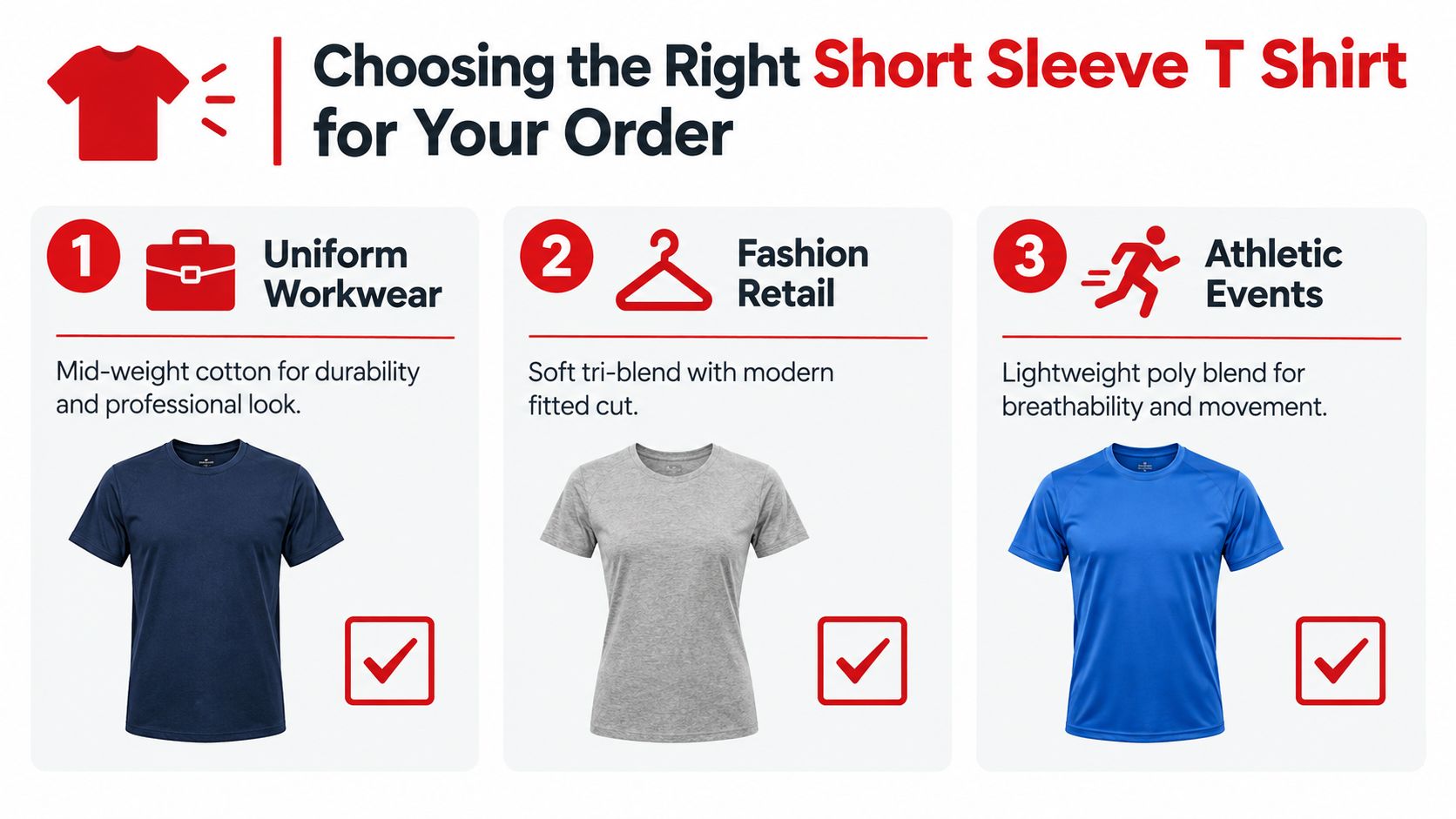
Use this garment selection visual as a prompt for your supplier conversation, then confirm the details against the exact blank.
The final rule is simple: pick the fit your audience will wear, match the fabric to the environment, then approve print parameters on the garment before production. Wear X Apparel, LLC provides garment selection support and DTF printing for custom tees, hoodies, and other apparel, with workflows covering artwork intake, print application, and quality checks. Visit Wear X Apparel, LLC to discuss a single custom item or a batch order and reduce avoidable garment and print rework.
Comments