


Custom Shirt Fast Delivery: How to Get Orders Quickly

You need 50 custom shirts for a trade show in nine days. Three printers advertise rush delivery, but one quotes production time, another quotes transit time, and the third promises that your order will arrive “fast.” You're left wondering whether the deadline is today, after artwork approval, or when the printer finally receives the blank garments.
That confusion causes more late custom apparel orders than carrier speed alone. Custom shirt fast delivery depends on three connected bottlenecks: artwork approval, blank inventory, and production-to-carrier handoff. Shipping is only the final part of the journey.
Table of Contents
Why Custom Shirt Orders Get Delayed - The three delays that matter most
Understanding the Two Clocks of Custom Apparel Fulfillment - The production clock - The transit clock
Preparing Artwork to Eliminate Proofing Bottlenecks - What causes a proof rejection - A first-pass submission checklist
Selecting Shipping Upgrades That Actually Save Time - Match the service to the handoff - A practical decision test
Building Your Fast Delivery Action Plan - Five levers that shorten the path
Why Custom Shirt Orders Get Delayed
A buyer often sees “rush shipping” and assumes the shirts will be made immediately. In practice, the package can't enter the carrier network until the design is approved, the garments are available, and the production queue has room. If any one of those steps stalls, paying for a faster service level won't recover the lost time.
The three delays that matter most
Artwork creates the first hidden delay. A logo copied from a website may look acceptable on a screen but fail print review because it's pixelated, saved in the wrong color mode, or missing usable fonts. A proof can also require several rounds of revision when the print size, placement, or colors don't match the buyer's expectations.
Blank garment inventory creates the second. A printer may list a shirt style online while the requested sizes or colors are unavailable at its distributor. Substituting a different blank requires approval, and waiting for that approval can push production behind schedule. Special-order garments create an even longer path because the printer must source them before decoration begins.
Capacity creates the third. A shop can advertise rush services and still have a full production queue. The stated turnaround may apply only after artwork approval and blank receipt, not from the moment you submit the order. Ask whether the quoted time is a production commitment, a shipping estimate, or a combined arrival date.
Practical rule: Ask the printer to identify the exact date your order will be printed, packed, and handed to the carrier. “Rush” isn't a timeline until those milestones are written down.
The distinction matters because apparel expectations have tightened. One industry guide reports that more than 50% of consumers expect a standard online order within two days, while 80% of apparel merchants say customers expect delivery within two to three days. The same guide says 75% of surveyed apparel retailers already ship in two days or faster, making speed a competitive standard rather than an unusual upgrade. Industry delivery expectations for apparel explain why event buyers increasingly compare custom orders with mainstream ecommerce.
Understanding the Two Clocks of Custom Apparel Fulfillment
A shirt order for next week can look simple at checkout and still miss the event date. The delay usually sits on one of two clocks. The production clock runs from order review through packing. The transit clock starts only when the carrier receives the parcel. Combining them into one estimate conceals the actual bottleneck.
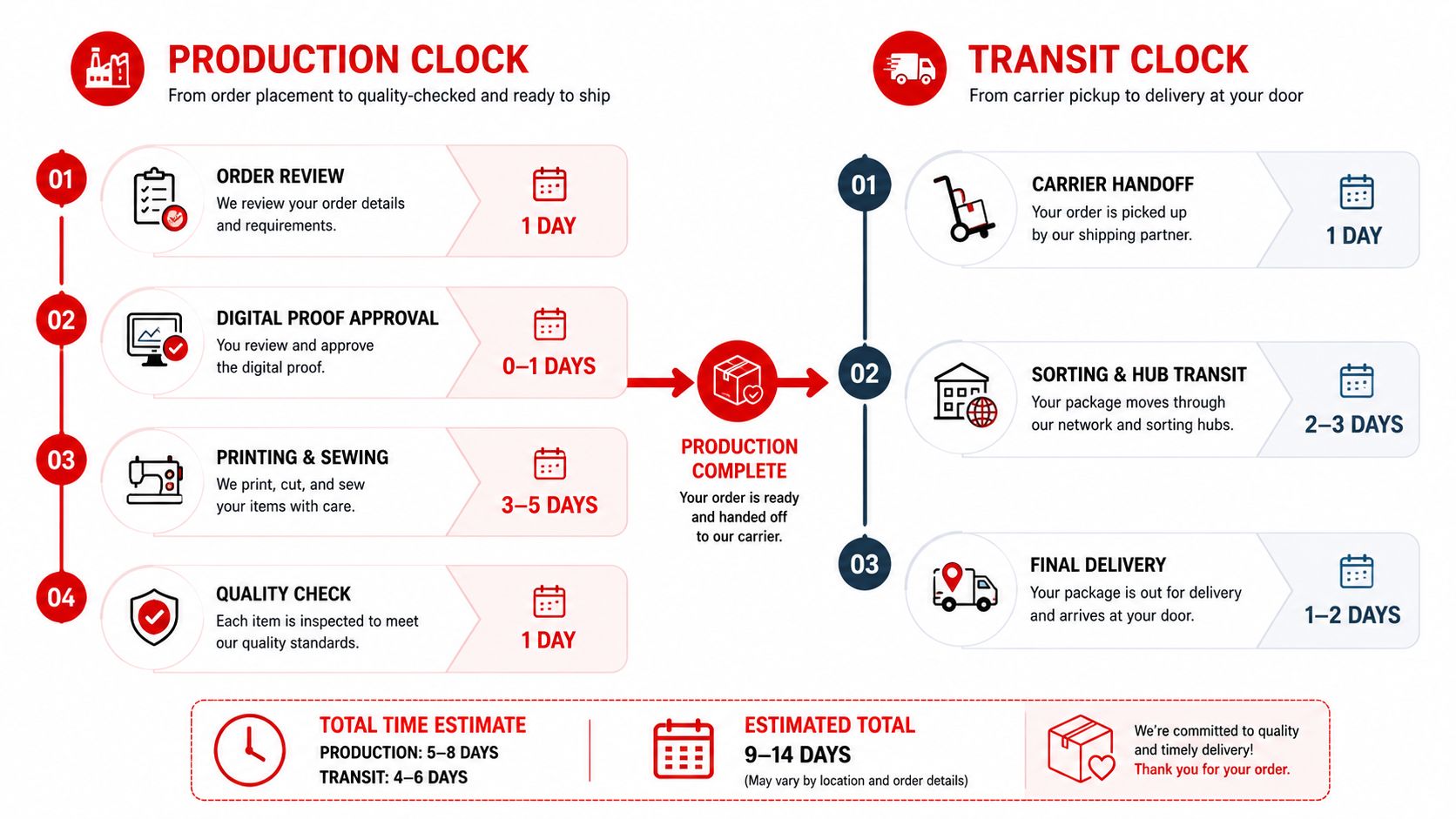
The production clock
Production normally includes artwork review, proof approval, blank-garment confirmation, decoration, quality control, and packing. A printer may complete the initial review in 1 to 2 business days, while blank sourcing can take 0 to 3 days depending on stock. For small runs, DTF production is commonly cited at 3 to 7 business days, and the broader fast-turn custom apparel benchmark is often 7 to 14 business days. Custom apparel turnaround guidance notes that print-ready artwork and available blanks support the fastest schedules.
The shop may change the order of some tasks, but each stage still has to clear:
Order review and proofing: The printer checks dimensions, placement, colors, and file suitability.
Blank confirmation: The requested garment, sizes, and colors are reserved or sourced.
Printing and application: The shop creates the transfer or print and applies it to each garment.
Quality control and packing: Staff inspect the decoration, count the pieces, and prepare the shipment.
A standard order can approach 10 business days when these stages run in sequence and approvals remain unanswered. An aggressive workflow can compress the path to 4 to 5 business days only if artwork is ready, blanks are confirmed, the selected method fits the order, and the buyer responds immediately. That is an operating scenario, not a promise.
The transit clock
Carrier transit begins after production, not at checkout. It may take 1 to 5 days, based on service level, destination, cutoff time, and weekend handling. A two-day service does not recover time lost when a printer finishes on Friday after the pickup cutoff.
The logistics context reinforces the separation. One source reports that average U.S. shipping speed ranges from 1 to 5 business days, compared with an 8-day average about 15 years earlier. The same source cites a ShipStation benchmark in which top-performing apparel brands process 92% of orders within 4 hours, compared with an industry average of 26 hours. Shipping speed and order processing context illustrates why the production-to-carrier handoff deserves its own deadline.
Heavier garments require their own check. The catalog description for the RXB Marlboro Rodeo Hoodie lists an 8.5 oz./yd² ring-spun cotton and polyester fleece blend, a fleece-lined hood, reinforced seams, and a three-dimensional velvety chest logo. Those specifications do not confirm inventory or delivery speed. The printer still needs to verify stock and choose an application process that suits the construction. For a visual reference, see an on-demand production timeline example from Wear X Apparel.
Preparing Artwork to Eliminate Proofing Bottlenecks
The fastest buyer isn't always the one who pays for the fastest shipping. It's often the buyer who submits artwork that passes review immediately.
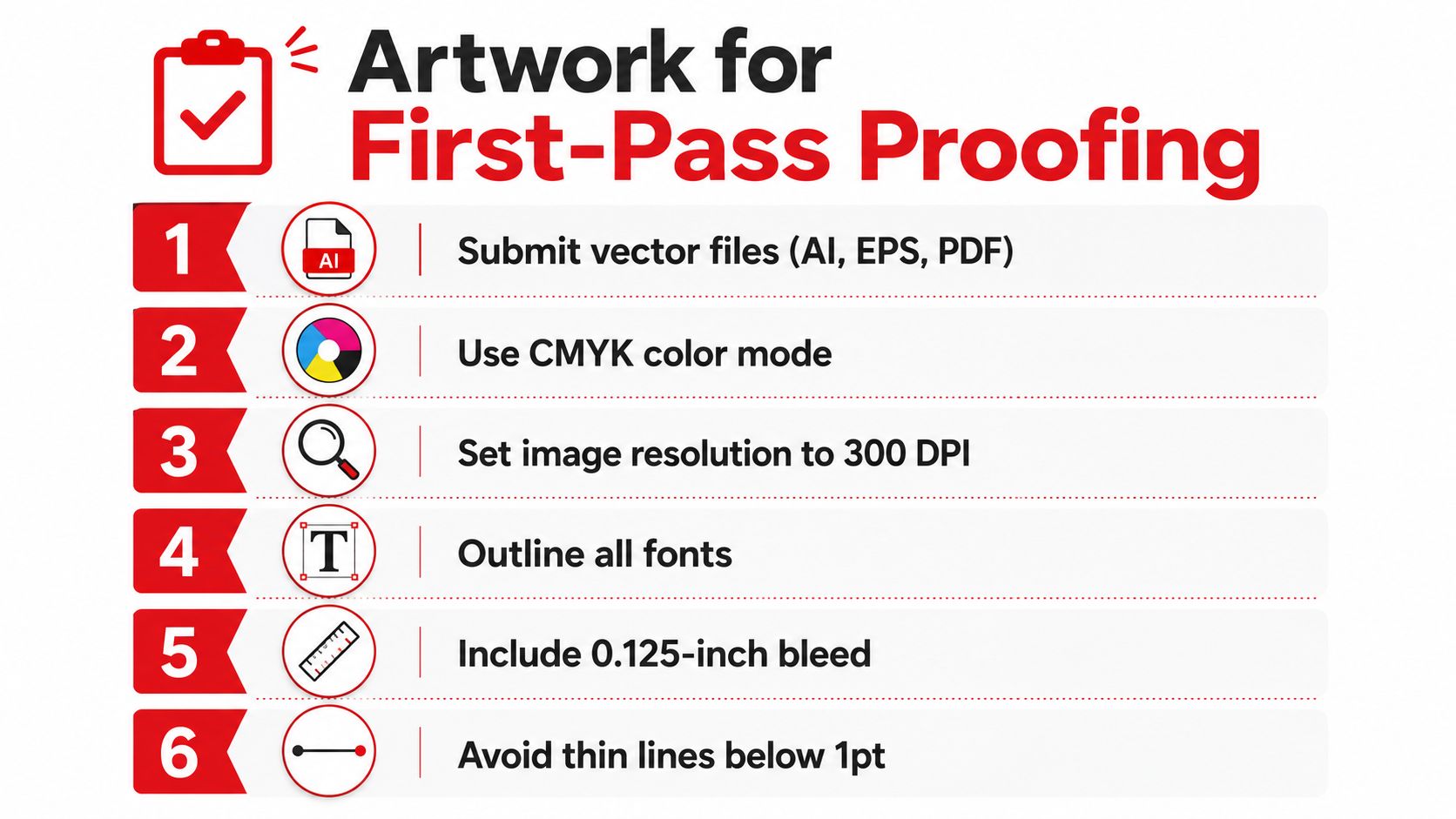
For screen printing, send vector artwork such as AI, EPS, or SVG files whenever possible. Vector files preserve clean edges when the printer changes the design size. For DTF, submit a high-resolution PNG or PSD at 300 DPI minimum, with a transparent background when the design requires one. Use CMYK values or Pantone references instead of relying only on RGB color, because screen colors and printed results don't translate perfectly between color systems.
What causes a proof rejection
A logo downloaded from a website is a common problem. Web images are frequently too small for a large chest or back print, and enlarging them exposes jagged edges. Text can also change appearance if the printer doesn't have the original font, so convert all fonts to outlines or include the font files as requested by the shop.
Gradients create another issue for traditional screen printing because the process may require separations or a simplified treatment. Thin lines and tiny details can disappear on fabric even when they look sharp on a monitor. If speed matters more than visual complexity, simplify the artwork before submission rather than waiting for the printer to request revisions.
A first-pass submission checklist
Confirm print dimensions: Match the file dimensions to the intended print area.
Verify color requirements: Make sure the number and type of colors fit the chosen production method.
Outline fonts: Convert every font to outlines so text doesn't reflow.
Remove unwanted backgrounds: Use transparency where the design needs to sit directly on the garment.
Check small details: Increase undersized elements and avoid fragile lines.
Name files clearly: Identify the garment color, print location, and version.
Some printers offer a print-ready art fast-track when files meet their published requirements. That can remove artwork from a general proofing queue, but it doesn't remove the need for the printer to verify placement and production suitability. A reference image for preparing a design can be found in this custom apparel artwork example.
Choosing the Fastest Production Method for Your Order
The fastest method depends on the order's bottleneck, not the label attached to the decoration. DTF is often the practical choice for a rush order with detailed artwork because it avoids screen setup and digitizing. That reduces preparation work when the design has several colors, fine details, or a small quantity. Review a DTF apparel example to see the type of artwork this process can handle.
Screen printing can be faster for larger repeatable orders, especially with limited colors and approved artwork. It still requires setup and color separation, so that preparation can outweigh its production efficiency when the quantity is small or the event is close. HTV suits names, numbers, and simple one-color graphics. Detailed multi-color artwork takes more cutting, weeding, and layering, which can turn a seemingly simple rush order into a slow one.
Method | Rush Turnaround | Best For | Cost Per Unit (50 pcs) | Design Limits |
|---|---|---|---|---|
DTF | Depends on shop capacity, blank availability, and order conditions | Detailed graphics, small batches, mixed garments | Request a quote | Handles detailed, full-color artwork, with a potentially heavier feel across large solid areas |
Screen printing | Varies by shop capacity, setup, and quantity | Larger runs with repeatable artwork | Request a quote | Best suited to separated colors and stable designs |
HTV | Varies with design complexity and garment count | Names, numbers, and simple graphics | Request a quote | Layering and weeding become slower for detailed multi-color designs |
Cost per unit depends on blank selection, quantity, print locations, artwork, and rush handling, so request a quote based on the actual order rather than relying on a generic price.
A 24-piece order needed in three days is a DTF candidate only if the printer has the required blanks and can schedule application immediately. A 200-piece order with a one-week window may suit screen printing if the artwork is approved and production capacity is confirmed. Neither method is automatically faster. The shortest path is the one that matches the artwork, blank inventory, and queue.
Ask for three confirmations before approving production: are the blanks physically available, is the artwork production-ready, and when will the finished shirts leave the shop? Those answers reveal whether decoration or inventory is the primary constraint. A fast method cannot recover time lost waiting for garments or approval.
Selecting Shipping Upgrades That Actually Save Time
Shipping upgrades help only after production is complete. A printer can finish shirts on Wednesday, but if the order misses the carrier pickup, the parcel may not move until Thursday. That single cutoff issue can matter more than the difference between two-day and overnight service.
Match the service to the handoff
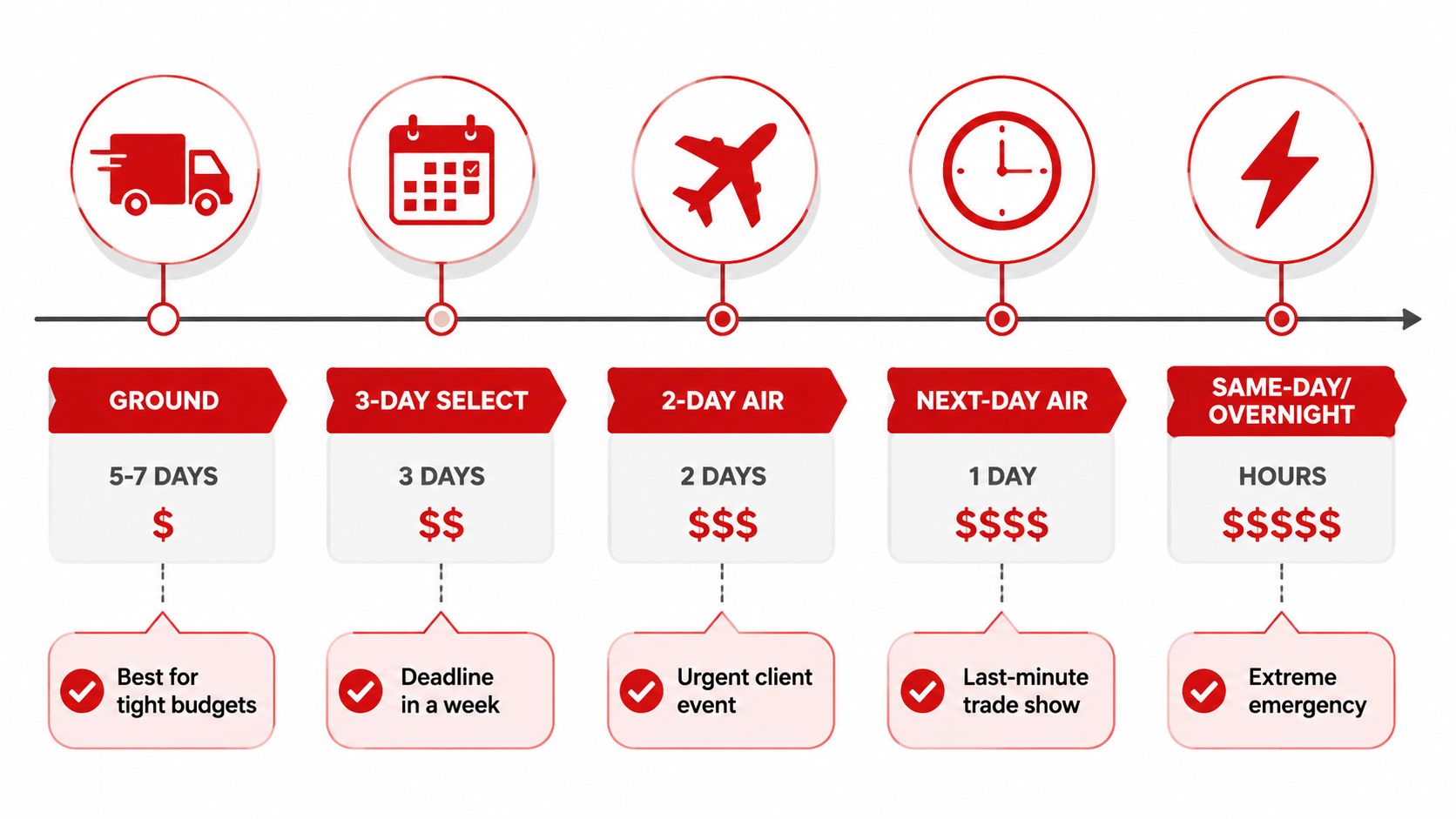
Ground service works when the event has comfortable lead time and the destination is within the carrier's normal network. Three-day service fits a deadline that leaves room for production and a limited transit window. Two-day air is often appropriate when the order will be handed over early enough to travel before the event. Next-day air makes sense only when the printer guarantees same-day handoff and the destination accepts the delivery window.
The advertised transit time doesn't necessarily include weekends, pickup cutoffs, weather interruptions, or residential delivery timing. Commercial addresses may have more predictable receiving hours, while residential deliveries can arrive later in the day. Ask the printer whether the quoted arrival date is based on a carrier estimate or a tracking-backed commitment.
A practical decision test
Suppose production finishes by noon on Wednesday and the event is Saturday. Two-day air may deliver Friday, while overnight service may add cost without improving the usable outcome if both options arrive before the event. The right choice depends on the actual handoff date, the carrier's service map, and whether Friday delivery gives you enough time to inspect the shirts.
For large orders, ask about freight options rather than assuming every carton should move as an individual parcel. LTL or expedited ground may be more suitable for a high-volume shipment, but the printer should confirm handling, appointment requirements, and delivery timing.
Will-call pickup can remove the final-mile segment when the printer or carrier supports it. You can also ask whether a carrier hub pickup is available, but don't rely on an estimated date until tracking shows that the shipment has been accepted and is moving. An overnight label attached to an unfinished order is not a delivery solution.
Building Your Fast Delivery Action Plan
Work backward from the event, not forward from the order form. Start with the arrival date, subtract the carrier transit window, subtract production time, and reserve a buffer for artwork approval. The remaining date is the latest practical order deadline, not the date you should aim for.
Five levers that shorten the path
Simplify the design: Reduce unnecessary detail if it creates proofing questions or complicates the decoration method.
Choose confirmed blanks: Select garments the printer has physically confirmed, rather than relying on an online catalog listing.
Approve immediately: Treat the proof as a production trigger. Delayed approval moves every later stage.
Use a rapid method: Consider DTF for detailed small or medium orders when the shop confirms its schedule.
Buy the right transit service: Select shipping after you know the production completion date, not before.
For a 30-piece order needed in five business days, the timeline might look like this:
Day one morning: Submit print-ready artwork, sizes, colors, garment choice, and delivery address.
Day one afternoon: Receive and approve the proof.
Day two: Printer confirms blanks and schedules production.
Days three and four: DTF application, inspection, counting, and packing.
Day four: Carrier handoff before the stated cutoff.
Day five: Delivery, with enough time to inspect the order before the event if the service performs as expected.
That schedule is possible only when the printer confirms each dependency. Before placing the order, ask: What is your actual daily production cutoff? Are the blanks physically available? Is decoration performed in-house? Who handles artwork revisions? When will the tracking number show carrier acceptance? What happens if one size is unavailable?
The industry benchmark for small to medium fast-turn apparel remains broader than a five-day scenario, so treat this plan as an aggressive rush workflow rather than a standard promise. For larger or more complex programs, lead times can expand to 15 to 20 working days for simple custom garments, while complex made-to-order programs may run 6 to 20 weeks. Sampling and approvals can add 7 to 14 days of contingency, especially on first-time programs. Custom apparel lead-time benchmarks reinforce why a repeat order with approved specifications is easier to schedule than a new, highly customized production run.
Wear X Apparel, LLC provides garment selection and DTF production services for custom T-shirts, hoodies, and batch orders, with artwork intake, print application, quality checks, and fulfillment support. If your event date is close, share the quantity, sizes, artwork, garment preferences, and delivery deadline through Wear X Apparel, LLC so the team can help identify the bottleneck before you pay for shipping.
Comments