


Custom T Shirts Cost Explained and How to Save

A single custom T-shirt commonly costs about $8 to $15 for DTG or print-on-demand production, while a no-minimum order can start at $15.99 or more all-in. At 50 or more shirts, the price may move toward $6 to $10 each, and high-volume simple screen printing can fall below $5 per shirt, with blank choice and quantity driving the cost most.
You may be getting quotes because one shirt design can produce very different totals. A local printer might recommend screen printing, an online service might quote DTG, and a DTF provider might price the same artwork for a mixed-size run. The shirts may look similar in a product photo, but the production recipe isn't the same.
Think of custom apparel like ordering a pizza. The base is the blank garment. The cooking method is the print process. Artwork complexity adds toppings, and delivery or rush service adds fulfillment costs. Change any one of those parts and the final bill changes.
Table of Contents
Introduction Why Custom T Shirt Prices Vary So Much - The same design can produce different bills - What you'll learn from the price recipe
What Makes Up the Cost of a Custom T Shirt - Start with the blank garment - Add the print method - Account for artwork complexity - Include fulfillment and finishing
How Print Method and Artwork Change Your Price - DTF for flexible small runs - DTG for direct digital artwork - Screen printing for scale and simple art
Real Price Tiers and Per Unit Examples by Quantity - How the math changes
The Hidden Costs Behind Small Runs and No Minimum Orders - Where small-order surprises appear
Smart Ways to Lower Your Custom T Shirt Cost Without Losing Quality - Match the savings tactic to the order
Introduction Why Custom T Shirt Prices Vary So Much
Suppose you need shirts for a small event. You send the same logo to three vendors and receive three prices. One quote looks reasonable until shipping appears. Another has a lower shirt price but adds setup charges. The third costs more per piece but includes full-color artwork and individual fulfillment.
That difference doesn't necessarily mean one printer is overcharging. Custom T-shirt cost is a tiered outcome, not a universal price tag. The blank shirt, decoration method, order quantity, print locations, artwork preparation, and fulfillment all affect what you pay. Pricing guides consistently identify the garment, method, customization, and order size as the main variables in the calculation, as outlined in this custom shirt pricing breakdown.
The same design can produce different bills
A detailed illustration may be practical with a digital process because it doesn't require a separate screen for every color. A simple one-color logo may cost less through screen printing when you're ordering enough pieces to spread setup work across the run.
The blank also matters. A lightweight basic cotton shirt and a heavier premium garment serve different purposes and carry different base costs. If you're printing workwear, team apparel, promotional pieces, or retail merchandise, choosing the cheapest blank can create fit and durability problems that cost more later through reprints.
What you'll learn from the price recipe
The useful question isn't just, “How much does a custom T-shirt cost?” Ask instead:
What garment am I buying?
Which method fits the artwork?
How many pieces will I order?
What fees are included in the quote?
What changes if I add another print location or choose a better blank?
Once you answer those questions, quotes become much easier to compare. You can estimate a realistic budget, identify avoidable charges, and decide whether DTF, DTG, or screen printing makes sense before approving production.
What Makes Up the Cost of a Custom T Shirt
A reliable quote usually has four cost buckets. Read it like a recipe, and you'll see why two shirts with similar artwork can have different prices.
Start with the blank garment
The blank is the shirt before decoration. Its price reflects fabric, weight, construction, brand, fit, and finishing details. A basic blank can keep the starting cost low, while a premium garment may add noticeably to the unit price.
Garment choice also affects print behavior. Cotton, blends, fleece, and performance fabrics may require different decoration settings or recommendations. A heavy hoodie, for example, isn't priced like a short-sleeve T-shirt because the garment itself contains more material and construction.
For a concrete example of how garment specifications affect the product, the RXB Marlboro Rodeo Hoodie is described as an 8.5 oz./yd² heavy-weight hoodie made from a 70/30 ring-spun cotton/polyester blend, with a fleece-lined hood and reinforced seam construction.
Add the print method
The decoration method determines how the artwork reaches the fabric.
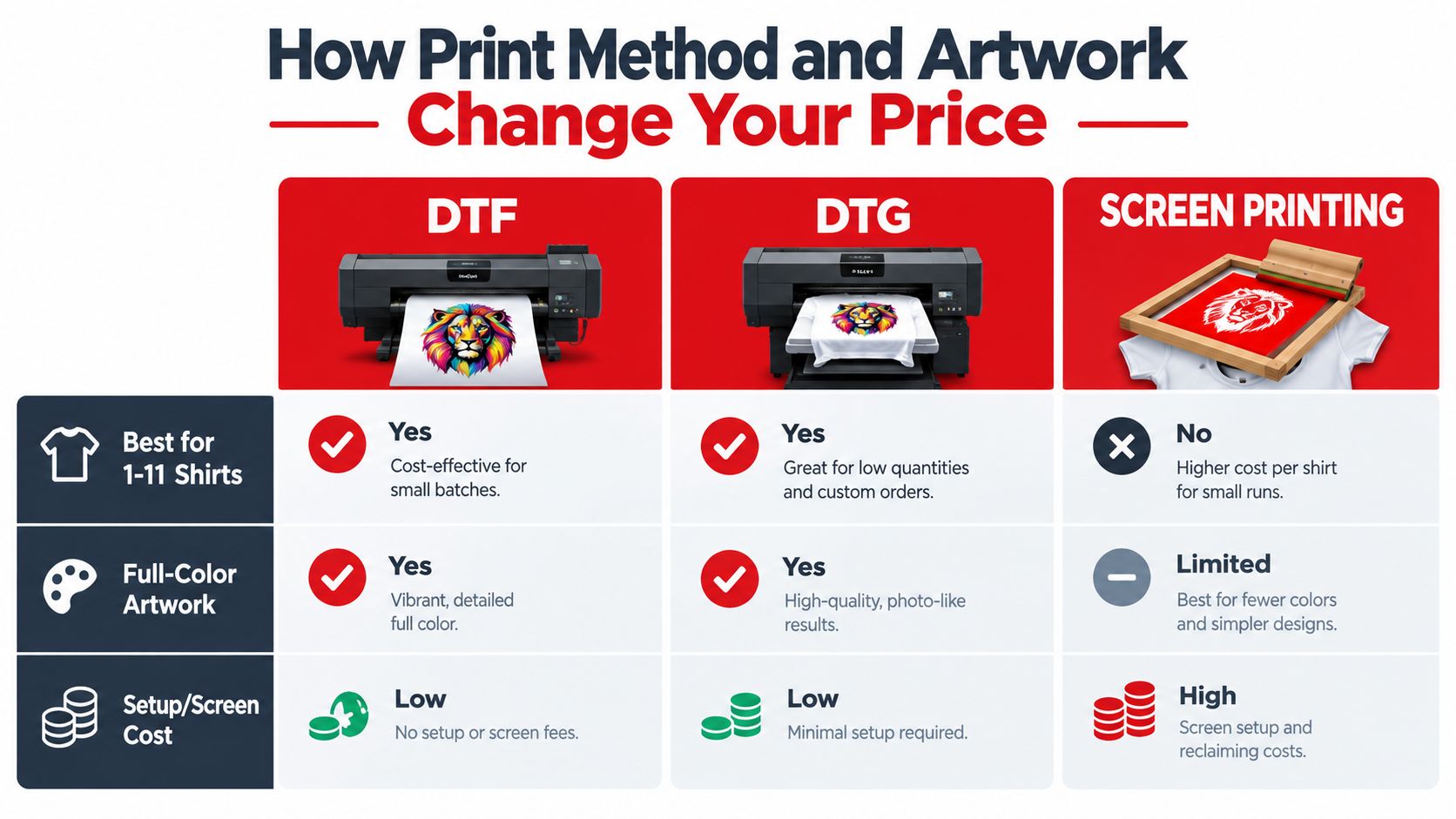
DTF applies a prepared transfer and works well for detailed, full-color designs, mixed sizes, and low-minimum orders.
DTG prints directly onto the garment and suits short runs where each shirt may contain complex artwork.
Screen printing uses screens, ink, and setup work. It becomes more economical as quantity rises, especially with simple artwork.
These methods don't just differ in appearance. They distribute labor and material costs differently.
Account for artwork complexity
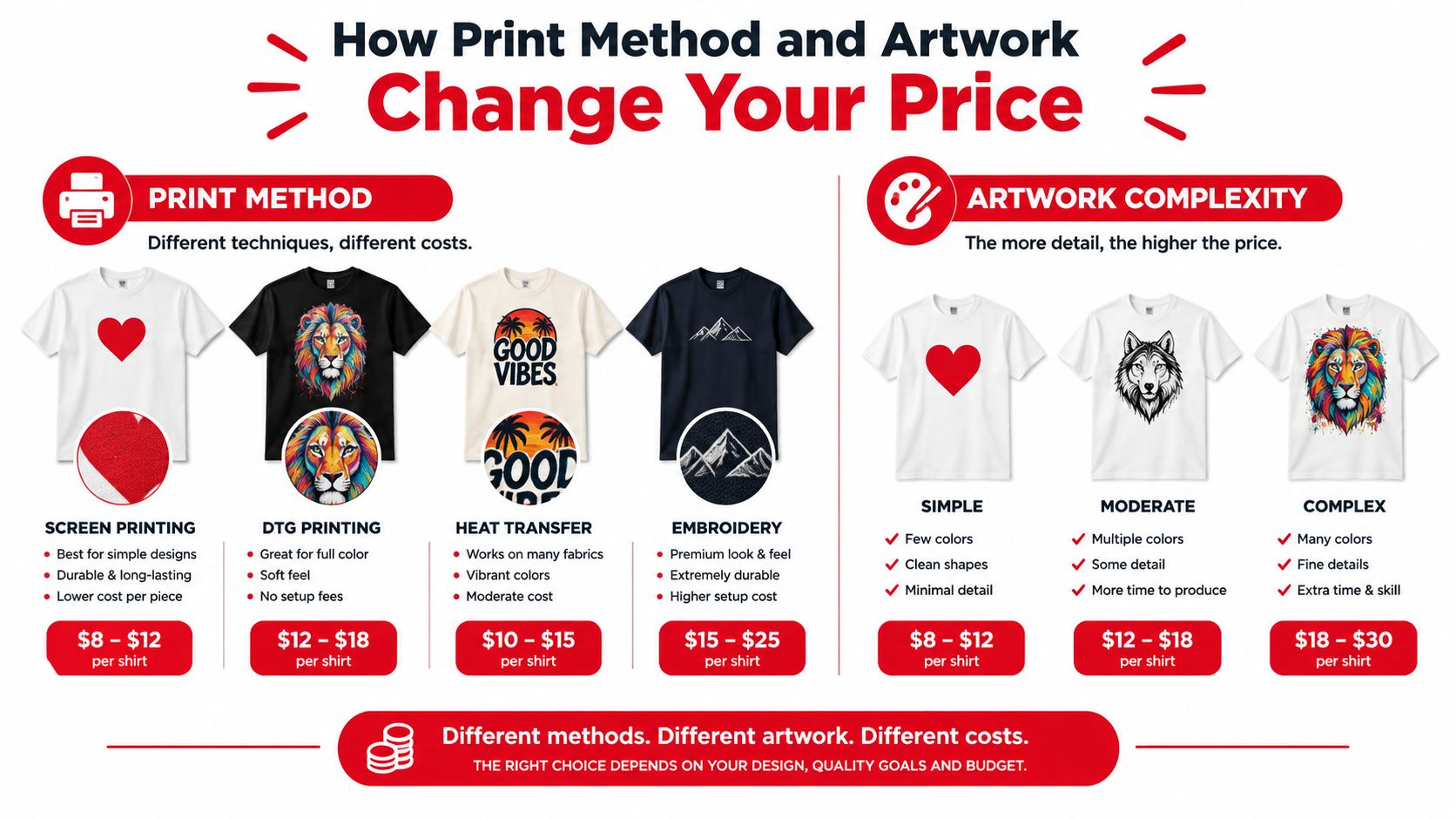
Artwork can change the price through color count, image detail, print size, and print locations. A one-color chest mark is simpler to prepare than a full-color illustration covering the front and back.
Screen printing makes this especially visible because each color can require its own screen and setup. Digital methods remove much of that screen-by-screen preparation, but they still require file checks, sizing, placement, and production handling.
Pricing rule: Quantity and blank choice often move the final unit cost more than the design alone. The design matters, but it works inside the production system you choose.
Include fulfillment and finishing
The final bucket includes work beyond printing. Artwork review, garment sorting, folding, packing, shipping, and rush handling may appear as separate charges or be included in a bundled price.
When comparing quotes, ask whether the number is production-only or all-in. A low per-shirt figure may exclude shipping, setup, artwork preparation, or additional print locations. The four-bucket method gives you a simple way to spot what a quote includes before you compare it with another vendor.
How Print Method and Artwork Change Your Price
A small order of detailed event shirts and a large order of simple staff tees follow different pricing recipes. The final cost comes from four parts: the garment, printing method, quantity, and artwork complexity. Change any one ingredient, and the price can shift.
DTF for flexible small runs
DTF works well for mixed-size orders, full-color artwork, and low minimums. The same design can be printed across different garment sizes without creating a separate screen system for each color. That makes it useful for samples, staff shirts, creator merchandise, and event apparel when demand is uncertain.
DTF is not automatically the least expensive option. Industrial transfer costs can be around $0.85 to $1.20 per print, while a full-service small-run order costs more once the garment, labor, application, and fulfillment are included, according to this DTF cost comparison.
For a clear look at how the transfer is applied, see this DTF printing example.
DTG for direct digital artwork
DTG prints directly onto the garment, so it suits short runs and detailed images. Because the artwork is handled digitally, a complex illustration does not need a separate screen for every ink color.
The trade-off is the per-shirt cost. Digital printing generally costs more per garment than a well-planned bulk screen-print order. It may still be the practical choice when you want to avoid leftover inventory or when every shirt needs the same detailed image instead of a simple logo.
Screen printing for scale and simple art
Screen printing has fixed preparation costs. Independent pricing guides report screen fees of about $15 to $35 per color and setup fees around $25 to $75. A four-color job can therefore create $60 to $140 in screen fees before production begins, as detailed in this screen-printing cost breakdown.
Those costs matter most on small orders because fewer shirts share the setup bill. As quantity increases, the same preparation is spread across more garments, which can make screen printing the lower-cost method.
For a simple one-color design, bulk screen printing may reach roughly $5 to $10 per shirt, while digital printing is often more economical for 1 to 11 shirts. DTF tends to win when artwork, sizes, or quantities need flexibility. Screen printing tends to win when the design is simple and the order is large.
Real Price Tiers and Per Unit Examples by Quantity
Quantity changes the economics because fixed work gets divided across the order. A one-shirt order carries the full burden of file preparation, garment handling, and fulfillment. A larger order repeats the garment and application step, but the setup work doesn't necessarily multiply at the same rate.
The following ranges are planning examples, not guaranteed quotes. Method, garment, artwork, location, and fulfillment can move the final figure.
Quantity Tier | DTG / Print on Demand | DTF Full Service | Screen Print Simple 1 Color |
|---|---|---|---|
One shirt | About $8 to $15 production range | Often higher for a no-minimum all-in order | Usually inefficient because setup is concentrated |
25 shirts | Often near small-run digital economics | Suitable for detailed or mixed-size designs | Setup begins to spread across the order |
50 shirts | Digital pricing remains relatively stable | Useful for full-color or varied-size artwork | About $6 to $10 per shirt for typical standard styles |
100+ shirts | May remain higher per unit than bulk screen printing | Can remain practical for complex designs | About $3 to $7 per shirt for screen printing at scale |
The $8 to $15 single-shirt range for DTG or print-on-demand production appears in major custom-apparel pricing guides, including the Printify T-shirt pricing calculator guide. That same pricing pattern shows why one-off orders sit at the high end while volume orders move toward wholesale economics.
At 50 shirts, standard screen-printed styles are often quoted around $6 to $10 per shirt, while 100 or more simple screen-printed shirts can reach approximately $3 to $7 each, according to the verified production-cost breakdown in this custom T-shirt printing cost guide.
How the math changes
Suppose a screen-print job has a fixed preparation cost. On a small order, that cost is divided among only a few garments. On a larger order, each shirt absorbs a smaller portion, so the unit price falls even if the artwork stays exactly the same.
Blank selection can reverse some of those savings. A premium blank may add $2 to $4 per shirt, according to the pricing ranges supplied for this guide. That can be worthwhile for retail merchandise or long-term workwear, but less attractive for a one-time giveaway.
Use the table to choose a starting method, then request an itemized quote. The useful comparison isn't just “DTF versus screen printing.” It's this garment, this artwork, this quantity, and this fulfillment requirement.
The Hidden Costs Behind Small Runs and No Minimum Orders
The advertised shirt price often isn't the amount that leaves your account. Small orders expose charges that bulk orders can absorb more discreetly, including artwork review, setup, shipping, and handling.
A no-minimum order may start around $15.99 for one shirt, while a 50-shirt order can fall closer to $11.42 each, according to the neutral pricing reference in this custom T-shirt earnings and cost guide. Finished retail shirts may list around $20 to $40, but production-only costs can be much lower.
Where small-order surprises appear
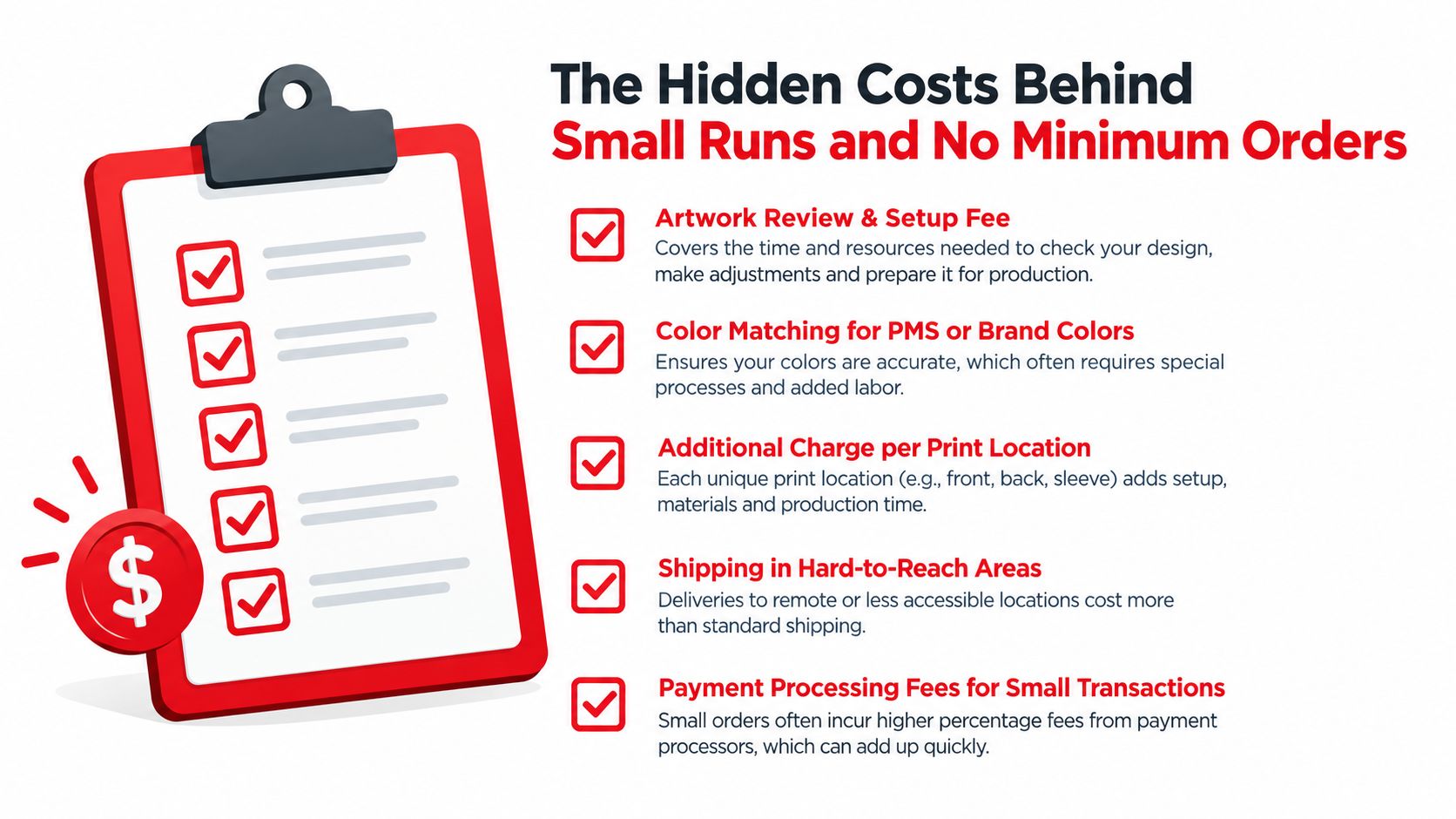
A vendor may need to inspect or adjust your artwork before production. Brand color matching can require extra preparation. Adding a sleeve, back, or second front location creates another application step, and unusual packaging or a rush deadline can change fulfillment costs.
Shipping deserves special attention. A shirt may have a reasonable unit price but become expensive after delivery is added to a tiny order. The fewer pieces you buy, the fewer garments there are to share that shipping cost.
Before approving a quote, check:
Artwork preparation: Is file review or cleanup included?
Color requirements: Does exact brand-color matching add a charge?
Print locations: Does the price cover one location or several?
Garment: Is the quoted blank the exact brand, style, and color you requested?
Shipping: Is delivery included, estimated separately, or charged per package?
Timing: Does the quote cover standard production, or are rush services extra?
Quantity: Does the price change if you add or remove a few pieces?
A useful order reference is this custom apparel workflow visual. The goal isn't to eliminate every fee. It's to make sure you know which fees you're paying and why.
Smart Ways to Lower Your Custom T Shirt Cost Without Losing Quality
Start with changes that reduce production work without weakening the garment or design.
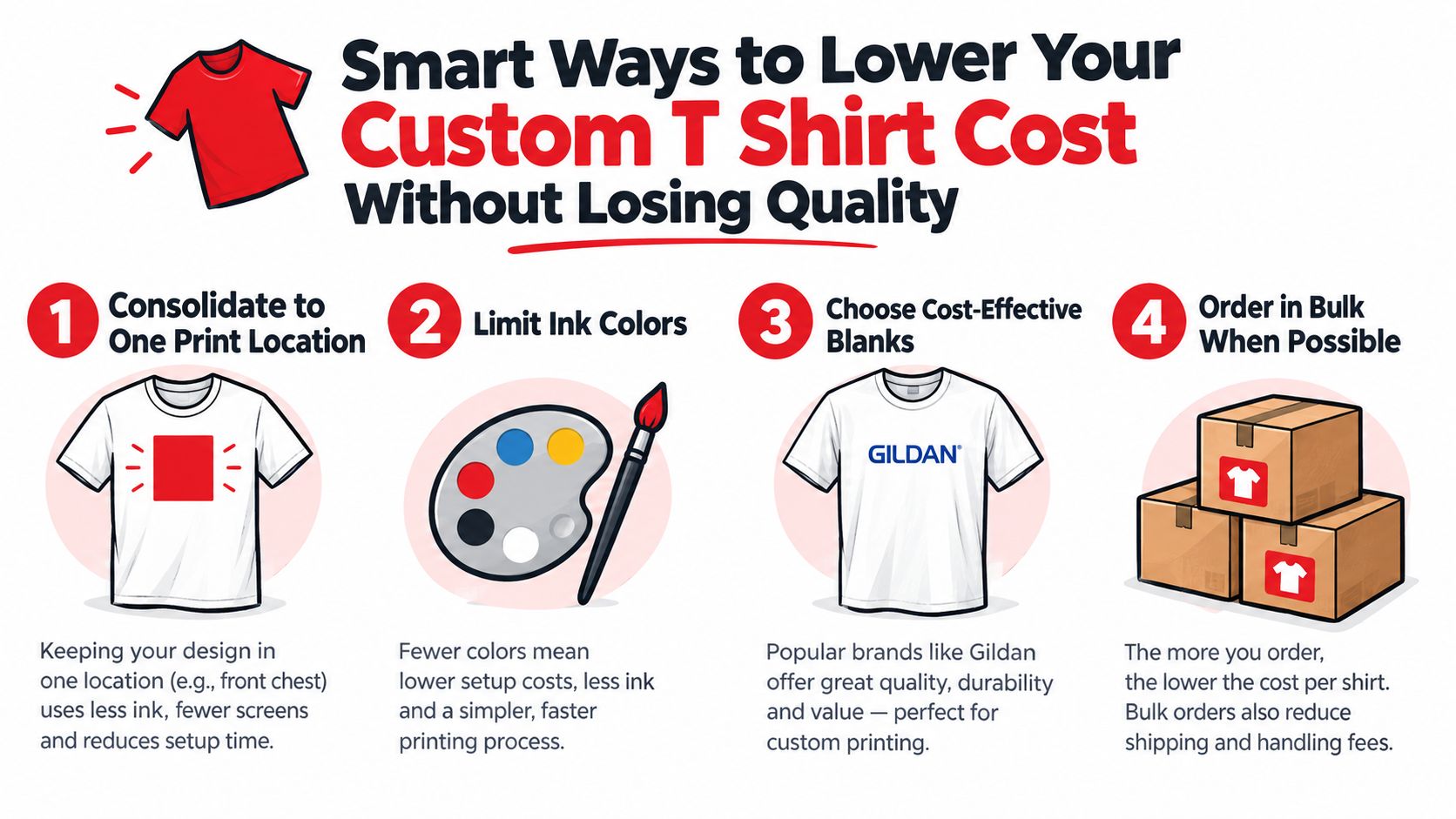
Use one print location. A front-only design is usually simpler than front, back, and sleeve decoration. If the back print isn't essential, removing it can reduce preparation and application work.
Limit the ink colors when screen printing. Each additional screen can add setup cost. A strong designer can often simplify artwork into a smaller palette without making the design feel basic.
Choose the blank for the job. A Gildan 5000 may be a practical starting point for a straightforward promotional or group order, while a premium blank may make more sense for retail merchandise or apparel people will wear frequently. Don't pay for features your audience won't notice, but don't choose a flimsy garment for a product that needs to represent your brand repeatedly.
Match the savings tactic to the order
Group sizes and colors where possible, but don't force everyone into the wrong fit to chase a lower quote. If the order is close to a vendor's next quantity tier, ask for both totals. The extra pieces may be useful for replacements, late registrations, or future sales.
For full-color artwork with mixed sizes, DTF can prevent the screen setup burden and keep the order flexible. For a simple logo on a large run, screen printing may deliver better unit economics. The cheapest method is the one that fits the entire order, not merely the transfer or ink cost.
Wear X Apparel, LLC offers garment selection support and DTF production for T-shirts, hoodies, and other apparel, so a buyer can discuss the blank, artwork, and run size before production. This DTF production example shows the kind of garment-focused planning that helps prevent expensive rework.
A practical production overview can also help you evaluate the process before ordering.
Planning Your Order and Getting an Accurate Quote
Prepare three answers before contacting a printer:
Quantity: State the exact number of shirts, plus whether you may need more later.
Garment: Name the preferred style, material, color, and size range.
Artwork: Share the file, print dimensions, colors, locations, and deadline.
Then ask every vendor to quote the same recipe. Compare the garment, method, print locations, setup, artwork handling, shipping, and taxes on equal terms. A price that looks lower may just exclude one of those buckets.
Ask whether the quoted amount is production-only or all-in. Confirm the approval process, expected timeline, and shipping policy before payment, particularly for event shirts or made-to-order merchandise. Written policy resources and a clear proofing process can prevent misunderstandings.
If you're unsure whether DTF, DTG, or screen printing fits your design, describe the intended use instead of asking only for the cheapest method. A small business, ranch operation, team, creator, or event organizer may need a different balance of garment durability, color detail, quantity, and flexibility.
Wear X Apparel, LLC helps customers select garments and arrange DTF production for custom T-shirts, hoodies, and other apparel, including single items and batch orders. Share your quantity, garment preferences, artwork, and deadline when you visit Wear X Apparel, LLC to request guidance and build a quote around the actual cost of your project.
Comments