


Custom Team Uniforms Basketball: A Complete Ordering Guide

Three weeks before the first tip-off, a volunteer is usually holding three things at once: a roster spreadsheet, a logo file pulled from an old team website, and a supplier quote that doesn't explain what happens next. The questions arrive quickly. Which fabric should the team choose? Will the tallest player fit the sample? Does the artwork need to be rebuilt? Can the uniforms arrive before the schedule starts changing?
Ordering custom team uniforms basketball succeeds when those questions are handled in sequence. Fabric, fit, artwork, decoration, pricing, production, and fulfillment all affect one another. Rushing one decision often creates rework later, while a simple approval process gives a small club or school a much better chance of receiving a complete, wearable kit on time.
Table of Contents
Choosing Fabrics and Styles That Perform on the Court - Build the base garment around movement - Separate performance from casual apparel
Sizing a Whole Team Without Guesswork - Use a sample before approving the full roster - Plan for the roster you'll actually have
Artwork Intake and Why DTF Printing Works for Team Kits - Confirm names and numbers before production - Understand what DTF contributes
Pricing, Minimums, and Timelines in Real Terms - Read the volume break correctly - Back-plan from the first game
Fulfillment Options and Smart Ordering Habits - Keep the reorder path open - Test trends against the actual job
Why Custom Basketball Uniforms Deserve a Real Plan
Basketball uniforms weren't always the standardized kits teams recognize today. Early players often wore ordinary athletic or street clothing, while the first official uniform concepts appeared in a 1901 Spalding catalog, which listed three pant styles and two jersey styles. By the 1920s, long pants had developed into medium-length shorts, and by the 1930s, heavy wool jerseys had shifted toward lighter polyester and nylon blends. That progression still matters because modern customization is built on the same movement toward lighter, more practical team apparel, as documented in the history of basketball uniforms.
A uniform order also has to satisfy more than a visual brief. Teams generally need at least two sets of shirts, home teams typically wear light colors, and player surnames must reach a minimum height of 2.5 inches, or 64 mm, under modern basketball uniform rules. The NBA has retained early design principles too, including numbered and lettered garments and the requirement that jerseys be tucked in.
Practical rule: Treat the uniform as equipment with an identity system, not as a graphic printed onto a shirt.
Start with the game date, roster status, and intended use. A youth club with changing player sizes has different priorities from a school team ordering a fixed set for an established squad. A recreational team may need a low minimum and flexible reorders, while a tournament program may care more about matching warmups, sponsor placement, and consistent color reproduction.
The visual concept belongs near the beginning, but it shouldn't lead the process by itself. Before approving a mockup, confirm the garment construction, size chart, print zones, player-name format, number style, minimum order, production window, and delivery method. A supplier should be able to tell you what file is needed, what happens after approval, and which changes trigger a new review.
A useful starting point is a shared order folder containing the roster, size worksheet, logo files, brand colors, sponsor requirements, approved mockups, and final production notes. You can use a visual reference such as this team apparel example for direction, but a screenshot alone isn't a production file. The order becomes manageable when each approval has a clear owner and a written record.
Choosing Fabrics and Styles That Perform on the Court
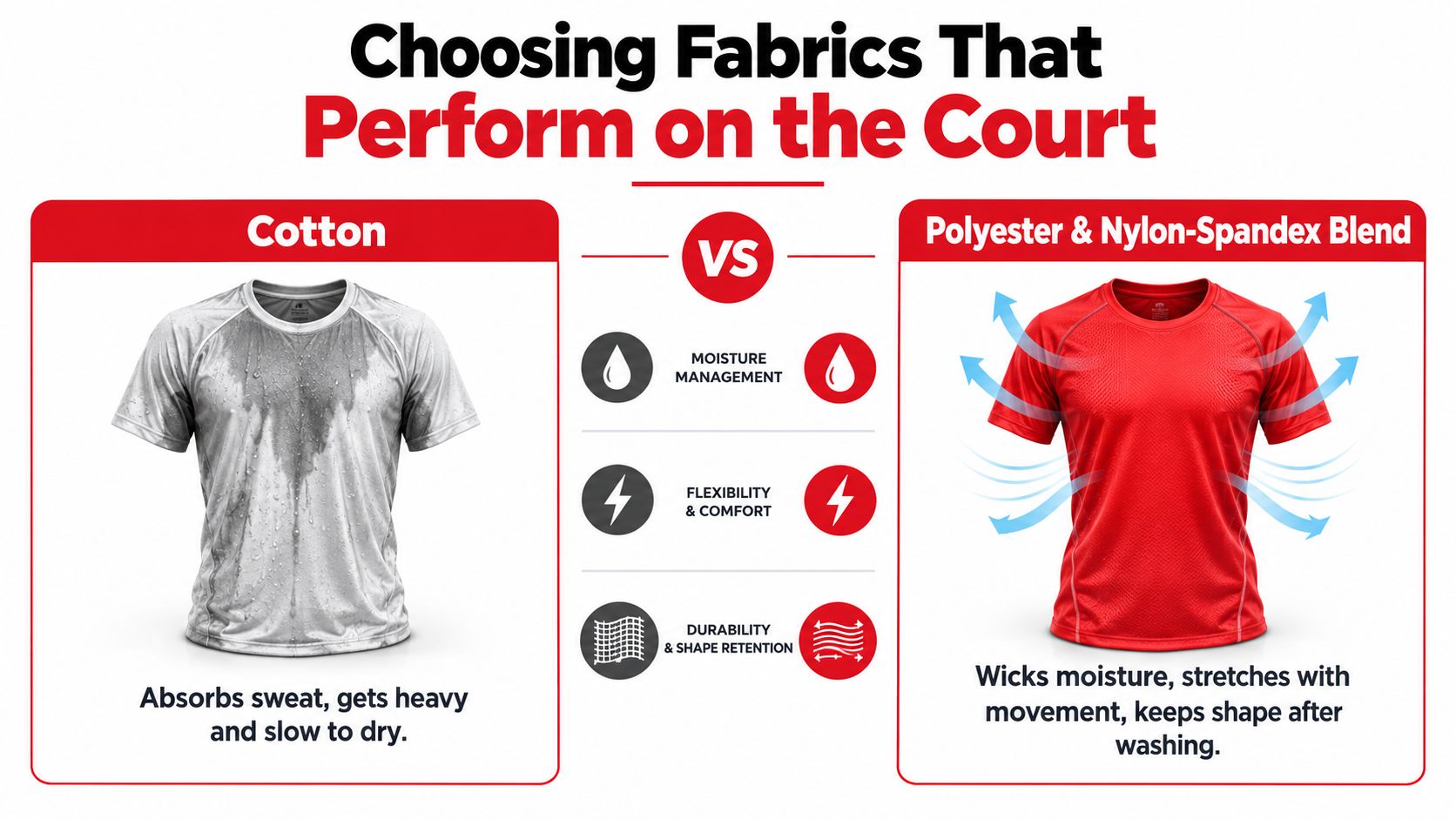
Fabric selection should begin with fiber content, airflow, stretch, and layering, not with a catalog photograph. Basketball involves repeated acceleration, jumping, contact, and rapid changes of direction. A garment that looks dry while hanging on a rack can still hold moisture during play or restrict evaporation once decoration and compression layers are added.
Controlled basketball testing used primarily synthetic garments, including a jersey made from 92% nylon and 8% spandex and compression layers made from 90% polyester and 10% spandex. The study recorded trapped sweat ranging from 0 to 1.33 kg, showing that garment construction and layering can materially affect sweat-loss estimates during play, as described in the basketball uniform sweat-retention research.
Build the base garment around movement
For most basketball kits, begin by specifying a high-synthetic polyester mesh or knit with moisture-management properties. Independent activewear research found that synthetic fabrics generally dry more effectively than natural fibers, and that airflow and sweat volume also affect drying performance. The practical implication is simple: fiber chemistry helps, but it won't compensate for a dense construction with poor air permeability. The active sportswear fabric research supports testing the complete garment rather than relying on a fiber label alone.
Ask the supplier where mesh panels sit. Side panels, underarm sections, and back zones can improve airflow, but panel placement must preserve durability and a clean print area. A heavily decorated or less breathable construction may slow evaporation even when the underlying fabric is synthetic.
Choose the cut according to the players and the competition. A standard jersey and short combination is usually easier to size and reorder than a highly specialized cut. Stretch can help with movement and layering, while compression garments require a closer fit than the outer uniform. Don't approve a sample based only on a hanger test. Have players run, jump, reach overhead, and wear the layers they'll use during games.
Separate performance from casual apparel
A warmup hoodie has a different job from a game jersey. For example, the RXB Marlboro Rodeo Hoodie is described as a heavy-weight hoodie with a three-dimensional velvety chest logo, an 8.5 oz./yd² fabric weight in the US specification, a 70/30 ring-spun cotton/polyester fleece blend, a generous fit, and a fleece-lined hood. Those features may suit travel or sideline wear, but they shouldn't be treated as a substitute for a breathable on-court base layer.
Use “dry feel” as a prompt for testing, not as proof. Request the fabric composition, construction details, decoration method, and a physical sample when the order is large enough to justify it. The right question isn't whether the garment sounds technical. It's whether the finished kit stays comfortable when the athlete is moving, sweating, and wearing the intended layers.
Sizing a Whole Team Without Guesswork
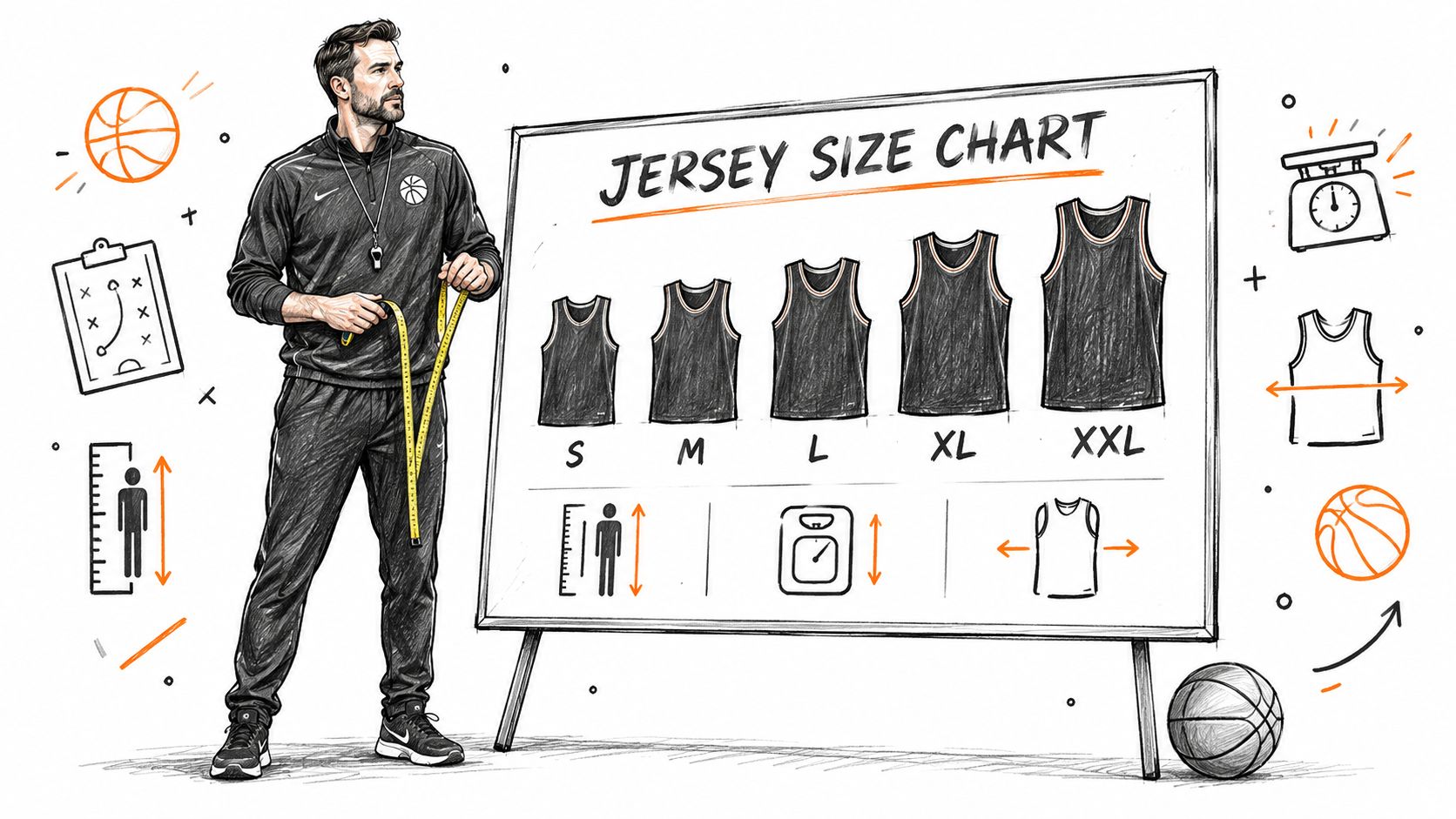
Sizing errors usually start when a manager asks players for a familiar clothing size and transfers those answers directly to a supplier form. Streetwear sizes vary widely, and basketball cuts have different proportions around the chest, waist, arm opening, and short length. A reliable roster sheet uses the supplier's actual measurements as the decision authority.
Collect each player's height, weight, chest or bust measurement, waist measurement, preferred fit, and likely base-layer use. Add the player's name, number, garment type, and whether the uniform is for a child, youth, or adult range. Ask players to identify whether they prefer a traditional fit or a looser silhouette, but don't let preference override measurements where the supplier's chart clearly points to another size.
Use a sample before approving the full roster
Order or request a sample set that represents the difficult cases, not just the average player. The tallest athlete, broadest athlete, smallest athlete, and anyone planning to wear compression layers should test the garment. Check the shoulder line, arm opening, waistband, short rise, drawcord, and freedom of movement.
A sample can reveal a problem that a chart won't show. A player may technically fall inside a size range but find that the arm opening catches during a shooting motion. Another may prefer a larger jersey but discover that the corresponding shorts become too loose. Record those observations beside the supplier's measurements, then make one documented sizing decision for each player.
Plan for the roster you'll actually have
Parents sometimes size up for growth, while coaches may want a closer fit for a tournament uniform. Both choices have consequences. Sizing up can extend the usable life of a youth kit, but excessive fabric can interfere with movement and produce a less consistent team appearance. For compression layers, the intended close fit matters more than the player's usual T-shirt size.
Keep a small number of spare garments in the most commonly used sizes when the budget allows, but don't guess at the quantity or sizes without reviewing the roster. A spare is useful for a late addition, an exchange, or an emergency replacement. It's less useful if it sits in an unsuitable size or uses a different fabric and decoration specification.
Before production, have every player or parent confirm the final size in writing. Freeze the roster only after the sample has been reviewed. That single approval step prevents the common mistake of changing sizes through scattered text messages after artwork has already been prepared.
Artwork Intake and Why DTF Printing Works for Team Kits
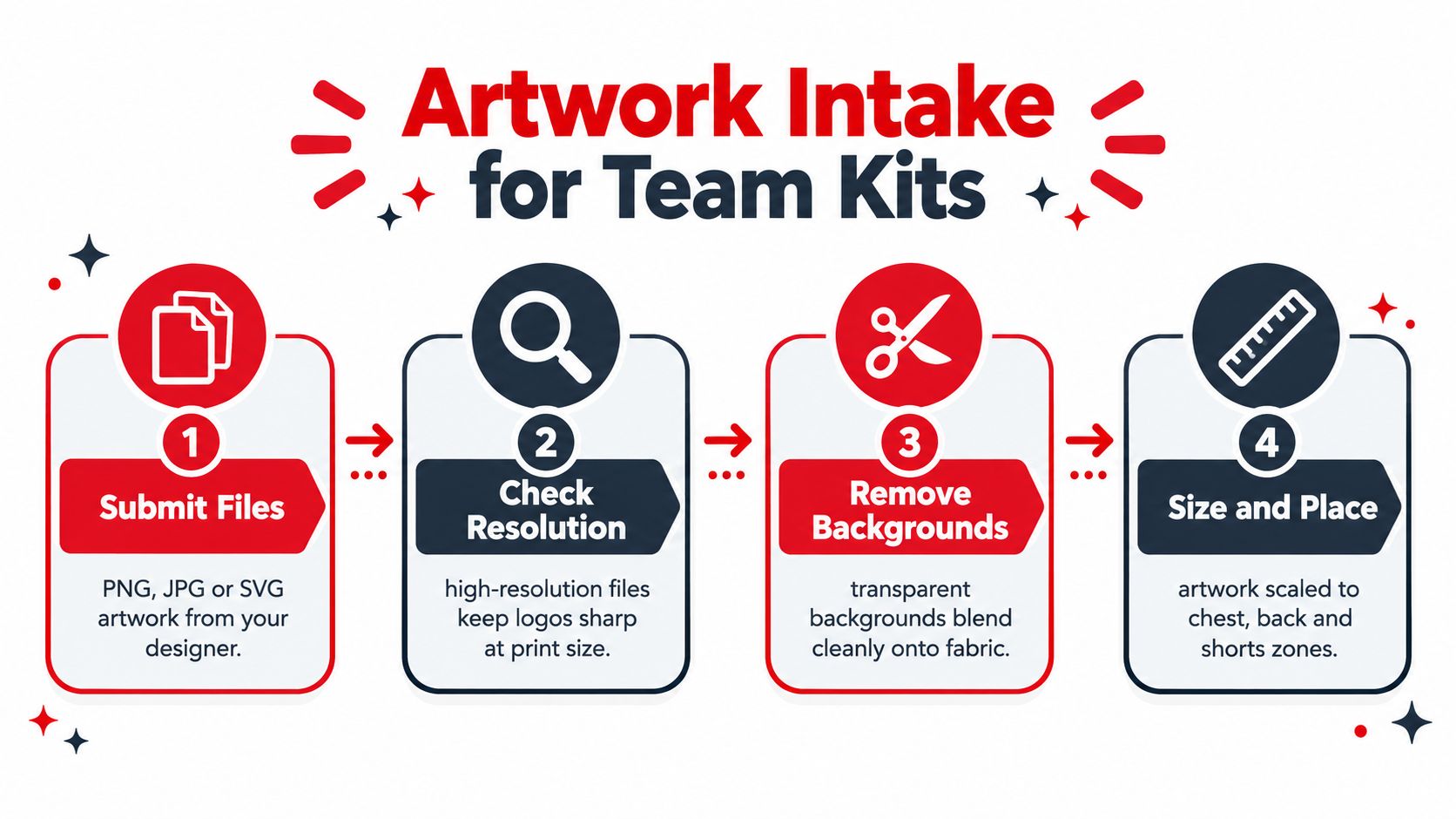
A print-ready file is more than a logo that looks acceptable on a phone screen. Suppliers commonly work with PNG, JPG, or SVG files, but the usable choice depends on the artwork. A transparent PNG can work well for a raster logo, while SVG is valuable when the design needs to scale cleanly. A JPG may be usable when the background is intentional, but it's a poor choice when a white rectangle must disappear around the mark.
Send the original logo, the team color references, the desired number font, player list, sponsor marks, and a sketch of placement. Identify the chest, back, shorts, sleeve, and warmup zones separately. Artwork should be checked at its intended print size, because a file that looks sharp as a small preview may show rough edges once enlarged.
Confirm names and numbers before production
The player-name list is a production document, not a casual reference. Match every name to the correct number, size, garment, and spelling. Decide whether surnames use all capitals, title case, a curved baseline, or a straight baseline before the supplier prepares the final layout.
The minimum surname height is 2.5 inches, or 64 mm, under the uniform rules referenced earlier. That requirement makes placement and lettering decisions important, especially when a long surname has to fit across a narrow back panel. A supplier should confirm the final dimensions rather than scaling every name identically.
Understand what DTF contributes
Direct-to-Film, or DTF, printing transfers a prepared design from film onto the garment using adhesive and heat. It suits team projects that need detailed, multicolor artwork across different garment colors and can support both individual pieces and batch orders. It's particularly practical when a club needs a custom practice jersey, a small replacement run, or a mixed garment order without creating a separate simplified artwork system.
DTF isn't automatically the right choice for every uniform. Ask how the print will affect stretch, hand feel, wash care, and breathability in the intended placement. Large solid areas can feel different from small names or numbers, and a decoration that works well on a hoodie may not be ideal over a highly ventilated jersey panel.
Use this DTF production reference as a visual example of the process, then ask the supplier to confirm the specific application method for the garment you selected.
Save the approved artwork in an organized folder with the final mockup and production notes. Don't rely on a supplier's portal as the only copy. Reorders become much easier when the original files, name layout, number specifications, color references, and garment details remain available.
Pricing, Minimums, and Timelines in Real Terms
A uniform quote is only useful when you know what it includes. Compare the garment, decoration, names and numbers, setup or artwork charges, sample costs, shipping, minimum quantity, and replacement policy. Two suppliers may quote similar per-unit prices while offering different fabrics, different levels of artwork support, or different delivery terms.
Available market-facing pricing references place many custom uniforms at about USD 14 to USD 25 per uniform for orders of 10 to 50 pieces, and about USD 12 to USD 22 per uniform for orders of 100 or more, as summarized in the basketball uniform supplier pricing reference. These are comparison ranges, not a guaranteed quote. The final figure depends on garment specification, customization, order size, and the supplier's production model.
Order Size | Typical Price per Uniform | Typical Lead Time |
|---|---|---|
10 to 50 pieces | USD 14 to USD 25 | About 3 to 4 weeks after design approval |
100 or more pieces | USD 12 to USD 22 | About 3 to 4 weeks after design approval |
Read the volume break correctly
Larger orders may reduce the per-unit price because setup, purchasing, and production work are spread across more garments. That doesn't mean ordering more is automatically cheaper for a small club. Extra uniforms tie up cash, and an oversized order can leave you with unusable garments when players leave or sizes change.
Ask whether the quoted range includes every customization. A base jersey price may exclude names, numbers, sponsor marks, shorts, rush handling, or delivery. Request a line-item quote that shows the cost of a standard uniform, the cost of player personalization, and the effect of adding warmups or replacement pieces.
Minimums deserve the same scrutiny. Some suppliers use minimums by design, colorway, garment type, or total order. Others may permit smaller runs but charge differently. If your roster is still changing, confirm whether a late addition can be produced under the same artwork and fabric specification.
Back-plan from the first game
The quoted delivery window of about 3 to 4 weeks after design approval means the clock may not start when you first submit an inquiry. Artwork corrections, missing sizes, delayed approvals, sample reviews, and payment processing can all occur before production begins.
Work backward from the first game:
Set the required arrival date, leaving time for inspection and distribution.
Allow the supplier's quoted production and delivery window after final design approval.
Add time for sample fitting, roster confirmation, artwork correction, and internal approval.
Set a hard deadline for the deposit or final payment.
Require a written confirmation of the production start date and shipping method.
Ask every supplier three direct questions:
What exact event starts the production clock?
What costs are excluded from the quoted per-unit price?
What happens if one garment arrives damaged, misprinted, or in the wrong size?
Those answers expose more than a polished design page does. A low quote with unclear timing and no replacement process can become the expensive option once the team is close to game day.
Fulfillment Options and Smart Ordering Habits
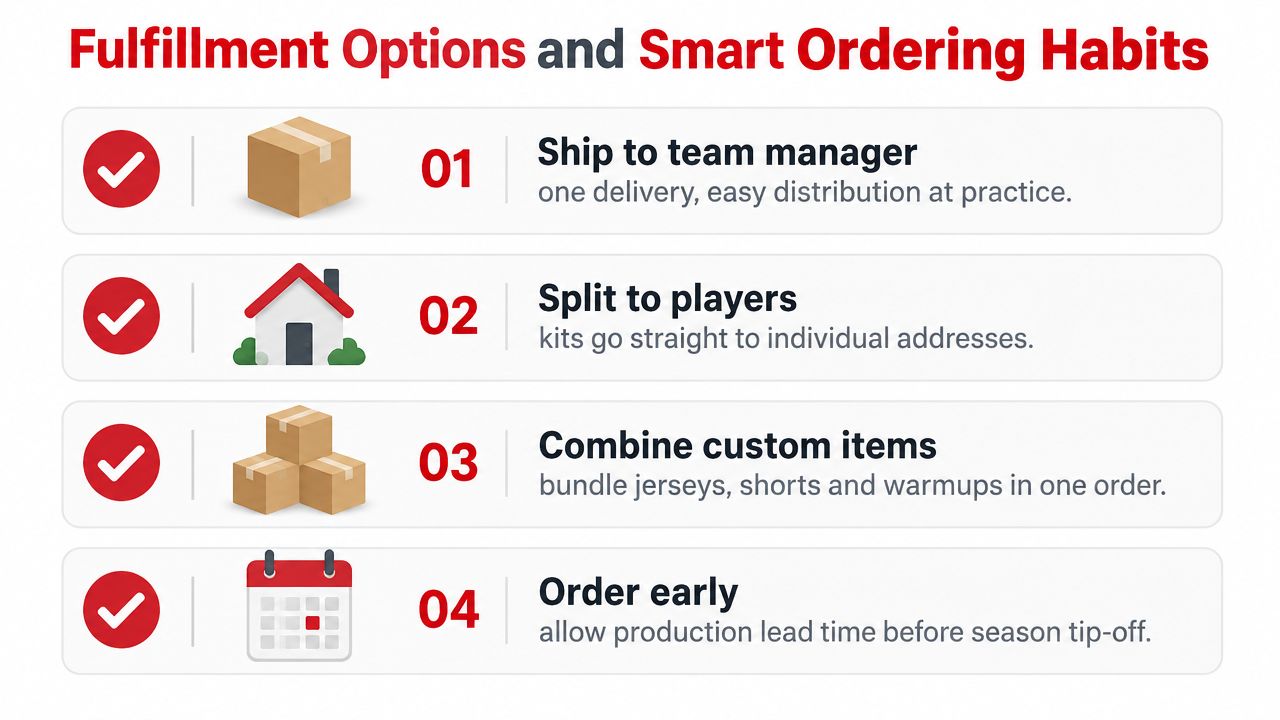
Choose fulfillment based on who will receive, check, and distribute the order. Sending every uniform to one manager creates one delivery and simplifies handoff at practice, but that person must sort each garment against the roster. Shipping kits to individual addresses reduces sorting work while adding address collection, shipping coordination, and more chances for an incomplete order record. For small clubs, a single destination is often easier to control. For schools with families spread across locations, direct shipping may reduce volunteer workload.
A third option pairs custom uniforms with ready-to-buy merchandise through a supplier storefront. This can suit warmups, fan apparel, or staff garments, provided the order separates custom production from stock fulfillment. Names, numbers, and team artwork may place custom items under different return terms. Confirm those terms before payment, not after a personalized item needs replacing.
Keep the reorder path open
Store the final print-ready files, approved mockup, garment name, fabric specification, size list, and production notes together. A replacement order should use the approved specification, rather than rely on someone remembering the exact blue, number font, or print placement. An on-demand fulfillment reference can also help the buyer compare how future additions may fit into the supplier's ordering process.
If the supplier offers custom work and a merchandise storefront, confirm whether both services use the same account, communication channel, and fulfillment terms. Wear X Apparel, LLC, combines custom garment selection and DTF production support with an online shop and service resources covering shipping, returns, and terms. That setup may suit a club ordering player kits alongside separately purchased merchandise, but each item's treatment still needs confirmation before payment.
Test trends against the actual job
Coverage of team uniform design points to 2026 projected demand for retro styling, bold color blocking, sublimation, and recycled polyester blends in youth and collegiate programs, according to recent team uniform design coverage. Use those ideas as design inputs, then test them against the actual garment and order requirements.
Recycled polyester may support a team's material goals, but request the fiber composition and care instructions. Sublimation can suit all-over designs, while DTF may fit detailed artwork, individual pieces, or mixed garment orders. Neither decoration label confirms breathability, fit, or delivery timing.
Use this supplier-communication checklist:
Specification: Confirm fiber content, construction, fit, decoration, and care instructions.
Roster: Send one controlled size and personalization sheet.
Artwork: Approve a final proof showing every print zone.
Timing: Confirm when production starts and how delivery will be handled.
Policies: Read custom-item return, replacement, cancellation, and damage terms.
Reorders: Ask how approved files and garment details will be retained.
Your Pre-Order Checklist for Game Day
A dependable order is built through verification, not luck. Before paying a deposit, make sure the team has completed these checks in order:
Validate the garment: Confirm fabric content, airflow features, stretch, fit, decoration compatibility, and intended layering.
Fit representative players: Use the supplier's measurements, test samples on the tallest and broadest players, and record every final size.
Lock the roster data: Match each name and number to the correct garment and review spelling with the player or parent.
Prepare production artwork: Supply the appropriate PNG, JPG, or SVG files, remove unwanted backgrounds, and approve placement at print size.
Benchmark the quote: Compare the per-unit price against order volume, then identify artwork, personalization, shipping, and replacement costs separately.
Back-plan the deadline: Work backward from the first game and leave room for approval, fitting, production, delivery, inspection, and distribution.
Confirm fulfillment: Decide whether the order goes to one manager, multiple addresses, or a mix of custom and ready-to-buy items.
Save the specification: Keep the final artwork, size chart, roster, garment details, and approved proof for future replacements.
Start with sizing and artwork, because those two inputs create the most avoidable delays. Once the sample fits, the roster is controlled, and the supplier has approved the files, the rest of the order becomes a production task rather than a last-minute gamble.
Wear X Apparel, LLC offers garment selection support and DTF printing for individual pieces and batch apparel orders, including team and organization projects. Visit Wear X Apparel, LLC to review custom apparel services, production guidance, and ordering resources before you finalize your basketball uniform plan.
Comments