


Difference Between DTG and DTF: A 2026 Guide

Neither DTG nor DTF is universally better. DTG prioritizes a soft, integrated hand on cotton, while DTF prioritizes fabric versatility and transfer-based opacity, with properly applied DTF transfers commonly placed at approximately 50 or more wash cycles and DTG often reported around 40–50 cycles under comparable care conditions (industry durability guidance).
The popular advice says to choose DTG for premium work and DTF for everything else. That shortcut is useful only until the garment changes. A cotton retail shirt, a polyester team jersey, a dark hoodie, and a mixed-fabric workwear order can all require different answers.
The practical difference between DTG and DTF is not a contest between old and new technology. It's a garment-design decision. Start with the fabric, color, stretch, handling, desired feel, and wash conditions. Then choose the process that fits the product.
Table of Contents
What Actually Separates DTG and DTF - A short history with operational consequences
How DTF Printing Technology Works - Why the film changes the job
Direct-to-Garment versus Transfer-Based Quality - What customers actually notice - Where quality decisions go wrong
Durability and Material Constraints - Test the garment you will sell
Cost Analysis and Production Efficiency - Count workflow cost, not just consumables
Choosing the Right Method for Your Project - A practical matching guide
What Actually Separates DTG and DTF
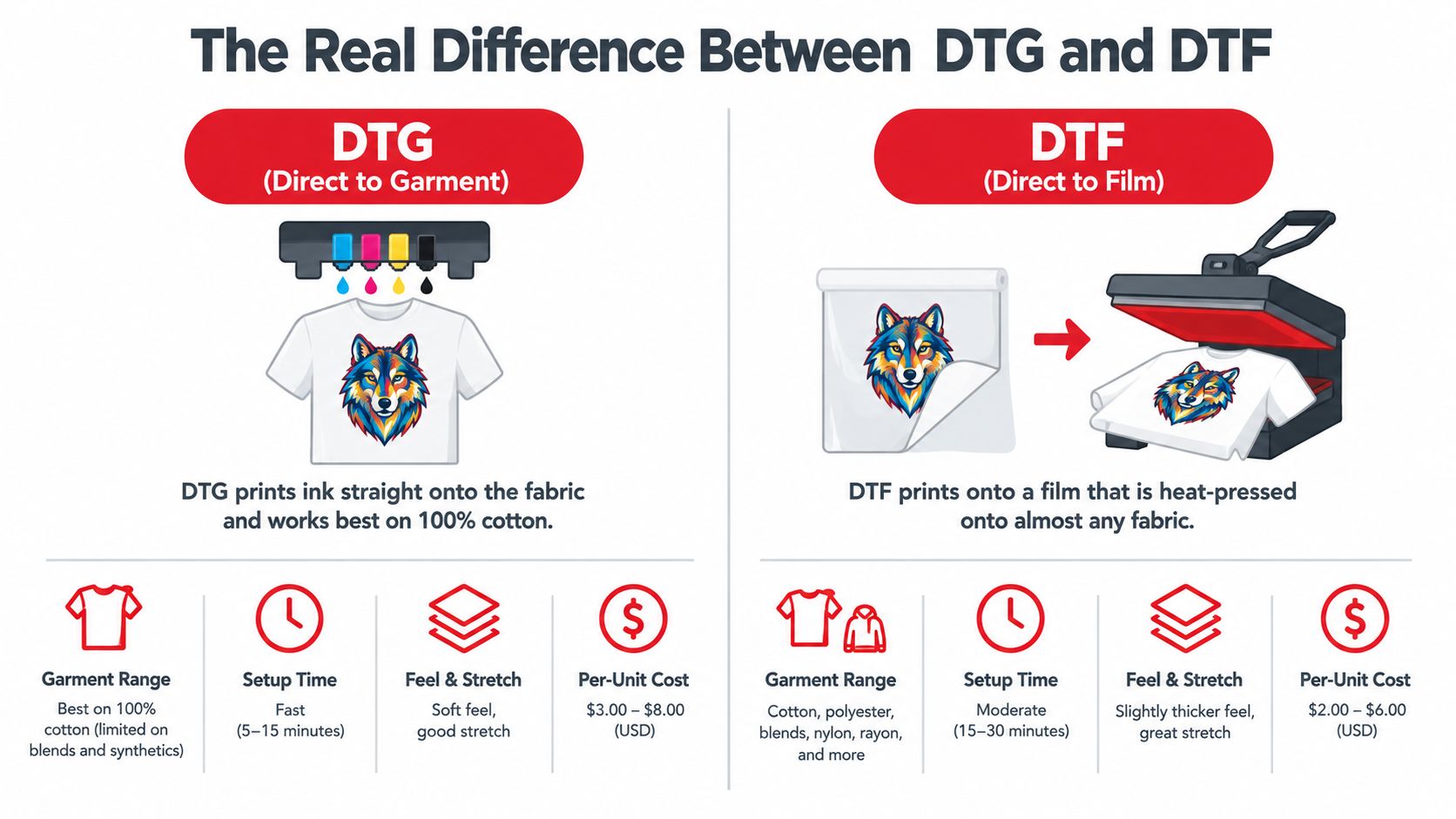
Shops get this choice wrong when they treat it like a winner-versus-loser debate. Direct-to-garment, or DTG, prints aqueous ink straight onto a prepared garment. Direct-to-film, or DTF, prints the image onto coated film, adds adhesive powder, and heat presses that image onto the garment later. The practical difference is not hype or age. It is where the graphic is built, how it bonds, and how that decision matches the garment you are decorating.
DTG is a direct-print workflow. The shirt goes into the printer, the ink goes into the textile, and the print is cured on the garment. On dark goods, that usually means pretreatment and careful white-ink control. If pretreatment is inconsistent, the print can look inconsistent too. Fabric content, shirt construction, and operator discipline all affect the result.
DTF splits production into two stages. The artwork is printed on film first, adhesive is added, and the transfer is stored or pressed when needed. That changes the job in a useful way. The fabric does not need to accept ink the way it does with DTG, so the same graphic can move more easily across cotton, polyester, blends, and nylon.
A short history with operational consequences
DTG has the longer commercial track record. The first commercially available U.S. DTG printer, Revolution, appeared in 1996, its inventor filed a patent in July 1996, and the patent was granted in August 2000. Brother introduced the purpose-built GT-541 in 2005, which helped establish DTG as a commercial garment-decoration process. DTF arrived later, gaining broad attention in the late 2010s and around 2020 as a more accessible full-color transfer option, according to this technical overview of DTG printing.
In practice, that history matters less than the production logic behind each method. DTG is a mature direct-print system that rewards good garment prep and works best when the feel of the print matters. DTF is a newer transfer system built to reduce fabric restrictions and simplify mixed-garment orders.
Decision factor | DTG | DTF |
|---|---|---|
Image location | Printed directly into prepared textile | Printed on coated film, then heat-pressed |
Best material fit | Cotton and other natural fibers | Cotton, polyester, blends, and nylon |
Surface feel | Softer and more integrated | A noticeable polymer and ink layer |
Dark garments | Requires careful white-ink and pretreatment control | Strong opacity from the transfer layer |
Main operational advantage | Natural hand on cotton | Broad substrate flexibility |
Practical rule: Start with the garment, the artwork, and the use case. Then pick the print method.
How DTF Printing Technology Works
DTF starts away from the garment. The printer lays water-based pigment ink onto coated PET film, including a white layer when the artwork needs opacity. While the ink is still suitable for bonding, hot-melt adhesive powder is applied to the printed area. The film is then cured so the powder forms the adhesive layer that will connect the graphic to the textile.
A heat press applies the finished transfer to the garment. Heat and pressure activate the adhesive, and the carrier film is peeled away, leaving the design bonded to the fabric surface. The process doesn't depend on the garment absorbing the ink, which is why DTF can work across cotton, polyester, blends, and nylon (this comparison of DTF substrates and workflows).
Why the film changes the job
DTG asks the textile to behave like a printable surface. Cotton generally accepts that process well, but synthetic fibers and inconsistent pretreatment can complicate the result. DTF asks a different question: can the adhesive bond correctly to the garment under controlled heat and pressure?
That distinction matters for dark uniforms, performance garments, and mixed inventories. A polyester jersey and a cotton tee can receive the same prepared transfer design, although the press settings and garment response still need to be checked.
The trade-off appears on the surface. DTF places a polymer and ink layer on top of the textile, so large solid graphics can feel more film-like and may influence drape or breathability. This isn't a defect by itself. It's the physical result of choosing opacity and material range over a print that disappears into the fibers.
A transfer can also be prepared separately from the final garment. That gives a shop more flexibility when the blank arrives later, when a customer orders different garment colors, or when one design will be used across several fabric types. It doesn't remove quality-control requirements. Powder coverage, curing, press temperature, pressure, dwell time, and peel timing all affect the finished bond.
A clean transfer is not just a printed image. It's a controlled adhesive system, and every step affects the final garment.
For a visual reference to the production workflow, see this Wear X Apparel DTF process image.
Direct-to-Garment versus Transfer-Based Quality
DTF takes the opposite route. The graphic remains on the garment surface as a bonded layer. That construction supports strong opacity and vivid color, especially on dark garments, but the hand is more noticeable. Large areas of dense color can feel smooth and slightly plastic-like, while small logos or detailed marks may be barely intrusive during wear.
What customers actually notice
A soft hand matters most when the garment is sold as a premium everyday piece. A customer wearing a cotton tee against bare skin may care more about breathability and natural movement than maximum opacity. For a team jersey or work shirt, the customer may care more about consistent color, fabric compatibility, and resistance to repeated handling.
The artwork still matters, but not in the simplistic way many comparisons suggest. DTG is strong for detailed artwork and subtle transitions on suitable cotton garments. DTF is strong when the design needs a clear, opaque presence across dark or synthetic materials. Neither method guarantees a better image without proper file preparation, curing, and inspection.
If the priority is... | The more natural fit is... | Why |
|---|---|---|
Soft feel on cotton | DTG | Ink integrates more closely with the textile |
Strong opacity on dark garments | DTF | The transfer layer doesn't rely on fabric absorption |
Mixed fabric inventory | DTF | The same production logic can serve more material types |
Premium natural drape | DTG | Less material sits above the fabric |
Small, bold emblem on workwear | DTF | The surface layer supports clear contrast and application flexibility |
The RXB Marlboro Rodeo Hoodie shows why garment construction belongs in the conversation. It uses an 8.5 oz./yd² fleece weight in the U.S., a 70/30 ring-spun cotton/polyester blend, a 100% cotton face, and a three-dimensional velvety chest logo. Those garment details don't dictate one universal print method, but they do show why the face fabric, decoration texture, and intended wearing experience must be evaluated together.
Where quality decisions go wrong
The common mistake is approving a print sample on one fabric and assuming it represents every garment in the order. A print that feels excellent on a light cotton tee may feel too heavy on a large dark hoodie when the same artwork is transferred as a solid block. Conversely, a DTF mark that works perfectly on a polyester uniform may be unnecessary on a breathable cotton retail shirt.
The “best” print is the one that feels intentional on the finished garment, not the one that wins a printer comparison.
Durability and Material Constraints
Durability is where shops make the wrong call when they treat DTG and DTF as a printer contest. The better question is simpler. What will this garment be used for, and how much print can the fabric carry before the result feels wrong in wear?
Published guidance often places properly applied DTF transfers at approximately 50 or more wash cycles, while DTG is often reported around 40–50 cycles under comparable care conditions (wash-cycle guidance for DTF and DTG). Treat those numbers as directional, not universal. A print can stay visible and still fail the job through cracking, edge lift, fading, distortion, or peel. End use matters just as much. Outdoor workwear, team uniforms, and occasional fashion wear do not stress a print in the same way.
In production, the material usually decides where problems show up first. DTF tends to hold up well on blends and synthetics because the image sits on an adhesive-backed layer, but a weak bond creates its own failures. Miss the press settings and you can get corner lift, cracking, or early delamination. DTG can last well too, especially on cotton, but it asks for tighter control of pretreatment, curing, and fabric consistency. On the wrong blank, the print may wash down unevenly or lose surface quality faster than the sample suggested.
Test the garment you will sell
A real test uses the same blank, artwork scale, print coverage, and production settings you plan to ship. A cotton sample does not validate a polyester uniform. A left-chest logo does not validate a dense full-front graphic.
That is why I prefer a simple QC routine the floor can repeat:
Set one wash method: Use a recognized wash test and keep it consistent across comparisons.
Judge failure, not visibility alone: Check cracking, peeling, edge lift, color change, and image distortion.
Log production conditions: Record curing, transfer temperature, pressure, dwell time, and garment composition with each result.
Match the test to the job: Workwear needs a different acceptance standard than a fashion tee worn occasionally.
A good adhesive choice affects that outcome too. Shops running transfer workflows often review tack, peel behavior, and bond consistency as part of setup. This X-tra Sticky adhesive reference image is the kind of checkpoint teams use when dialing in transfer behavior.
The sustainability argument has the same problem as the durability argument. It depends on the job. DTF adds PET film and polyurethane-based adhesive. Digital garment printing can reduce excess stock in short runs. Most of the footprint comes from consumables, curing energy, rejects, and disposal. A recent trade discussion of DTF durability and sustainability makes that trade-off clear.
The right choice is the print that suits the garment, survives the use case, and still feels intentional after repeated wear.
Cost Analysis and Production Efficiency
The cheapest-looking method can become expensive when the workflow fights the garment. DTG carries pretreatment, curing, white-ink management, and garment-by-garment handling. DTF adds film, adhesive powder, curing, and heat pressing, but it can separate transfer production from final garment application.
That distinction changes how a shop handles mixed orders. A batch containing cotton shirts, polyester polos, and nylon garments creates more substrate risk for DTG. DTF may offer a more consistent production path because the image is built on film before application. The operator still needs to validate each garment and press setting, but the ink no longer depends on every textile accepting it in the same way.
Count workflow cost, not just consumables
A useful cost review includes:
Cost area | DTG pressure point | DTF pressure point |
|---|---|---|
Preparation | Pretreatment and drying | Film preparation and adhesive powder |
Application | Direct print and curing per garment | Heat pressing and peeling |
Maintenance | White-ink circulation and printhead care | Film, powder handling, and press consistency |
Inventory | Garment-specific printing | Transfers can be prepared before application |
Quality risk | Uneven pretreatment or weak fabric compatibility | Poor adhesive coverage or incorrect press conditions |
DTG can remain efficient for cotton orders where the soft integrated feel is the product requirement. DTF can be more practical when one artwork must move across mixed garments, dark colors, or workwear materials.
Production speed also depends on the entire line, not just the printer. A fast printer won't solve a slow pretreatment station. A fast press won't solve poorly cured transfers. Measure the time from blank garment to inspected finished piece.
A shop considering made-to-order work can review this Wear X Apparel production workflow image alongside its own labor steps. The useful question is not “Which printer costs less?” It's “Which workflow creates fewer corrections for this garment mix?”
Choosing the Right Method for Your Project
Start with the garment, not the artwork. A detailed illustration doesn't automatically belong on DTG, and a simple logo doesn't automatically belong on DTF. Fabric composition, color, stretch, handling, desired softness, order mix, and expected wash conditions should drive the recommendation.
Use this decision sequence:
Identify the fiber content. Cotton-rich natural-fiber garments favor DTG when softness matters. Polyester, nylon, blends, and performance materials generally point toward DTF.
Check the garment color. Dark garments need reliable opacity. DTF can provide that through its surface transfer layer, while DTG requires careful white-ink and pretreatment control.
Decide how the garment will be worn. Retail tees and premium cotton pieces often benefit from a softer hand. Uniforms, team apparel, and workwear often prioritize consistent application across varied materials.
Assess stretch and handling. A transfer must flex with the fabric and bond correctly. A direct print must remain compatible with the fibers and curing process.
Test before scaling. Approve the actual blank, decoration size, and care protocol rather than relying on a generic sample.
A practical matching guide
Project requirement | Recommended starting point | Reason |
|---|---|---|
Premium cotton shirt where softness dominates | DTG | The ink integrates more naturally with the textile |
Polyester athletic or team apparel | DTF | The transfer process suits synthetic materials |
Dark hoodie with an opaque graphic | DTF | The surface layer supports strong contrast |
Mixed-fabric corporate or workwear order | DTF | One transfer workflow can serve varied substrates |
Cotton garment with a subtle, integrated image | DTG | The print can preserve a more natural hand |
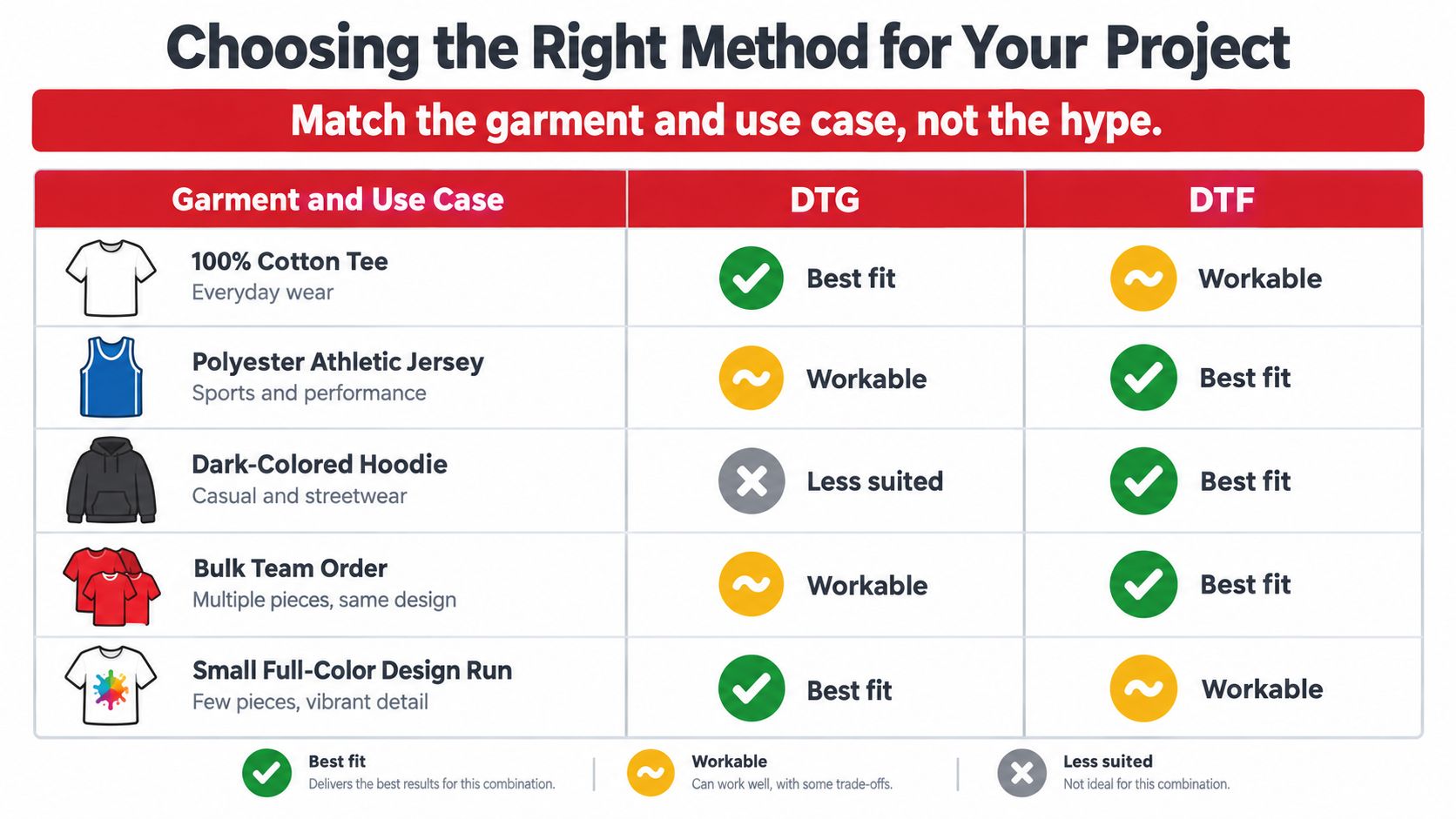
For ranch operations, outdoor brands, teams, and corporate apparel programs, the right answer may be a hybrid workflow. Use DTG where cotton softness is central to the product, and DTF where synthetic materials, dark garments, varied blanks, or repeated handling create the bigger production risk. That isn't indecision. It's proper garment matching.
The technology should serve the product design. Ask where the garment will be worn, what it will touch, how it will stretch, how it will be washed, and what the customer should feel when they pick it up.
Wear X Apparel, LLC provides DTF garment printing, garment selection support, and made-to-order apparel for single items and batch orders serving teams, events, organizations, and branded workwear needs. Visit Wear X Apparel, LLC to discuss the fabric, garment, artwork, and intended use before choosing between DTG and DTF.
Comments