


Direct to Film Printing Services: A Complete Guide

You've got an event coming up, a team that needs matching shirts, or a small business logo ready to leave the screen and land on real garments. The order might be one hoodie, five shirts, or a mixed batch for staff and customers. You don't want to buy production equipment, order hundreds of identical pieces, or discover after delivery that the print lifts from the fabric.
That's where direct to film printing services make practical sense. You're hiring a workflow, not renting a machine. The right provider should help you select garments, prepare artwork, approve the placement, apply the transfer, inspect the finished pieces, and get the order to the right address. The technology matters, but the service decisions matter more.
Table of Contents
Why Custom Apparel Buyers Land on DTF - The service is the product
What Direct to Film Printing Actually Means - The five production actions - What you provide and what the service handles
How a DTF Service Workflow Runs From Brief to Box - Artwork intake - Mockup or sample - Production and quality control - Fulfillment
Single Items, Batches, and Finishing Choices - Finishing decisions that change the handoff
How to Tell a Reliable DTF Service From a Risky One - The provider scorecard - Questions that expose weak process control
Where Wear X Apparel Fits in This Picture - A fit for low-minimum and mixed-use customers
Why Custom Apparel Buyers Land on DTF
A team captain often starts with a simple request: put the club logo on shirts, use several garment colors, and keep the order manageable. An event organizer may need staff apparel with a detailed sponsor graphic, but only for the people working the event. A small ranch operation might want branded hoodies without committing to a large inventory of one design.
These buyers aren't really choosing between printers. They're choosing between minimums, flexibility, garment options, finish, and confidence. DTF fits because the design can be produced as a transfer and applied to individual garments or short and medium runs. That makes it useful for personalized apparel, team orders, events, workwear, and merchandise programs. Grand View Research's DTF market outlook estimates the global market at approximately USD 2.7 billion in 2024, with a projection of USD 3.9 billion by 2030, a forecast increase of roughly 44%.
The service is the product
A reliable provider takes responsibility for more than pressing a design. You should expect a conversation about the blank garment, artwork dimensions, placement, size run, production quantity, and intended use. A logo for an occasional event shirt doesn't face the same conditions as a large back print on workwear exposed to friction and repeated laundering.
The distinction is important because a technically capable shop can still deliver a poor customer experience. If nobody confirms whether the garment is cotton, polyester, or a blend, the production recipe is already being treated too casually. If nobody shows you a mockup or confirms the final dimensions, you're approving a guess.
Practical rule: Choose the provider that makes the important decisions visible before production, not the one that only promises a vivid print.
A western lifestyle customer may also care about the garment itself, not just the decoration. If you're choosing a western graphic for a shirt or hoodie, this cowboy and cowgirl apparel example illustrates the kind of visual context that can influence garment selection and placement.
DTF has become a significant production segment rather than a specialty experiment. Industry reporting states that more than 7.2 billion DTF prints were produced worldwide in 2024, almost 30% more than the previous year, according to WTiN's 2025 DTF market review. The useful takeaway for a buyer isn't the headline alone. It's that DTF now supports the everyday service needs of commercial decorators, promotional suppliers, fashion projects, personalized products, and made-to-order apparel.
What Direct to Film Printing Actually Means
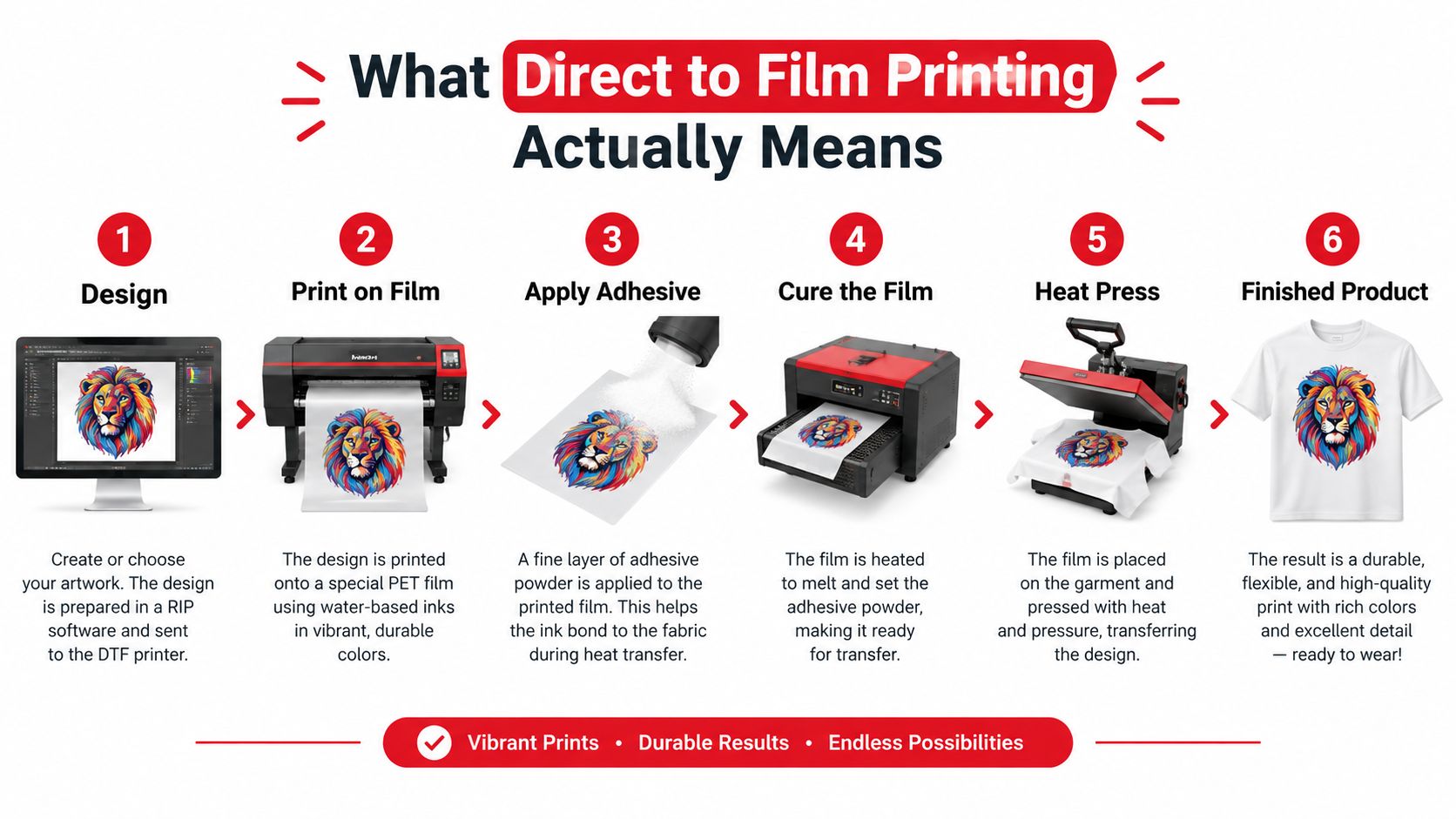
Direct-to-film printing puts the artwork on a coated transfer film first, rather than printing directly onto the garment. The printed film receives a thermoplastic adhesive powder, the powder is cured, and the finished transfer is applied with heat and pressure.
Think of it as a professionally manufactured sticker with an adhesive layer designed for fabric, combined with an iron-on application process. The provider prints the color image onto film, adds the bonding material behind it, melts that material into a controlled layer, and presses the result onto the garment. The film is removed after the transfer reaches the required peel condition.
The five production actions
Artwork preparation: You provide the design, ideally with clear dimensions, intended placement, and the correct background treatment. The provider checks whether the file can produce the requested detail at the final size.
Film printing: A DTF printer places the design on coated film, including the white layer needed to maintain color visibility on darker garments.
Adhesive application: Hot-melt powder is applied to the wet printed areas. It should cover the design consistently, because gaps in adhesive coverage can create weak edges or wash failure.
Curing: The powdered film passes through a curing process that melts the adhesive into a continuous backing. Technical specifications for TPU DTF powders commonly identify a melt-onset range of approximately 110 to 130°C, with full curing typically requiring about 160 to 170°C for 2 to 3 minutes in a conveyor or infrared oven, as documented in DTF Technology's TPU powder specifications.
Heat pressing: The transfer is positioned on the garment and pressed. A representative application window is 145 to 155°C for roughly 10 seconds under medium-high pressure, although the correct recipe depends on the blank and transfer construction.
What you provide and what the service handles
You should supply the artwork, desired garment type, color, size breakdown, quantity, placement, deadline, and delivery address. Ask the provider to confirm the file requirements and whether the quote includes garment sourcing, transfer production, application, inspection, and fulfillment.
DTF differs from screen printing because it doesn't require a separate screen setup for each color. That makes detailed, multicolor designs and short runs easier to manage. It differs from direct-to-garment printing, which places ink directly into the fabric and often favors particular garment compositions. DTF carries the decoration on a film-based layer, which gives it broader practical flexibility across cotton, polyester, and blended garments, provided the process is adjusted correctly.
How a DTF Service Workflow Runs From Brief to Box
A professional order should feel like a sequence of decisions, not a file upload followed by silence. Wear X Apparel's production and service content presents the customer journey around garment selection, artwork intake, application, quality checks, and fulfillment. That is the right model to expect from direct to film printing services.
Artwork intake
The first handoff should turn your idea into a production brief. Send the artwork in the requested format, state the finished width and height, identify the print location, and provide the garment style and quantity. If you're ordering different sizes or colors, list them separately rather than describing the batch generally.
A useful intake conversation answers practical questions:
File condition: Is the artwork supplied at the intended print size, with the required transparency and color information?
Placement: Is the design for the left chest, full front, sleeve, back, or another location?
Garment details: What are the fiber content, color, fabric weight, and stretch characteristics?
Order structure: Are all pieces using one design, or are there multiple graphics and personalization details?
Timing: When must the finished order arrive, and where should it ship?
Don't approve production until these details are written down.
Mockup or sample
A mockup should show more than a design floating on a blank shirt. It should make the placement, approximate scale, garment color, and orientation clear. A physical sample or test press is stronger when the garment has unusual stretch, a sensitive dye system, a large coverage area, or a high-friction use case.
The purpose isn't artistic approval alone. It's to catch the problems that become expensive after a batch is pressed, including a logo that sits too low, a graphic that feels oversized, or a color treatment that behaves differently on a dark garment.
Production and quality control
During production, the provider should match the transfer and garment to a controlled recipe. A meaningful quality check examines adhesion, edge condition, alignment, surface appearance, stretch recovery, and any signs of scorching, dye migration, or tackiness. It shouldn't stop at “the image looks sharp.”
For a mixed order, the shop should record the relevant production conditions by garment style. A hoodie, performance shirt, and cotton tee may not tolerate identical heat and pressure.
Fulfillment
Before the box leaves, confirm the final quantity, folded or packaged condition, shipping address, and tracking communication. Ask how defects or shortages are handled and whether custom work has a different return policy from ready-to-buy merchandise.
A good handoff leaves you with an approved design, a defined garment specification, a recorded production method, and a clear path for resolving a problem.
Single Items, Batches, and Finishing Choices
Your first decision is whether you need one finished garment, a production batch, or transfers for in-house application. A prototype should prove the artwork, placement, fit, and overall result before you order repeatedly. A batch requires consistent sizing, garment selection, artwork placement, and repeatable application across every piece.
Pricing can reflect transfer area, garment cost, labor, and quantity. Gang-sheet nesting uses film space efficiently when several designs or repeated logos share one sheet. Ask whether the quote covers transfers only or finished garments, including artwork handling, pressing, packaging, and fulfillment.
Finishing decisions that change the handoff
Hot peel and cold peel identify when the film is removed after pressing. The transfer system and production process determine the correct method. Cut-to-shape transfers reduce handling during application. A full sheet or gang sheet suits organized production when your team will separate and press the designs.
Option | Best For | Typical Trade-Off |
|---|---|---|
Single finished garment | Prototypes, gifts, personal orders, and artwork approval | Simplest customer experience, but less efficient for repeated designs |
Batched finished garments | Teams, events, workwear, and merchandise runs | Better production consistency, with more coordination around sizes and garment styles |
Gang sheet | Multiple logos, names, or designs sharing transfer film | Efficient use of sheet space, but requires accurate nesting and separation |
Pre-cut transfer | Customers applying transfers individually | Easier placement and handling, though cutting adds a finishing decision |
Full-sheet delivery | Organized in-house pressing or repeat application | More control for the customer, but more labor and equipment responsibility |
Hot peel or cold peel | The transfer system specified by the provider | Peel timing affects finish and adhesion, so the provider's instructions must be followed |
Before approving a batch, request a sample or test piece when the garment, artwork, or use case is unfamiliar. Inspect the transfer surface, edges, stretch recovery, and overall presentation. The sample should answer a practical question: does this decoration look and feel right on the exact blank you plan to order?
Customers supplying blanks should confirm whether the service accepts them, how extra or damaged garments are handled, and whether each piece receives the same application treatment. Having the provider source the garments usually gives the shop tighter control over style consistency. Approve the exact blank before production either way.
For a visual reference, review this sticky DTF transfer example alongside the garment. The transfer and apparel should be judged as one finished product, not as separate purchasing decisions.
How to Tell a Reliable DTF Service From a Risky One
The fastest way to evaluate a DTF provider is to ask whether it treats every garment as the same job. A shop that gives one blanket temperature for cotton tees, polyester performance shirts, and blends is skipping a basic production decision.
A published technical guide recommends approximately 300 to 320°F, or 149 to 160°C, for 100% cotton for 12 to 15 seconds at medium-firm pressure. It lists 275 to 295°F, or 135 to 146°C, for 100% polyester for 10 to 12 seconds with lighter pressure, with athletic fabrics handled in the lower range to reduce scorching, dye migration, and distortion. The guidance appears in Screen Print Supplies' DTF film technical parameters.
The provider scorecard
Fabric awareness comes first. Ask how the shop identifies fiber content and dye systems, whether it performs a test press, and how it changes heat, dwell, and pressure for polyester or performance garments. A lower setting may protect the garment, while insufficient heat can prevent proper adhesive flow. The provider should be able to explain that trade-off clearly.
Durability evidence should be specific to the use case. A generic “50-wash” promise is weak because wash performance depends on the garment fiber and finish, transfer construction, curing, press temperature, pressure, peel timing, detergent, wash temperature, drying method, and abrasion. DTF Transfers Australia's testing guidance emphasizes that a wash count describes the tested sample and conditions, not every garment or care routine.
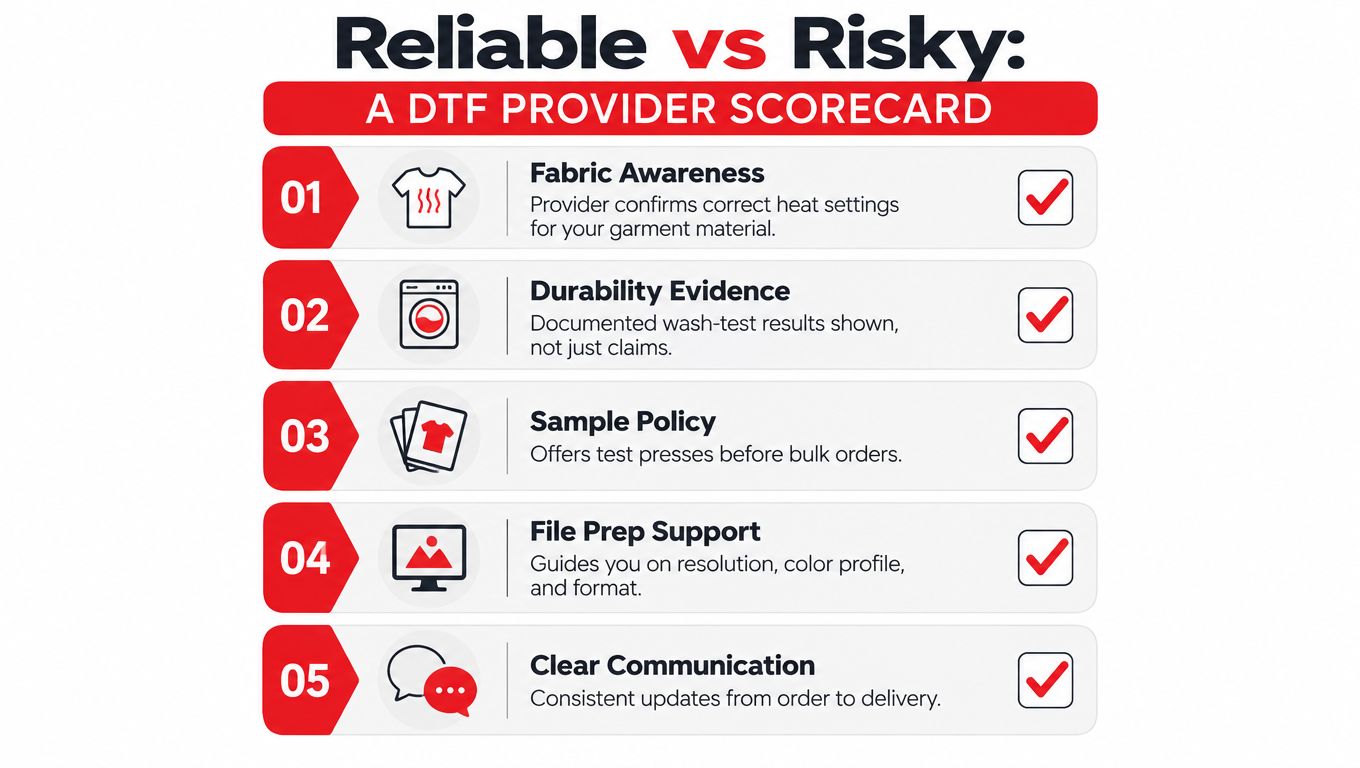
A stronger provider will discuss failure modes, including fading, cracking, edge lift, delamination, staining, and garment distortion. Ask for a sample on the actual garment, with the intended artwork, before committing to a larger run when the order will face commercial laundering, heavy friction, stretching, moisture, or outdoor work.
Questions that expose weak process control
Sample policy: Can you request a test press or preproduction garment?
File preparation: Will the provider flag low-resolution artwork, unsuitable transparency, or unclear dimensions before printing?
Production records: Does the shop track film type, powder lot, oven temperature, dwell time, press temperature, pressure, and peel condition?
Communication: Will you receive a written proof, production confirmation, and fulfillment update?
Policies: Are shipping, returns, defects, customer-supplied garments, and custom-order cancellations explained before payment?
Design detail also has a comfort cost. Technical guidance on DTG and DTF wash durability points to the importance of cohesion within the printed laminate and adhesion to a surface exposed to flexing, moisture, heat, and contact with other textiles. A large, highly detailed transfer may be printable, but that doesn't automatically make it the best choice for a breathable performance shirt or abrasive work environment.
Ask for evidence that matches the garment and the job. Color retention alone doesn't tell you whether edges will lift, the transfer will crack under stretch, or the garment will distort.
Where Wear X Apparel Fits in This Picture
Wear X Apparel, LLC combines custom apparel and merchandise with an emphasis on DTF production and an online shop for ready-to-buy products. That setup suits customers who want to compare existing merchandise, discuss a custom project, and keep both decisions with one brand instead of coordinating separate vendors.
The service flow covers garment selection, artwork intake, production application, quality checks, and fulfillment. Customers can also review service resources, FAQs, shipping and returns information, and an Ask-the-expert contact path before placing an order. Use those touchpoints to turn an initial idea into a defined production request with clear garment, artwork, and delivery expectations.
A fit for low-minimum and mixed-use customers
The customer base includes small businesses and ranch operations ordering branded workwear, event organizers outfitting participants or staff, clubs and teams managing sizes, and designers or low-minimum apparel makers that need production support without building a DTF workflow.
Wear X Apparel lists support and correspondence locations in Santa Ana, California, CA 92705, and Black Hawk, South Dakota, SD 57718. It also identifies the business as an LLC. These details do not establish print quality, but they give buyers concrete contact points and accountability when comparing providers.
The unified model helps when the garment choice remains open. Discuss the intended use, style, color, and size range before approving decoration. The decision may change between a cotton shirt, blended hoodie, or performance garment, so garment selection belongs in the production conversation rather than after the artwork is finalized.
For customers comparing ready-to-buy merchandise with custom production, this Wear X Apparel merchandise example shows how catalog shopping and custom apparel consultation can sit within one brand experience.
My recommendation is direct. Consider Wear X Apparel when you want garment selection and DTF decoration handled as one production job, particularly for teams, events, branded workwear, western lifestyle products, or small-batch merchandise. Request a written proof, fabric-specific settings, a sample policy, and durability information before approving the run, just as you would with any responsible provider.
A Pre-Order Checklist Before You Commit
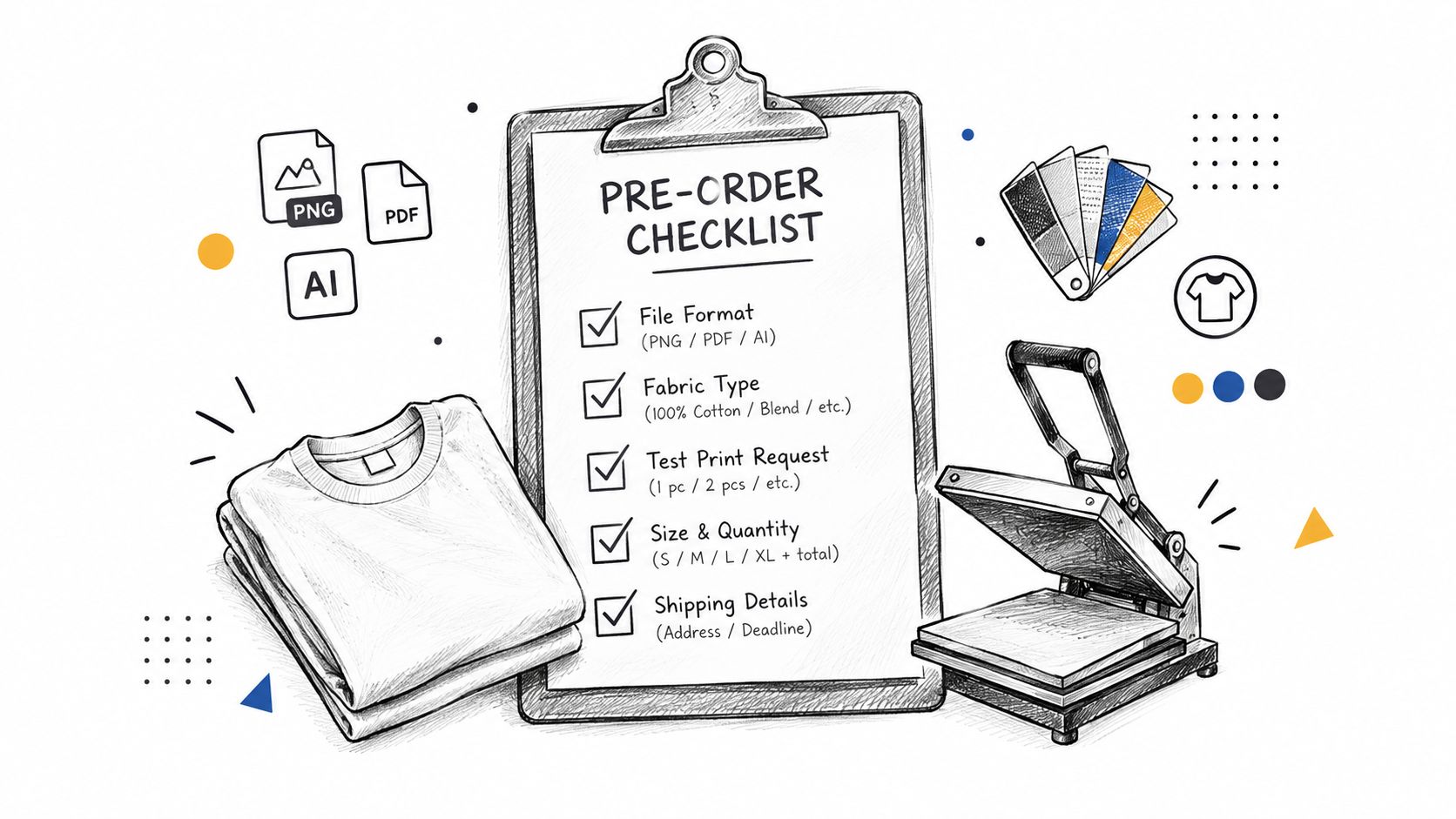
Run this checklist before sending artwork or paying an invoice:
Artwork: Confirm the file format, transparent areas, final dimensions, and color expectations.
Garment: Record the fiber composition, color, fabric weight, stretch, and dye system.
Application: Ask whether the transfer will be applied by the provider or supplied for your own pressing.
Test: Request a sample or test press on the actual garment when durability or fabric sensitivity matters.
Use case: Describe expected washing, drying, abrasion, moisture, stretching, and commercial-laundry exposure.
Finishing: Confirm gang-sheet, cut-to-shape, hot-peel, cold-peel, or finished-garment requirements.
Delivery: Write down the deadline, shipping address, packaging expectation, and tracking process.
Approval: Get a written recap of artwork placement, size, garment, quantity, production method, and defect policy.
A garment example can sharpen the conversation. The RXB Marlboro Rodeo Hoodie is described as a heavy-weight hoodie with a three-dimensional velvety chest logo, an 8.5 oz./yd² 70/30 ring-spun cotton/polyester blend with a 100% cotton face, fleece-lined hood, reinforced seams, ribbed cuffs and waistband, and production in South Dakota, USA. Those details are exactly the kind of garment information a provider needs before recommending a decoration and application recipe.
Use the video below as a final visual reminder of the production questions to clarify before an order moves into pressing.
Your confident order is no longer “five shirts with this logo.” It's a documented request with approved artwork, a named garment, a tested application plan, defined finishing, and a delivery expectation that both sides can verify.
Wear X Apparel, LLC provides custom garment selection, DTF printing, production support, and ready-to-buy apparel through its online shop. If you're planning a single item, team batch, event order, or branded workwear project, visit Wear X Apparel, LLC to review the service options and start a specific conversation about your garments and artwork.
Comments