


Dri Fit Long Sleeve Mens Guide to Fit and Fabric

You're choosing a long-sleeve shirt for a day that won't stay in one setting. It needs to handle a warm drive, a cooler office, a workout, or several hours outside without feeling clammy, bulky, or overly athletic. You may also want to add a team logo, ranch mark, event graphic, or company design without compromising the shirt's stretch and performance.
That's why Dri-FIT long-sleeve men's shirts have moved beyond the gym. The phrase often describes a category of moisture-wicking polyester tops, although Dri-FIT itself is Nike's branded technology. Nike launched the Dri-FIT line in 1991 as part of its FIT apparel system, describing it as an innovation intended to move sweat away from the body and help athletes stay cool and dry. Independent coverage also places the technology in use by Olympic athletes in 1996 and at the 1998 World Championship Football Tournament, showing how quickly moisture-management apparel moved into elite competition. Nike's history of Nike FIT and Dri-FIT
The useful buying questions aren't limited to “Does it wick sweat?” You'll get a better answer by asking how much you sweat, how much sun coverage you need, whether the shirt will be layered, and whether a printed design must survive repeated movement and washing. The sections below connect those decisions to the fabric, fit, construction, and decoration choices that shape everyday comfort.
Table of Contents
How Moisture Wicking Fabric Works - The movement happens in four stages - Construction changes the result
When Performance Polyester Feels Better Than Cotton - Match the fabric to the day
Fit Weight and Construction That Change Comfort - Fabric weight sets the basic trade-off - Openness changes more than breathability - Use this fitting checklist
Printing and Customization on Performance Long Sleeves - Start with the garment, not the artwork - Protect the print and the performance
Choosing the Right Shirt for Work Training and Everyday Wear - Make the decision from the outside inward
Introduction to Dri Fit Long Sleeve Mens Shirts
A long-sleeve performance shirt can be a surprisingly difficult garment to choose. A light version may feel cool during a hard workout but look too sheer for work. A denser version may provide useful coverage outdoors but feel warmer than expected when you're moving quickly. A slim cut can layer neatly under a jacket, while a generous cut may be more comfortable for ranch work or casual wear.
The first distinction is between brand name and fabric category. Nike's Dri-FIT is a specific branded system, but shoppers and decorators also use “Dri-FIT style” to describe polyester-based performance knits that move moisture across the fabric surface. The basic idea became central to modern athletic apparel because the same moisture-management principle could be applied to training tops, base layers, team uniforms, golf shirts, and long-sleeve outdoor garments. Nike's account of the FIT apparel system
A long sleeve isn't automatically warmer. Its comfort depends on the fabric's weight, openness, fit, and how much air can move through the garment.
That combination matters when one shirt has to serve several roles. A traveler may wear it over a base layer on a cool flight, then use it alone during a walk. An event crew may need a consistent branded top that looks presentable while staff members move between indoor and outdoor areas. A ranch worker may care more about sleeve coverage, opacity, and sun protection than an ultra-light hand feel.
This is also where cotton-versus-polyester advice often becomes too simple. Cotton can feel pleasant when sweat levels are low, while performance polyester becomes more useful as exertion and moisture increase. A good choice matches the garment to the wearer's actual day instead of treating one fiber as universally superior.
Decoration adds another layer. A smooth polyester knit can work well with Direct-to-Film printing, but stretch, heat sensitivity, surface texture, and artwork size all affect the final result. The right shirt therefore balances sweat transport, cooling, coverage, fit, and print suitability rather than maximizing just one feature.
How Moisture Wicking Fabric Works
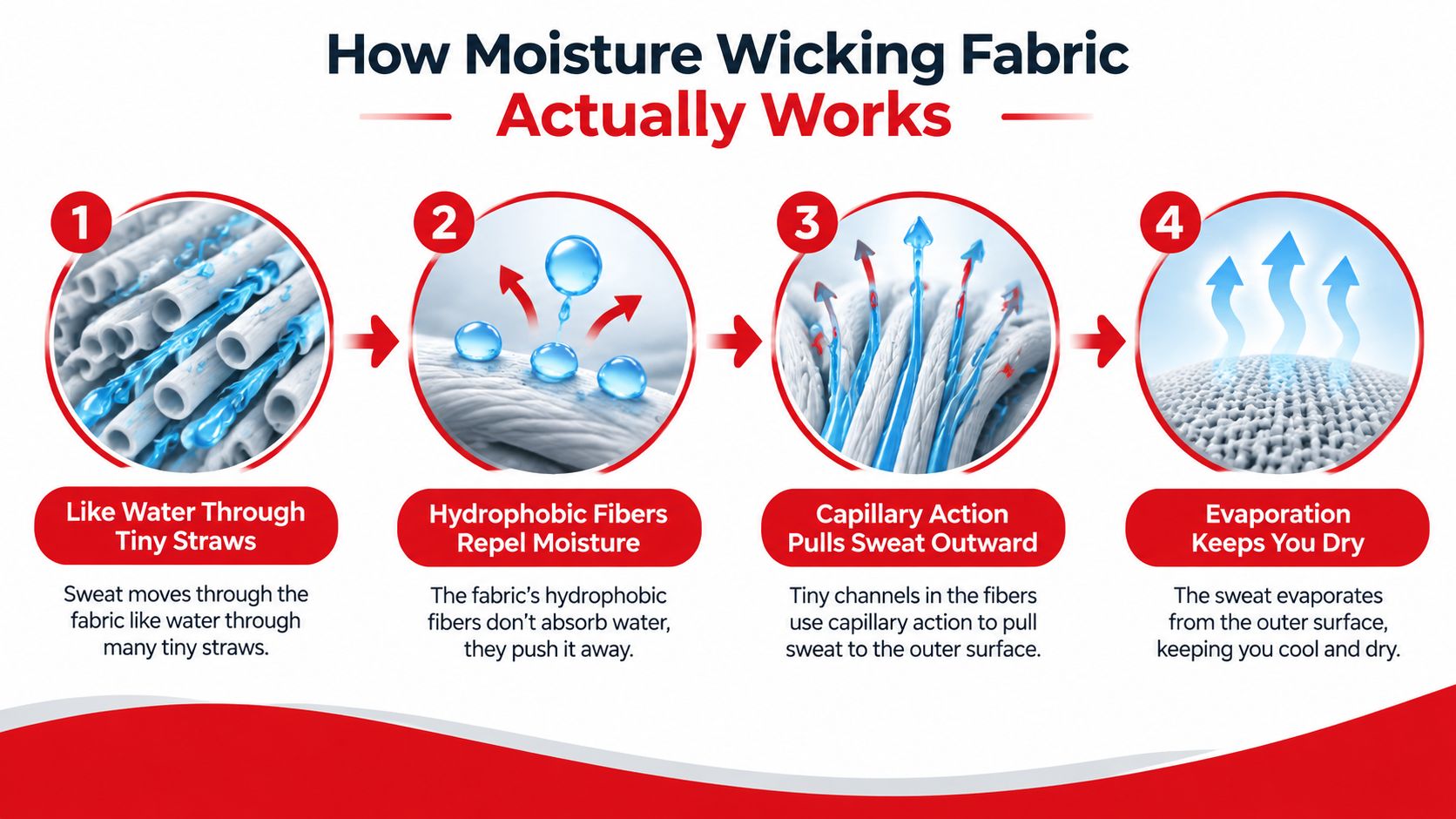
During a brisk walk, a training session, or physical work outdoors, sweat first reaches the shirt's inner surface. A performance knit helps move that moisture away from the skin and distribute it across more fabric, much like water traveling through a bundle of tiny straws. More exposed surface gives airflow and heat a better chance to support evaporation.
The movement happens in four stages
Sweat leaves the skin. Heat, movement, and physical work bring moisture to the shirt's inner face.
The fiber resists soaking. Polyester is intrinsically hydrophobic, so it does not readily hold water within its fiber structure. Its moisture regain is around 0.4%, leaving much of the liquid available to travel through spaces between fibers instead of remaining stored inside them. Technical explanation of moisture-wicking fabrics
Capillary action spreads the moisture. Small gaps in the yarn and knit act as channels, drawing sweat outward and across the fabric. This increases the area exposed to air.
Evaporation happens at the outer surface. Airflow and heat help moisture leave the garment after it reaches the exterior. During heavy exertion, the shirt can still feel wet, but spreading the liquid may reduce the soaked, clinging sensation created when moisture stays against the body.
Textile professionals evaluate this behavior with tests such as AATCC 195 and AATCC 197. Technical knits commonly target wicking speeds under 20 to 30 seconds and wicking heights above 8 cm in 30 minutes. Those results describe controlled fabric testing, not a promise that every wearer will experience identical comfort. Wicking test methods and performance fabric construction
Construction changes the result
Fiber choice is only one part of the experience. A knit's openness, density, stretch, and surface structure influence how quickly air moves, how much moisture it can spread, and whether the shirt feels suitable for a particular day. An open construction may feel cooler during active wear, while a denser surface can offer more coverage and a steadier base for decoration.
A cotton-polyester fleece hoodie shows the opposite construction from a lightweight long sleeve. The RXB Marlboro Rodeo Hoodie uses an 8.5 oz./yd² 70/30 ring-spun cotton/polyester three-end fleece with a 100% cotton face, a fleece-lined hood, generous fit, and reinforced seam details. That build emphasizes substantial warmth, comfort, and structure rather than the quick-drying behavior of a thin performance jersey.
The same distinction matters for DTF printing. A smoother, more stable polyester surface can support a clean transfer, while stretch, texture, heat sensitivity, and artwork size affect durability and appearance. A very open knit may help airflow but offer less opacity and a less consistent print surface.
Wicking describes how moisture moves. Construction determines how the garment feels. A shirt can transport sweat effectively yet feel too warm if its knit is dense, less private if it is overly open, or restrictive if the cut limits movement. Choose according to sweat level, sun exposure, coverage needs, and whether the shirt will carry a durable printed design.
When Performance Polyester Feels Better Than Cotton
A man can wear the same long-sleeve shirt to a desk, a commute, and an evening workout, yet prefer a different fabric at each stage. The deciding factor is often how much moisture the wearer is producing, not which fiber has the better reputation.
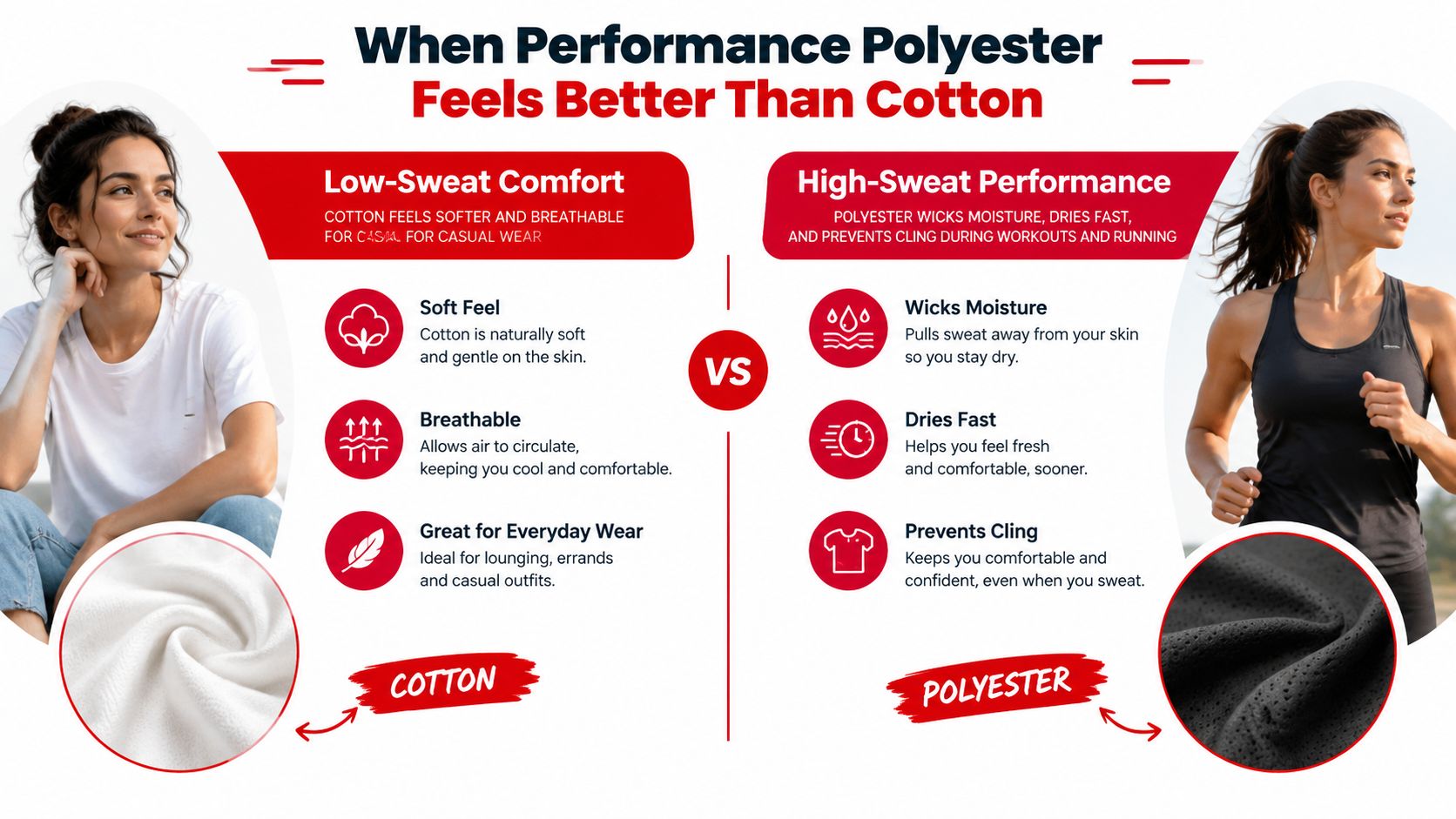
During low-sweat activities, cotton may feel softer and more familiar against the skin. Sitting at a desk, traveling in mild conditions, or running a short errand may not create enough moisture for strong wicking to matter. In those moments, cotton's softness can be the main comfort feature.
As exertion rises, the comparison changes. A psychophysical study found that cotton had the largest moisture-perception threshold at low sweat levels, while high-performance polyester performed better under heavier sweat loads. In plain language, cotton may make small amounts of moisture less noticeable, while polyester can feel more comfortable once activity creates substantially more sweat. Psychophysical research comparing cotton and polyester during sweating
Match the fabric to the day
Consider a man who commutes in the morning, works at a computer, and trains after work. If the shirt is mainly for the office and light movement, softness and appearance may matter more than maximum moisture transport. If he wears it directly through a demanding workout, polyester's ability to move moisture outward becomes more useful.
Outdoor work adds sun exposure, abrasion, repeated layering, and sweat to the decision. Polyester can help move moisture, but the buyer should also check fabric density, sleeve coverage, and the stated UPF rating. The word “performance” alone does not describe the whole shirt.
Travel creates another compromise. A top that feels excellent during a hard run may look too tight or shiny during a full day of casual wear. A moderately fitted performance knit, in a restrained color with a clean neckline, can fit more easily into a wider wardrobe. You can use this visual apparel reference when comparing how a performance top fits into casual outfits.
The same choice affects decoration. If the shirt will carry a DTF print, consider whether frequent sweaty workouts, sun exposure, and washing place more stress on the design. Fabric choice supports comfort, but print durability also depends on the garment and care routine.
Use cotton for desk work, travel, and light errands; choose polyester for demanding training or sweat-heavy outdoor activity.
Fit Weight and Construction That Change Comfort
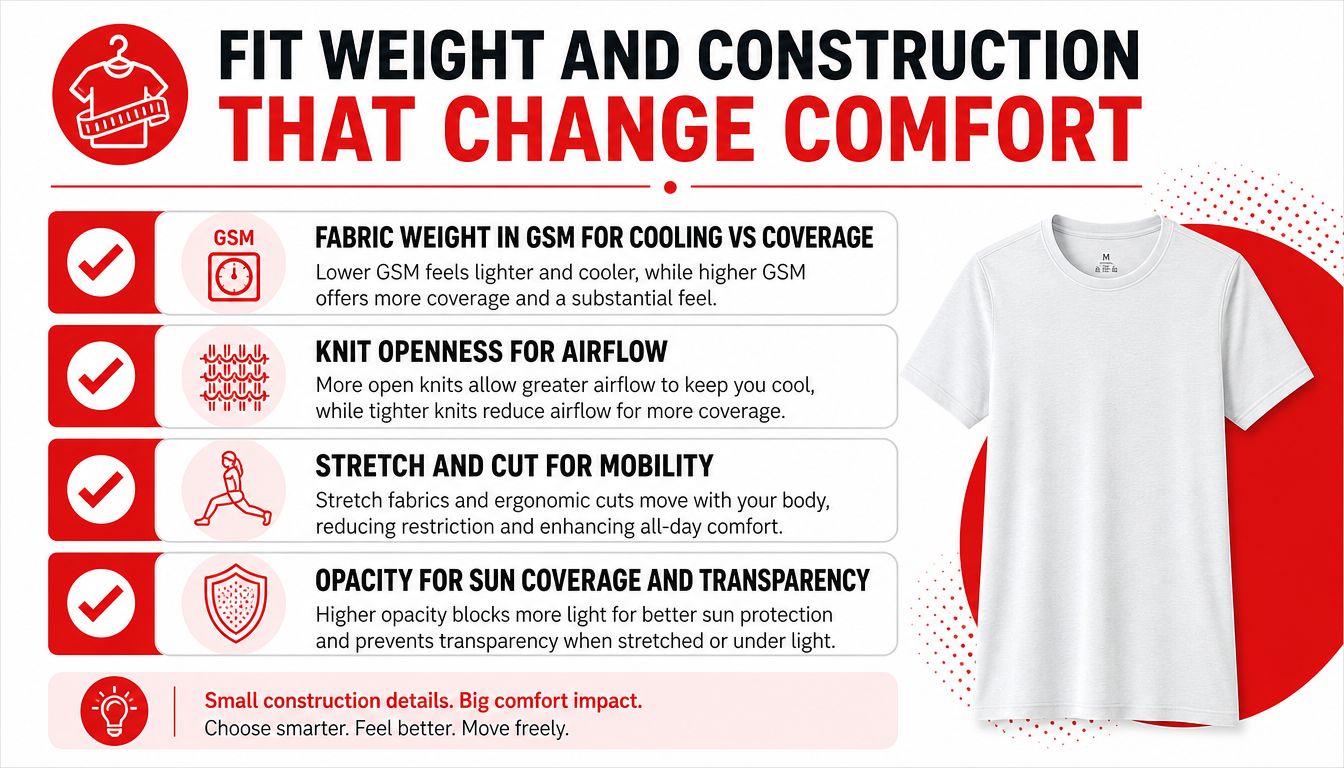
Two polyester shirts can produce very different wearing experiences. Fiber content is only the starting point. Knit density, fabric weight, stretch, cut, seam placement, and opacity determine whether a long sleeve feels cool, supportive, flexible, or distracting.
Fabric weight sets the basic trade-off
A lightweight performance knit usually favors airflow and quick moisture movement. It can suit hard training, warm indoor spaces, or layering beneath another garment. The trade-off may be less structure, lower opacity, or a more delicate hand.
A 150 gsm knit may feel light and flexible against the skin, while a 200 gsm knit generally feels more substantial and provides greater visual coverage. The denser option can work better for uniforms, field work, or transitional weather, but it may hold warmth longer during high exertion. Fabric weight should therefore match sweat level and expected conditions, rather than being treated as a quality score. Fabric-weight and knit-construction guidance
A fabric with more body may also give a DTF print a steadier base. That does not guarantee longer print life, because washing, stretching, heat, and repeated sweaty wear still affect the decoration.
Openness changes more than breathability
An open knit allows more air to pass through, which can feel useful during movement. Hold the shirt up to light before buying in bulk. If it reveals an undershirt or body outline more than expected, it may be unsuitable for a staff uniform or customer-facing workwear.
A tighter construction can improve opacity and coverage in the sun, while potentially slowing evaporation. The practical choice depends on whether the wearer needs maximum ventilation, more coverage, or a middle ground. A very open shirt may feel comfortable during a hot workout, yet provide less visual coverage when stretched or wet.
Fit changes the same balance. A close cut keeps fabric near the skin, which can support moisture transfer and reduce loose material during training. A relaxed cut leaves more room for layering and may feel easier during physical work. For everyday use, a moderate fit often adapts better to different settings than an aggressively slim or oversized silhouette.
Use this fitting checklist
Sleeve length: The cuff should reach the wrist during normal movement, rather than retreating halfway up the forearm when the wearer reaches forward.
Shoulder mobility: Raise both arms and rotate the shoulders. Tightness across the upper back suggests discomfort during work or training.
Hem behavior: A stable hem should stay in place when the wearer bends, stretches, or layers the shirt under outerwear.
Opacity: Check the garment in direct light, especially if it will be worn alone or carry a large DTF design.
Stretch recovery: Pull the fabric gently and check whether it returns smoothly instead of remaining distorted.
For outdoor use, knit construction also affects UV coverage. Polyester fabrics commonly reach UPF 30+, and some engineered PET fabrics have achieved UPF 53.71 with more than 95% UVA and UVB blocking. Protection generally improves as permeability decreases, while moisture can reduce protection in some cellulosic-polyester blends. Polyester, permeability, moisture, and UPF guidance
A denser long sleeve is therefore a sensible starting point for sun-exposed ranch, event, and field use when the garment lists an appropriate UPF specification. An ultralight open knit may suit indoor training or very high exertion, but buyers should not assume it offers equal coverage in bright sun, after becoming wet, or when pulled tight.
Printing and Customization on Performance Long Sleeves
A performance shirt can be excellent for movement and still create problems for decoration if the print plan ignores the fabric. Direct-to-Film printing applies a printed transfer to the garment surface, so the final result depends on how that surface stretches, flexes, and responds to heat.
Start with the garment, not the artwork
Smooth polyester jerseys usually offer a more consistent print surface than highly textured knits. Very open constructions, mesh panels, brushed interiors, and heavily ribbed areas can make a transfer sit unevenly. Before ordering, identify the exact fabric, surface finish, stretch direction, and intended print location.
Heat sensitivity deserves attention. Polyester garments can react differently to pressing temperatures and dwell times, and excessive heat may affect the fabric's appearance or hand feel. A decorator should confirm the garment's heat tolerance and use a test piece when the shirt is unfamiliar, especially for a large run.
Artwork scale matters too. A dense, oversized graphic may feel less flexible on a lightweight shirt than a smaller chest mark or sleeve detail. Fine lines, gradients, and layered colors can look sharp with DTF, but the design still needs to match the shirt's stretch and the wearer's movement.
Protect the print and the performance
Ask these questions before production:
Where will the transfer sit? Avoid placing a rigid design across areas that bend repeatedly, such as elbows or high-flex seams.
How much will the garment stretch? A design that spans a broad chest or back area needs enough flexibility for the shirt's normal movement.
Has the exact shirt been tested? Fabric color, surface texture, and finish can change the appearance of the transfer.
What care instructions apply? Washing and drying guidance should protect both the print and the fabric's performance finish.
Will the logo interfere with airflow? A very large printed area may feel different from the unprinted knit, even when the rest of the shirt remains breathable.
A pre-press review can catch issues before production. Check artwork edges, placement, sleeve alignment, and size grading across the requested garment range. A small logo may look balanced on a medium shirt but appear misplaced on a much larger or smaller size if placement isn't adjusted thoughtfully.
Wear X Apparel's DTF printing workflow reference is relevant for teams and creators comparing print application with garment selection. The central principle remains practical: a durable decoration begins with a compatible garment and a tested application process, not artwork alone.
Choosing the Right Shirt for Work Training and Everyday Wear
A ranch worker standing in strong sun, an event organizer moving between indoor and outdoor spaces, and a commuter heading from the office to the gym may all need a long-sleeve performance shirt. Their priorities differ. Sun exposure, sweat level, decoration needs, fit, and packability should guide the choice more than the label alone.
Current men's athleisure coverage points toward lightweight fabrics, simple basics, and flexible silhouettes. Performance long sleeves now serve as standalone tops, layering pieces, travel wear, workout apparel, and casual clothing. Men's athleisure direction for 2026
Use Case | Best Build | Why It Works |
|---|---|---|
Ranch or field work | Denser polyester knit with reliable sleeve coverage and a stated UPF rating | Adds opacity and sun coverage while still supporting moisture movement |
Event staff uniforms | Moderate-weight, smooth surface with a balanced fit | Looks consistent, supports decoration, and works across indoor and outdoor shifts |
High-intensity training | Lightweight, breathable knit with comfortable stretch | Reduces bulk and supports airflow during heavy movement |
Travel and commuting | Smooth moderate-weight fabric with a relaxed or regular cut | Layers easily and looks less specialized than a tight athletic top |
Everyday athleisure | Clean silhouette with restrained branding and stable hem | Moves between casual settings without looking like a technical base layer |
Team or club apparel | Consistent fabric, predictable sizing, and print-friendly surface | Simplifies ordering and helps logos appear uniform across garments |
Make the decision from the outside inward
Start with the wearer's environment. For extended outdoor work, compare fabric density, sleeve coverage, and the garment's stated UPF rating. Read the product listing carefully. A listing that says only “polyester” describes fiber content, not a confirmed UPF level. Look for a specific UPF specification and check that it applies to the exact shirt model before ordering.
Sweat level comes next. A very light, open knit can feel comfortable during hard training because air moves through it easily. That same construction may look too transparent or relaxed for event staff. For low-sweat everyday wear, softness, drape, and a clean appearance may matter more than the highest possible moisture transport.
Layering changes the fit decision. A close cut slides more easily under a jacket or overshirt, while a roomier cut leaves space for a base layer. Sizing up is not always the answer. Extra fabric can bunch under outerwear and change how a DTF design sits across the torso.
Group orders require a little more checking. Request size information, compare sleeve and body measurements, and approve a decorated sample before placing the full order. A shirt that suits training may look too athletic for a customer-facing team, especially if transparency, print placement, or silhouette varies from expectations.
Use this custom apparel planning visual to align garment choice, wear conditions, sizing, and production details before ordering. A practical sample connects the fabric decision to the final printed result.
Final Takeaways for Buying With Confidence
A good dri fit long sleeve mens shirt should fit the day ahead, not just the product page. Start with the likely combination of sweat, sun, movement, and decoration. A shirt for a cool commute and occasional walking has different demands from one worn through hard training or an outdoor shift.
Use this quick pairing guide before ordering:
Light training or warm-weather commuting: Choose a lighter performance knit when airflow and low bulk matter most.
Outdoor work or extended sun exposure: Choose a denser shirt with a stated UPF rating for the specific model. Fabric wetness, stretch, permeability, and density can affect coverage.
Team uniforms or customer-facing work: Favor a more opaque, structured surface that keeps its shape and presents a polished appearance.
Under jackets or overshirts: Choose a close, low-bulk cut so extra fabric does not bunch or shift a DTF design.
Large DTF artwork or frequent washing: Review stretch, surface texture, heat tolerance, print location, and care instructions. The print and fabric need to behave like partners, not competing layers.
Uncertain sizing or group orders: Approve a decorated sample first. It can expose sleeve-length, transparency, print-feel, and fit issues before the full order.
Care protects both the garment and its printed surface. Follow the shirt and print maker's washing instructions, and avoid handling a performance knit like a heavy cotton sweatshirt. After initial wear, inspect the design for lifting, cracking, or distortion. Small changes can reveal whether the selected fabric and print process suit the routine.
Nike's Dri-FIT history explains the technology's place in performance apparel, but the final choice depends on practical use. A useful sample connects fabric weight, sun exposure, sweat level, fit, and DTF durability in one check.
Wear X Apparel, LLC helps customers select garments for custom projects and provides DTF printing for individual pieces, teams, events, organizations, and branded apparel. Visit Wear X Apparel, LLC to review garment selection and production options for a long-sleeve performance shirt that matches the intended wear and print plan.
Comments