


DTF Printing Cost Per Shirt Explained

A realistic all-in DTF-printed shirt costs roughly $4 to $15 before profit, shipping, and taxes. That figure is a sum of parts, not a single input, including the transfer, blank garment, labor, overhead, finishing, and fulfillment.
You may be asking because one shop quoted a shirt at a few dollars while another quoted something much higher for what appears to be the same design. Usually, the difference isn't mysterious. One quote may cover only the transfer, while the other includes the garment, pressing, inspection, packaging, and the time required to complete the order.
The useful question isn't, “What does DTF printing cost per shirt?” It's, “Which costs are included in this quote, and what will my total landed cost be at my actual quantity?”
Table of Contents
What a DTF-Printed Shirt Costs - The receipt behind the number
How a DTF Transfer Is Priced - Read the transfer line by line
The Hidden Cost Layers Around the Transfer - What a transparent quote should show
Why Print Size Changes Everything - Specify the size before comparing quotes
How Order Volume Changes the Per-Shirt Number - The volume curve isn't only about materials
Garment Choice and Its Effect on Price - Match the fabric to the decoration plan
Practical Ways to Lower Your Per-Shirt Cost - Start with the artwork - Control fulfillment and waste
What a DTF-Printed Shirt Costs
A customer ordering shirts for an event, ranch crew, team, or new apparel idea often starts with one question: “What's your price per shirt?” The useful answer begins with the receipt. A finished-shirt price combines several separate charges, and each one affects the total at your actual order quantity.
A current cost breakdown lists the blank garment at approximately $2 to $8, the DTF transfer at $0.50 to $3.00, direct labor at $1 to $3, and allocated overhead at $0.50 to $1.50. Added together, those lines produce an indicative production cost of about $4 to $15 per shirt before profit, shipping, taxes, or unusually complex artwork, according to this DTF cost breakdown.
Use that range for planning, not as a universal retail price. A low per-shirt number may cover only the transfer, while a higher quote may include the garment, pressing, inspection, packaging, and fulfillment.
The receipt behind the number
A transparent DTF quote may show these lines:
Blank garment: The shirt, hoodie, or other apparel item.
Transfer: Ink, film, adhesive powder, and the cost of producing the printed film.
Artwork preparation: File cleanup, sizing, separation, or background removal when required.
Pressing and handling: Loading the garment, applying the transfer, peeling the film, and completing a finishing press.
Quality control and packaging: Checking placement and adhesion, folding, bagging, labeling, and preparing the order.
Overhead and fulfillment: Equipment, rent, utilities, maintenance, waste, shipping, and payment-related costs.
Two shops can quote different totals and both be accurate. Compare the same garment, print dimensions, quantity, delivery address, and artwork requirements before judging either price.
Practical rule: Never compare a finished-shirt quote with a transfer-only price.
Add every included line to find your total landed cost. That number, rather than the cheapest isolated line, shows what each shirt will cost for your order.
How a DTF Transfer Is Priced
A DTF transfer is a separate product before it ever reaches the shirt. The printer lays down CMYK color and white ink on PET film, then hot-melt adhesive powder bonds to the printed side. The completed film is later pressed onto the garment.
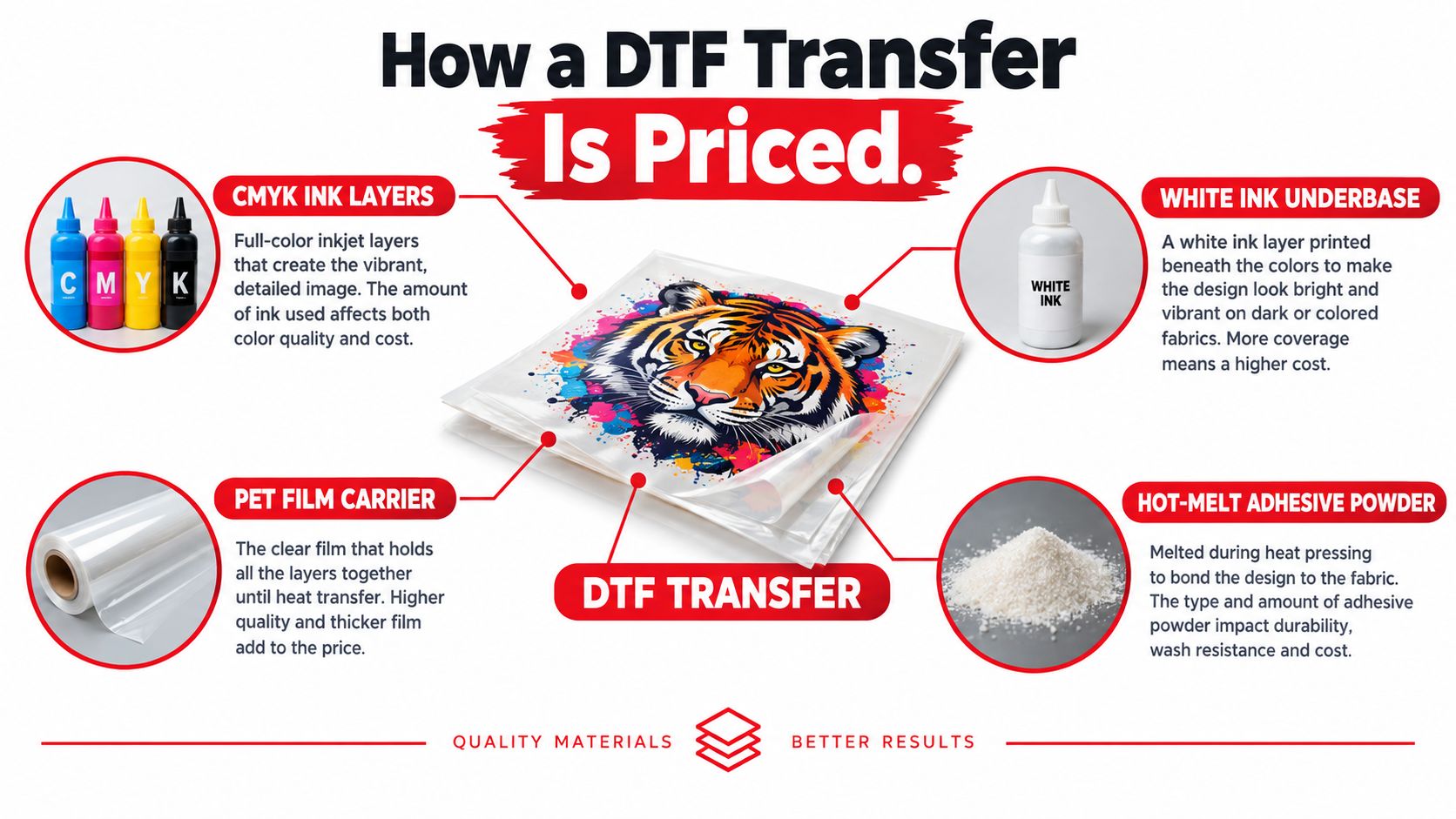
For a front-sized transfer made in-house, one industry analysis estimates a pre-labor cost of approximately $0.38 to $0.64. Its representative breakdown assigns about $0.18 to CMYK-plus-white ink, $0.06 to PET film, $0.04 to hot-melt adhesive powder, $0.08 to equipment amortization, and $0.02 to maintenance and waste. The equipment example assumes a five-year amortization period for a $10,000 setup, as detailed in this DTF equipment cost analysis.
Read the transfer line by line
Ink covers the artwork. More color coverage and a larger image generally require more ink. White ink also forms the base layer that helps color show on darker garments.
Film carries the image. The PET film is the temporary carrier. Larger artwork consumes more usable film area.
Powder creates adhesion. The hot-melt powder becomes the bonding layer between the printed design and fabric.
Equipment recovery supports production. A printer, curing system, and related tools must recover their cost over the prints they produce.
Maintenance and waste belong in the model. Failed prints, cleaning, handling mistakes, and upkeep are part of the process, even when the customer cannot see them.
The same analysis estimates that waste prints and maintenance can add roughly 5% to 10% to production costs. Those figures are benchmarks, not guaranteed prices. Ink formulation, printer efficiency, artwork density, wages, electricity, and waste rates can all change the result.
You can see the kind of finished garment that may receive a chest transfer in this DTF apparel example. The important distinction is that the transfer price still doesn't include the garment or the operator's time.
The Hidden Cost Layers Around the Transfer
A quote showing only “transfer” leaves out the work that turns a printed film into a finished product. The buyer pays for a garment, preparation, pressing, inspection, packing, and delivery, whether each item appears as a separate line or is built into one price.
The blank garment generally contributes approximately $2 to $8, based on material, construction, and market position. Direct labor for pressing, packaging, and quality checks adds about $1 to $3. Allocated overhead for rent, utilities, depreciation, and related operating expenses adds about $0.50 to $1.50. These ranges help you rebuild a quote, but the shop's workflow and order details determine the actual amount.
What a transparent quote should show
A production-ready quote should make each layer easy to identify:
Garment selection: Style, color, size range, and fabric affect the blank cost before printing starts.
Artwork preparation: A clean, print-ready file may need little work. Cleanup, resizing, or separation uses operator time.
Press application: The operator aligns the film, protects the garment, runs the press, peels the carrier, and may apply a finishing press.
Quality control: Placement, color appearance, adhesion, and garment condition need inspection.
Packaging: Folding, bagging, labeling, sorting, and carton preparation add handling time.
Shipping and fulfillment: One shipment to a single address requires different handling from separate packages for individual recipients.
Consumables and equipment also sit behind the transfer line. A set of DTF inks may cost $50 to $150, a film roll $30 to $80, and adhesive powder $20 to $50 per kilogram. Powder equipment may range from about $200 to $500 for entry-level shakers, while automated inline units can cost $1,000 or more. Shops recover these purchases across production, along with routine waste and maintenance.

The RXB Marlboro Rodeo Hoodie shows why the blank deserves its own line. Its listed specifications include an 8.5 oz./yd² US fabric weight, a 70/30 ring-spun cotton/polyester blend, a fleece-lined hood, reinforced construction details, and a three-dimensional velvety chest logo. That garment cannot be costed like a basic tee just because both receive one transfer.
If a quote says only “shirt” and “print,” ask whether artwork preparation, pressing, quality control, packaging, and shipping are included. A low per-shirt figure may reflect omitted work rather than a lower total landed cost.
Why Print Size Changes Everything
Print area is one of the clearest ways a DTF quote changes. A small left-chest logo and a large front graphic aren't the same transfer, even when they use identical artwork colors.
A detailed European model places a 10 × 10 cm left-chest print near €3.80, an A4 print at about €5.46 all-in, and an A3 print near €6.50. The A4 benchmark includes labor, electricity, maintenance, waste, ink, film, and powder, as shown in this European DTF garment cost model.
Print Size | Approx. Area | All-In Per-Garment Cost |
|---|---|---|
10 × 10 cm left chest | 100 cm² | About €3.80 |
A4 | A4 sheet area | About €5.46 |
A3 | A3 sheet area | About €6.50 |
The mechanism is straightforward. A larger design uses more printable film, more ink, and more adhesive powder. It may also require more careful alignment and handling, although labor doesn't always rise in direct proportion to image area.
Specify the size before comparing quotes
Ask each shop to quote the same placement and dimensions. “Front logo” could mean a compact chest mark, a medium design, or an almost full-front image. Those descriptions aren't precise enough for an apples-to-apples comparison.
Include:
Placement: Left chest, center chest, full front, sleeve, back, or another location.
Dimensions: Give the width and height in centimeters or inches.
Artwork coverage: Mention whether the design is a light logo or a dense full-color graphic.
Garment color: Dark garments may require a white underbase, which affects ink coverage.
A quote that seems high may be using a larger print than the quote you're comparing it with. Before negotiating the price, confirm that both shops are pricing the same physical transfer.
How Order Volume Changes the Per-Shirt Number
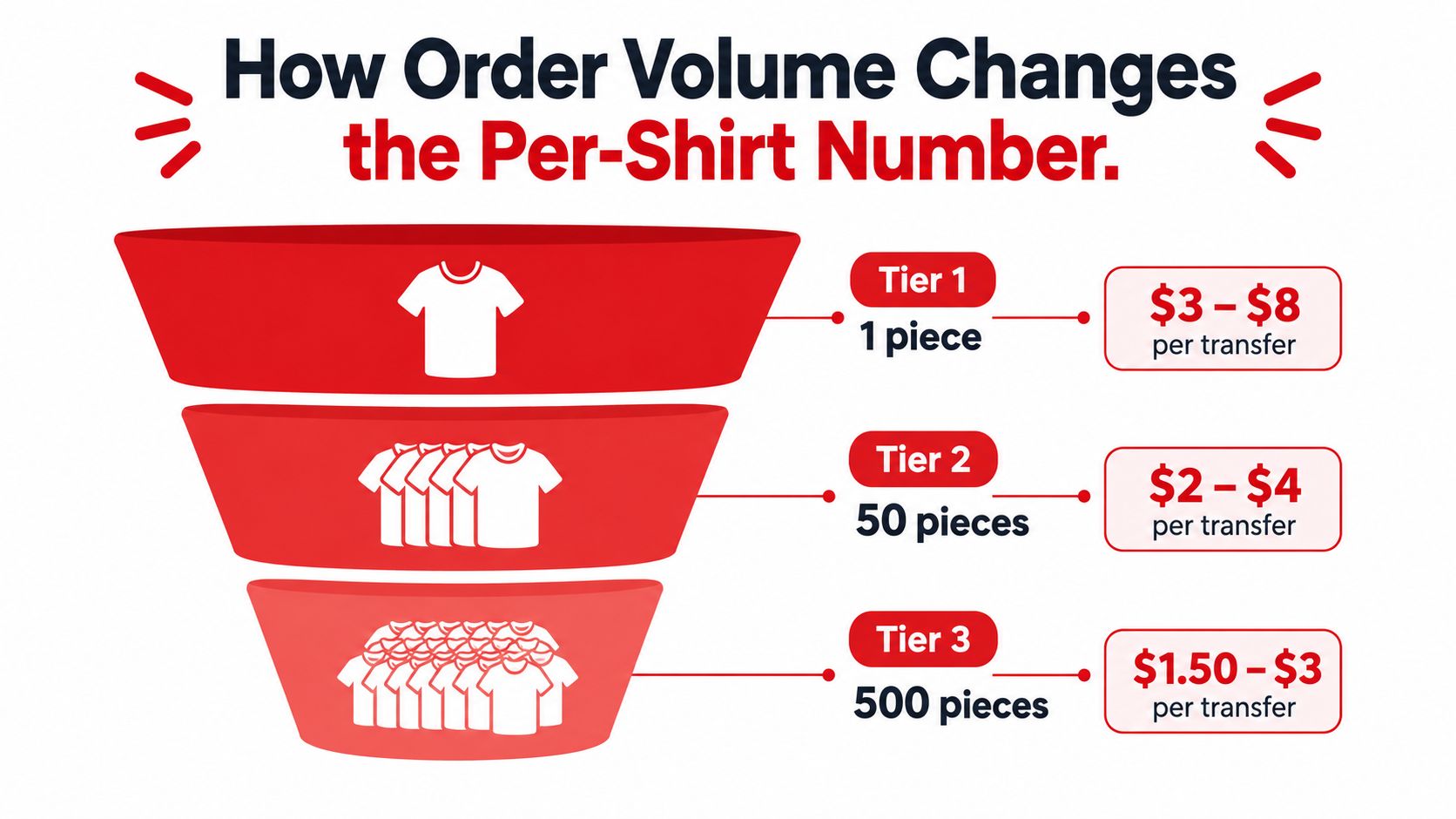
Order quantity changes the economics because fixed production effort gets distributed across more garments. A one-piece order still requires artwork handling, transfer production, pressing, inspection, and packing, while a repeated batch lets the operator organize those steps more efficiently.
One comparison estimates DTF transfer pricing at roughly $3 to $8 for one piece, $2 to $4 at 50 pieces, and $1.50 to $3 at 500 pieces. The same comparison places the point where screen printing may become cheaper at approximately 50 to 100 garments, depending on local pricing and design complexity. These figures come from this DTF and screen-printing cost comparison.
The volume curve isn't only about materials
Equipment amortization spreads across more prints as utilization rises. Setup and artwork handling become less significant per garment, and the operator can arrange repeated transfers efficiently on shared film. Labor still matters, but batch pressing usually uses time more effectively than switching between unrelated one-off jobs.
A broader comparison estimates DTF at roughly $3.32 to $9.20 per unit for orders up to 100, falling to about $1.80 to $4.50 above 500 units, depending on the production circumstances. Those ranges reinforce the need to ask about quantity rather than treating a single per-shirt number as permanent.
Here's a production walkthrough that can help visualize how DTF transfers move from printed film to finished apparel:
A large order isn't automatically cheaper after every fulfillment cost is included. Mixed sizes, several garment colors, front-and-back placements, replacement units, sorting, and distributed shipping can change the total. The right comparison is total landed cost at the quantity and workflow you need.
You can also review this custom apparel production example when thinking through how an order moves from design to fulfillment.
Garment Choice and Its Effect on Price
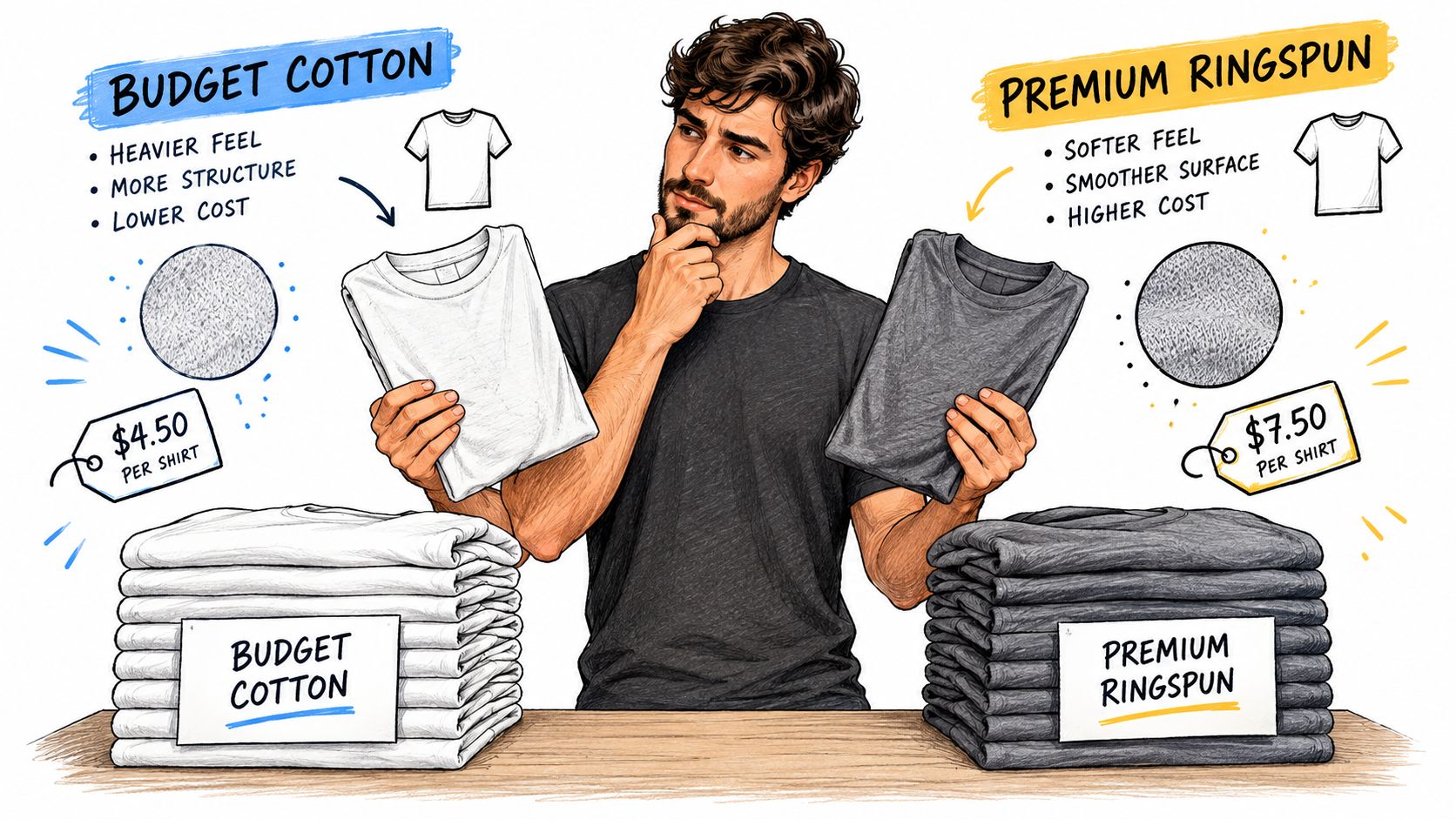
The blank garment sets the starting point for the quote. A basic cotton tee may sit toward the lower end of the $2 to $8 garment range, while premium ringspun, tri-blend, heavier garments, and specialty construction move toward the higher end. The transfer doesn't change just because the shirt costs more, but pressing, handling, and reject risk can change.
A hoodie adds fabric weight, seams, a hood, and sometimes pockets that make alignment and pressing less straightforward. A cap or structured item may require a different pressing setup and a smaller, denser transfer. Those handling differences belong in the labor discussion, not hidden inside an assumption that every garment takes the same time.
Match the fabric to the decoration plan
Basic tees: Usually offer the simplest pressing surface and the broadest choice of price points.
Premium tees: May provide a different fit, hand, and construction, but the blank cost rises with the garment specification.
Hoodies and crewnecks: Need careful placement around seams, pockets, ribbing, and thicker fleece.
Polyester blends: May require a controlled pressing approach to reduce the risk of scorching or dye migration.
Dark garments: Need a white ink base beneath the color image, so the transfer should be quoted with the correct coverage.
Caps and structured items: Often need specialized pressing equipment and placement decisions.
Choose the garment first, then the print size, then the quantity. Changing any one of those inputs can alter the other costs. A full-front design on a lightweight tee and a small chest mark on a heavyweight hoodie aren't interchangeable jobs, even if both use one color in the artwork.
Practical Ways to Lower Your Per-Shirt Cost
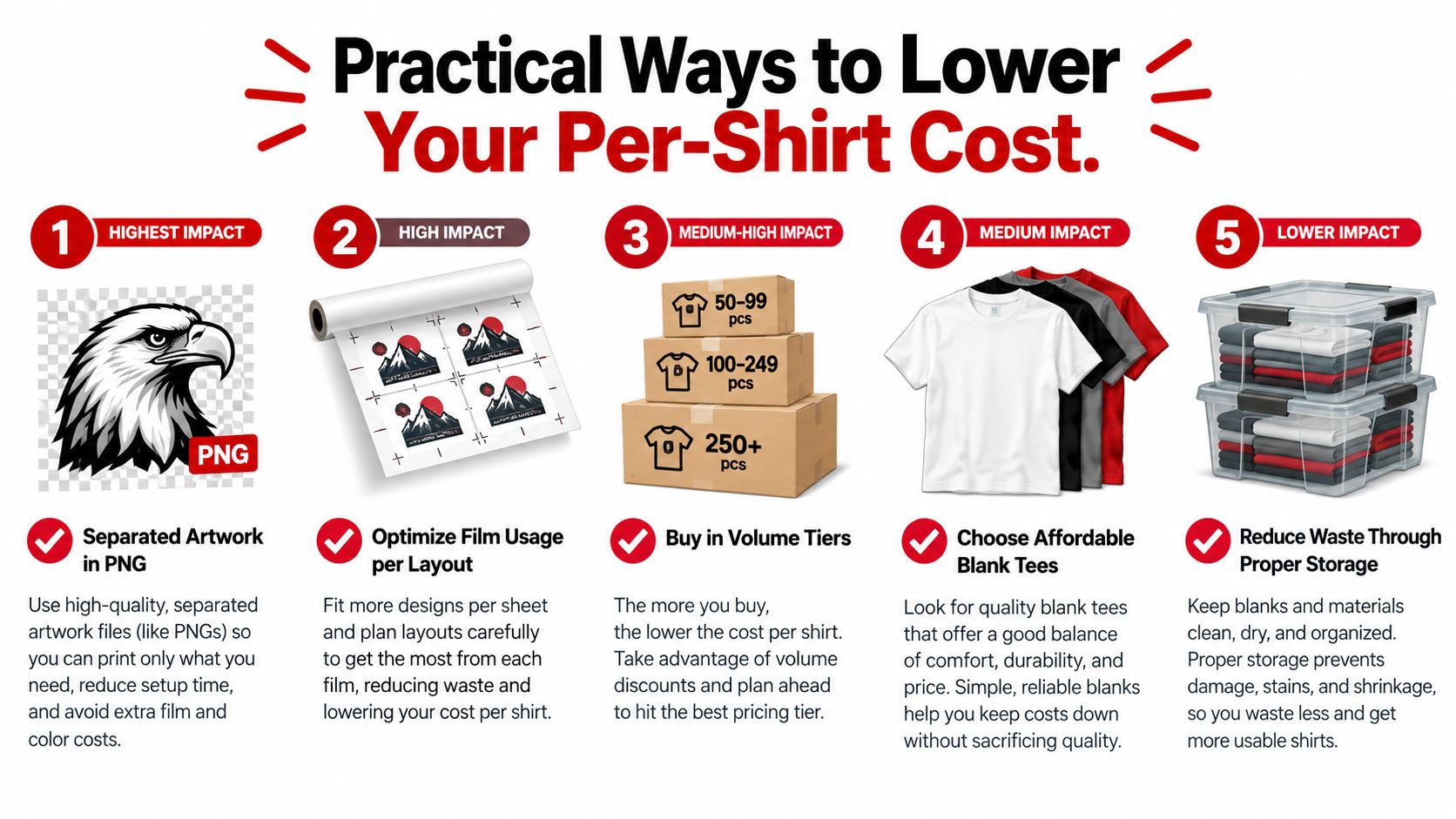
The largest savings usually come from reducing avoidable handling, not from asking a shop to cut essential production steps. Give the operator clean artwork, make the layout efficient, and make the order easy to produce consistently.
Start with the artwork
Send a separated PNG: A transparent-background PNG can remove the need for background removal or extra file preparation.
Confirm final dimensions: Supply the intended width and height instead of making the shop guess from a screen preview.
Avoid unnecessary variations: Standardizing the design size across available garments simplifies production and reduces setup decisions.
Use gang-sheet layouts: Nesting multiple designs on one film sheet can spread film and setup effort across more transfers.
Reduce full-front area where appropriate: A left-chest design uses less transfer area than a large front graphic when the smaller placement communicates the brand effectively.
Batching also matters. Pressing a group of the same design lets the operator repeat the alignment and handling process instead of constantly changing files, placements, and garment settings.
Control fulfillment and waste
Consolidate delivery to one address when possible. Sending individual garments to distributed recipients adds sorting, packing, and shipping complexity that may outweigh a nominal bulk discount.
Waste should be planned rather than ignored. The cited equipment analysis estimates that waste prints and maintenance add roughly 5% to 10% to production costs, so careful artwork checks, proper film storage, and a sensible allowance for replacement pieces can prevent more expensive rush reprints later. The goal isn't to order blindly. It's to discuss the replacement plan before production starts.
Ask for a quote that reflects the workflow you can support: one artwork file, one garment style where possible, consistent placements, a consolidated destination, and a realistic deadline.
Reading a Quote Like a Production Manager
A DTF quote becomes useful when you can audit it. Start by asking whether the blank garment and transfer are separate. If they're combined, request the garment style and transfer dimensions so you know what you're comparing.
Next, verify the print size. “Logo” isn't a measurement, and “front print” can describe very different areas. Ask for the width, height, placement, and whether the quote covers one side or multiple locations.
Then look for labor and setup. Pressing, inspection, folding, bagging, artwork preparation, and special handling may appear as separate lines or as an included production charge. Either approach can work, but you need to know whether those tasks are included.
Finally, identify the costs outside production:
Shipping: Confirm whether delivery goes to one address or several recipients.
Taxes: Check whether the quoted total includes applicable taxes.
Payment fees: Ask whether the payment method changes the final amount.
Artwork changes: Confirm whether revisions, cleanup, or resizing carry an additional charge.
Replacements: Ask how defects or damaged garments are handled before approving the run.
A transfer-only price can look impressively low because it excludes the shirt and the work required to apply it. A finished-shirt price can look high because it includes every operational layer. Neither number tells you enough until the quote is rebuilt using the same garment, print size, quantity, destination, and production requirements.
The rule to carry forward: Compare total landed cost at your actual order quantity, not the cheapest isolated line on a quote.
Wear X Apparel, LLC provides garment selection and DTF production services for custom T-shirts, hoodies, and other apparel, supporting single items and batch orders for teams, events, organizations, and made-to-order projects. Visit Wear X Apparel, LLC with your artwork, garment preferences, quantity, and delivery needs to request a quote that can be reviewed line by line.
Comments