


High Quality Checks in Custom DTF Apparel

A batch of event shirts can look perfect on the mockup and still arrive with problems that are impossible to ignore. The logo may sit too close to the collar, the garment color may be wrong, or the transfer may show cracked edges after the first wash. By then, the production team has already spent the material, press time, packing effort, and goodwill attached to the order.
High quality checks prevent that outcome by moving inspection to the point where each defect is created. In DTF custom apparel, that means approving the artwork before printing, verifying the garment before application, monitoring the transfer during production, and examining the finished piece before packing. A final visual check still matters, but it can't carry the entire quality system.
Table of Contents
The Real Cost of Skipping Process Checks - Why final inspection isn't enough - Stage gates protect small orders
The Statistical Foundation of Garment Inspection - Common causes and special causes - Turning observations into production knowledge
Artwork Intake and Pre-Production Verification - Start with the file, not the press - Verify the garment as an input material
Print Application and Curing Quality Metrics - Define a passing transfer - Sample during the run - Separate rework from release
Human Judgment Versus Automated Defect Detection - Where automated detection helps - Why people remain essential
The Real Cost of Skipping Process Checks
A production manager usually sees the failure before the customer explains it. The cartons arrive, someone opens the first package, and the design appears a little too high. The second shirt has the same problem. Then the team finds a different garment shade in the next size, followed by transfers with inconsistent edges.
At that point, checking every finished item won't solve the original issue. If the artwork file contained the wrong placement, or the production setup used an unapproved garment color, the error has already multiplied across the run. Reprinting may be possible, but the original garments, transfer materials, labor, and delivery schedule still create pressure.
Why final inspection isn't enough
End-of-line inspection answers one narrow question: does this finished item appear acceptable? It may identify a defect, but it often can't identify whether the cause was artwork preparation, garment selection, film handling, powder coverage, curing, heat-press settings, or packing.
That distinction matters in DTF production because different failures occur at different points:
Artwork errors can produce the wrong dimensions, background treatment, or placement.
Garment errors can introduce the wrong style, size, color, or surface characteristics.
Application errors can create poor adhesion, pinholes, uneven edges, or visible transfer distortion.
Fulfillment errors can send a correctly printed item to the wrong customer or package.
A single final glance may catch some of these issues. It won't reliably prevent the same issue from appearing on the next order.
Practical rule: Stop a defect at the earliest checkpoint where someone can still correct it without scrapping the finished garment.
Stage gates protect small orders
Large production runs can sometimes absorb rework more easily than made-to-order work, but small batches have their own risks. Every garment may be important to the customer, and a single rejected hoodie can matter more than an isolated defect in a large commodity lot.
A stage-gated workflow creates a clear decision at each point:
Artwork gate: Is the approved file suitable for the intended garment and placement?
Garment gate: Do the received garments match the order and support the application?
Production gate: Does the transfer meet the defined appearance and adhesion requirements?
Release gate: Does the finished item pass inspection, documentation, and packing review?
This approach trades a small amount of early attention for fewer late surprises. It also gives the production team a defensible record when a customer asks what “quality checked” means.
High quality checks aren't a final ceremony before shipping. They're a series of decisions that keep an avoidable mistake from moving to the next stage.
The Statistical Foundation of Garment Inspection
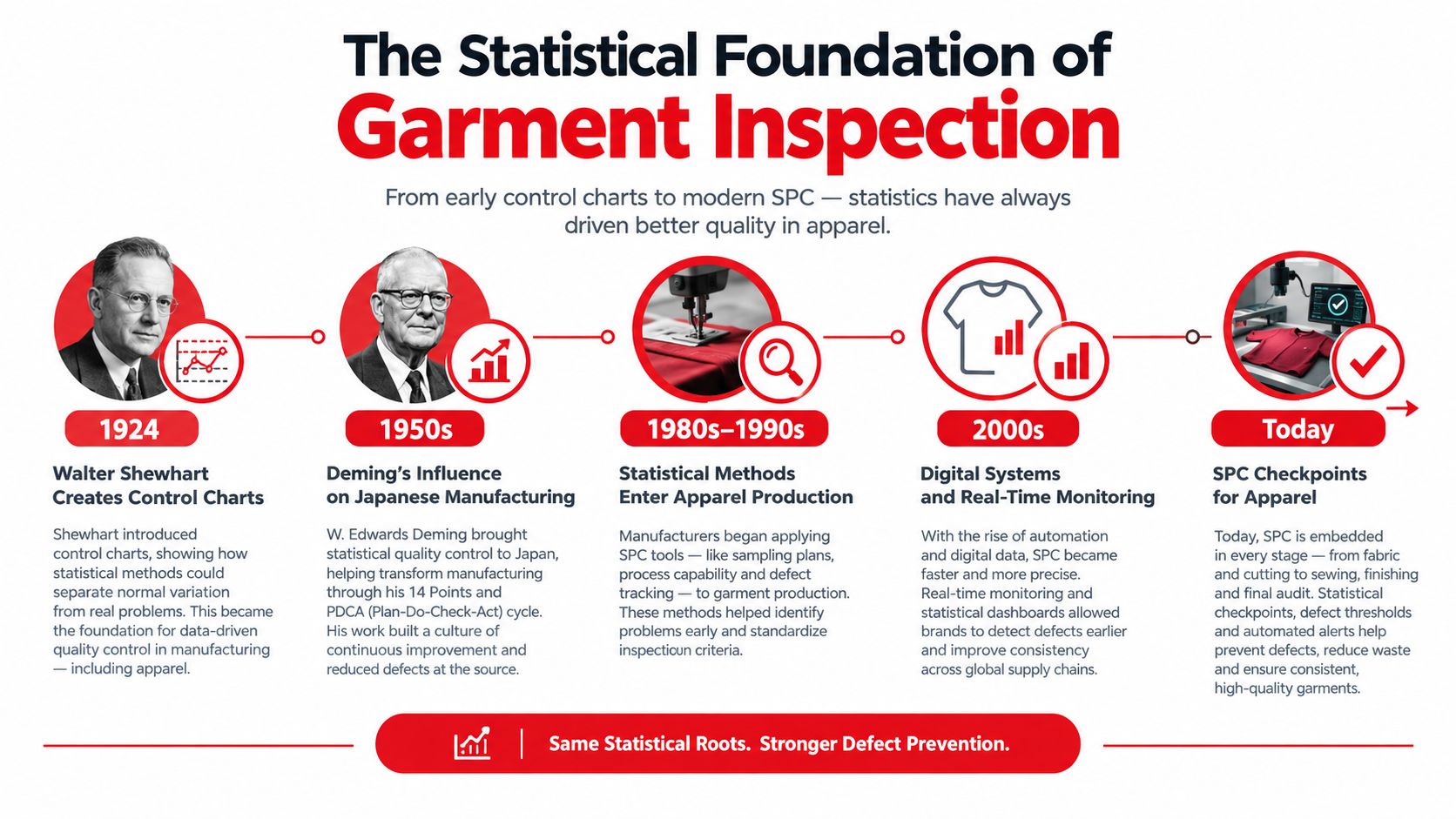
Modern quality control became more useful when manufacturers stopped treating quality as a judgment made only after production. On May 16, 1924, Walter A. Shewhart of Bell Telephone Laboratories proposed the first modern control chart in a one-page memorandum. The method shifted attention toward monitoring process variation while work was taking place, rather than relying primarily on end-of-line inspection. The historical account of Shewhart's control-chart milestone describes how this development helped distinguish predictable variation from unusual variation that could signal a correctable problem.
Common causes and special causes
A stable process produces outcomes within a reasonably predictable range. Small differences in print position, color density, or garment dimensions may occur as part of ordinary process variation. A sudden shift, repeated pattern, or result outside the defined limits suggests a special cause, such as a changed setting, material problem, equipment issue, or operator error.
That gives a DTF operation two responsibilities:
Establish normal performance: Record repeated observations for the characteristics that matter, such as placement, dimensions, color consistency, adhesion, and defect occurrence.
Investigate unusual results: Pause, identify the cause, correct the process, and decide what already-produced items need review.
This is different from inspecting every finished garment without recording what was found. Inspection can identify a bad shirt. Process control helps the team determine whether the bad shirt is isolated or evidence of a wider problem.
The National Institute of Standards and Technology's historical quality-control account identifies Shewhart's memorandum and his later book, Economic Control of Quality of Manufactured Product, as important milestones in the development of statistical process control. The practical lesson for apparel isn't that every small shop needs a complex laboratory system. It's that decisions should be based on recorded observations instead of memory or impressions.
Turning observations into production knowledge
A simple inspection record can include the order, design, garment type, color, size, production batch, operator, checkpoint, result, and corrective action. That information lets a manager ask better questions:
Did the issue appear only on one garment color?
Did it begin after a material change?
Did several sizes show the same placement problem?
Did the defect occur before or after a press adjustment?
Was the item reworked, rejected, or released with approval?
The historical contribution of statistical process control is therefore highly practical. Measurements and sampling guide action. They help a team continue production when results remain stable, adjust a process when variation changes, or stop production when the evidence points to a recurring cause.
Artwork Intake and Pre-Production Verification
A customer approves the mockup, the order reaches the press queue, and only then does someone notice that the transparent background contains a white box. The intake gate should catch that mistake before film, powder, ink, or garments are committed. It converts the customer's concept into production instructions the team can verify.
Start with the file, not the press
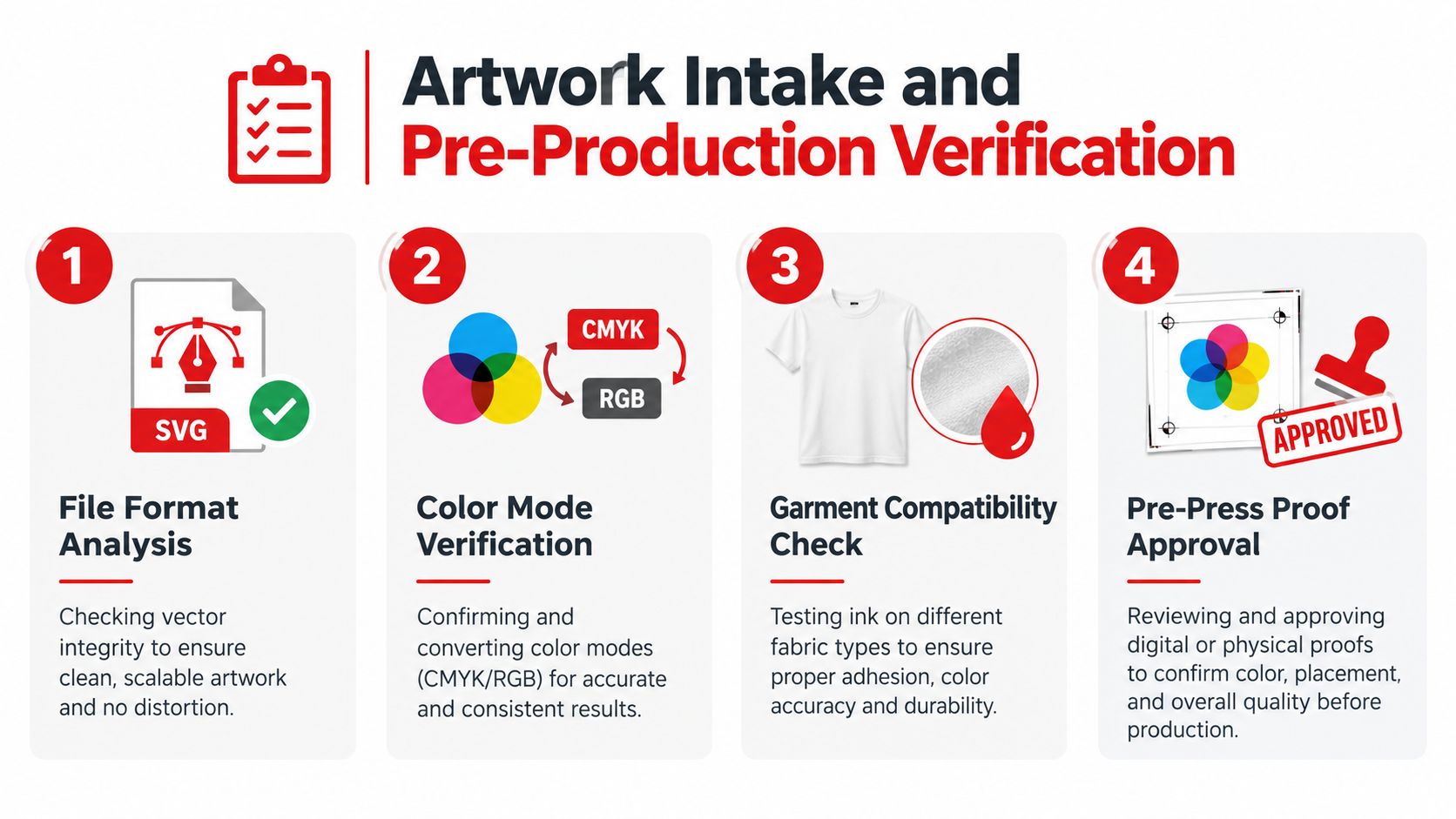
Artwork approval should establish two things: the file contains the intended design, and the DTF workflow can process it without changing its appearance. Check each point before releasing the order:
File integrity: Confirm that text, artwork elements, and transparent areas render correctly. Vector artwork should keep clean shapes when scaled. Raster artwork should remain clear at the planned print size.
Background treatment: Check for unwanted backgrounds, halos, and semi-transparent edges. Confirm whether each one should be removed or preserved. A white shape intended to disappear can become part of the transfer.
Color handling: Record how source colors will be interpreted during DTF preparation. RGB and CMYK files can produce different results, so the approved proof should represent the intended production appearance rather than a screen preview alone.
Dimensions and placement: Measure the design against the approved mockup. Verify width, height, vertical position, horizontal alignment, and clearance from collars, pockets, seams, and hems.
Approval status: Store one approved proof with the order and identify it as the production version. The operator should not work from an earlier attachment in an email thread.
The acceptable values depend on the garment, artwork, equipment, and customer standard. Define those requirements before printing, then record whether the file passes, needs clarification, or remains on hold. Speed at intake is useful only when it does not create rework at application.
Verify the garment as an input material
A correct file cannot compensate for the wrong blank. Compare the shipment with the order record before application, checking style, color, size, visible condition, fabric surface, seams, and construction. Separate mismatched or damaged garments before they enter the production batch.
Inspect for stains, holes, pulled threads, distorted panels, uneven seams, and other conditions that can affect the finished design. Defects can originate in fabric, garment construction, materials, equipment, or workflow. A documented apparel-defect framework supports examining those possible causes instead of treating visual inspection as the whole quality system.
Fabric composition and surface change the production decision. A heavier blank like the RXB Marlboro Rodeo Hoodie, with its fleece-lined hood and three-dimensional chest logo, can change placement and pressure choices. Fabric weight, face texture, existing decoration, seams, and panel shape belong in the review.
End the pre-production gate with one decision: approved, held for clarification, or rejected. If the file, mockup, garment, or order details do not agree, hold the job rather than letting the press schedule force approval.
Print Application and Curing Quality Metrics
A transfer can look acceptable on the platen and still fail during handling, packing, or washing. DTF quality therefore needs stage gates across printing, powder application, heat pressing, curing, and post-application review. Each gate should define the result, the measurement method, and the action taken when the result falls outside the approved range.
Define a passing transfer
“Make it look good” is not a usable production specification. Record the visible and physical conditions that qualify a transfer for release:
Clean artwork edges: Check for ragged borders, unwanted film, powder residue, and visible pinholes.
Consistent color appearance: Compare the approved first piece with later pieces under the same lighting. Look for density shifts, banding, unexpected color changes, and differences across garment colors.
Complete powder adhesion: Confirm that adhesive covers the printed area evenly. Bare patches and excess powder can both cause failures after pressing.
Correct placement: Measure from fixed garment references, such as the collar seam, pocket edge, or side seam. Visual judgment alone is too inconsistent for repeat orders.
Even application: Confirm that the transfer lies flat, with no lifted corners, wrinkles, bubbles, or distortion from pressure or garment movement.
Cure and adhesion: Follow the documented equipment and material settings, then apply the shop's defined handling or wash check. Release the garment only when the transfer remains attached and visually acceptable.
Settings depend on the film, adhesive, ink, garment, and press. The production record should capture the actual temperature, pressure, dwell time, and confirmation method used for the batch, rather than relying on a generic instruction for every garment.
Sample during the run
The first approved garment establishes the visual reference. It does not clear the entire order. Inspect additional pieces during the run, with extra checks after a roll change, material change, press adjustment, extended pause, or operator change. These events can alter transfer behavior even when the artwork file remains unchanged.
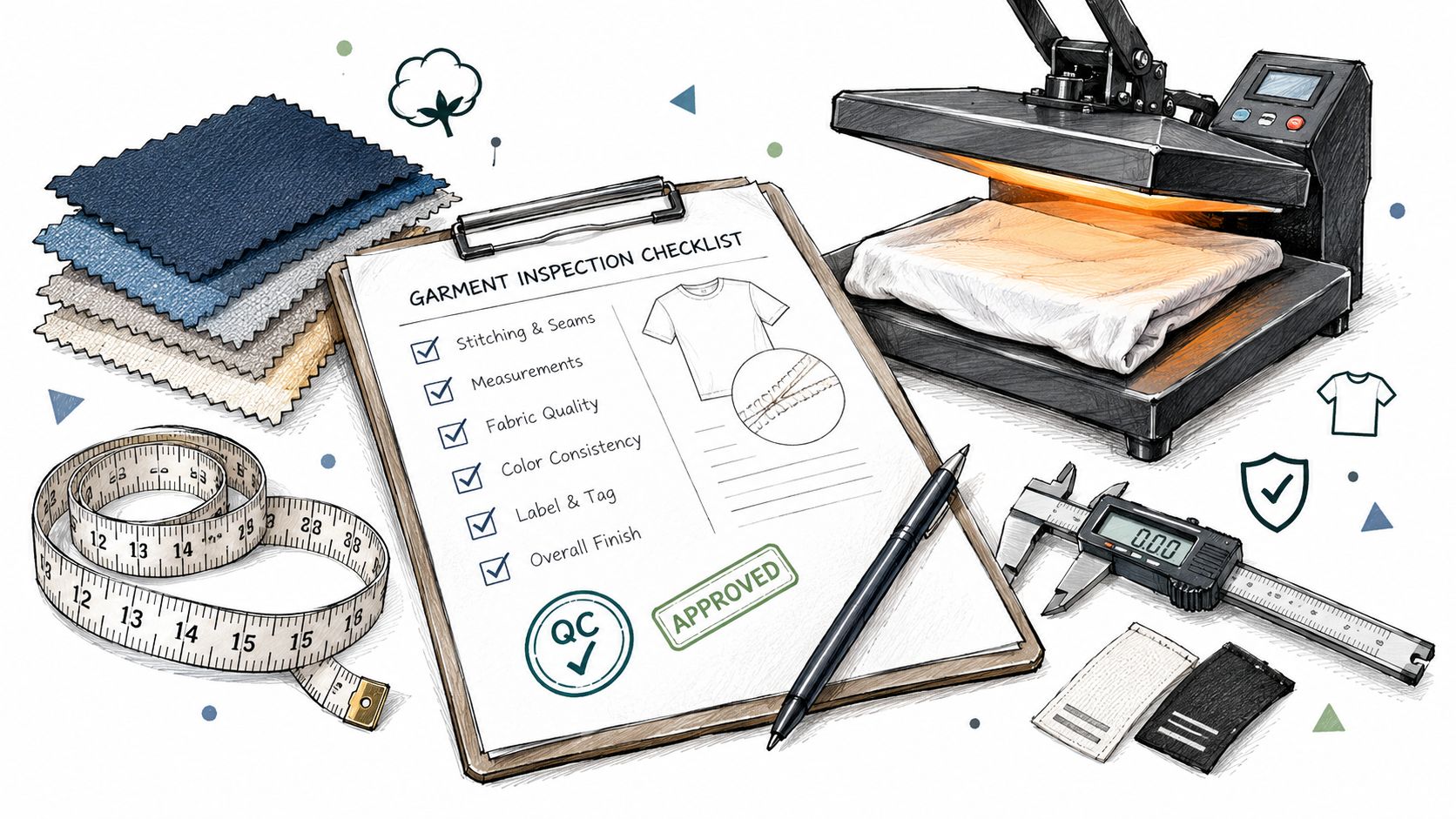
Track the batch, design, garment color and size, transfer condition, application result, and final disposition. A DTF garment production checklist image can support a documented application and inspection routine.
If a sample changes, stop the run and isolate affected items. Continuing at full speed while expecting variation to disappear usually increases rework and makes the failure harder to trace.
The following video can supplement a documented shop procedure, but it does not replace equipment-specific instructions or recorded approval:
Separate rework from release
A failed garment needs a recorded disposition, not an informal pile. Mark it as rework, reject, or hold, record the reason, and identify who made the decision. Rework should proceed only when the garment can be corrected without compromising appearance, adhesion, or customer requirements.
Consistent records expose recurring failures. The team can then adjust the print, powder, press, or handling process instead of finding the same defect at packing.
Human Judgment Versus Automated Defect Detection
Automation can inspect images quickly and consistently, but it doesn't understand every customer standard. A camera may identify a hole or broken seam while missing the fact that a design feels visually unbalanced against a collar, pocket, or textured panel.
Where automated detection helps
Automated systems are useful when the defect is visually defined, the camera view is stable, and the system has been validated against representative examples. They can screen for repeated conditions such as broken stitches, open seams, holes, missing areas, or obvious shape differences without fatigue.
A 2026 study using 2,157 images reported 89.6% mean average precision for detecting broken stitches, open seams, and fabric holes, with 5.7-millisecond inference per image. Those figures describe a defined image dataset and task, not universal inspection of every garment or DTF print. The study's reported textile-defect results should therefore be read as evidence of capability in a specialized setting, not as a blanket guarantee.
Automation also depends on lighting, camera position, fabric texture, image quality, defect size, training examples, and acceptable false alarms. A system that performs well on seams may not evaluate print color, transfer feel, placement relative to a customer mockup, or the acceptability of a minor visual difference.
Why people remain essential
Human inspectors are better positioned to judge context and intent. They can compare the finished garment with the approved proof, assess whether a color is acceptable on the selected fabric, feel for raised or poorly bonded areas, and recognize when placement looks wrong even if the image geometry appears technically close.
For low-volume and made-to-order work, there may not be enough representative defect images to validate an automated model responsibly. A small shop also needs to consider setup effort, false positives, maintenance, and who reviews the cases the system cannot classify confidently.
Inspection approach | Useful strength | Important limitation |
|---|---|---|
Human review | Handles customer-specific appearance, texture, placement, and context | Can vary with fatigue, lighting, training, and personal judgment |
Automated screening | Applies repeatable image checks at high speed | Depends on the dataset, image conditions, defect type, and validation quality |
Hybrid review | Uses automation for screening and people for approval | Requires clear escalation rules and documented human decisions |
The practical answer is a hybrid workflow. Let automation flag repeatable visual conditions where it has been tested, then keep human approval for design appearance, color acceptability, garment feel, seam relationships, and customer-specific standards.
Common Apparel Defects and Prevention Checkpoints
A defect is easiest to prevent when the team can identify where it entered the process. Use the apparel defect reference image during training, then make the production record identify both the observed issue and its origin stage. A final visual inspection can catch the symptom, but it cannot by itself explain whether the cause was the blank garment, artwork, transfer, press setup, or handling.
Common apparel defects include stains, needle holes, slipped stitches, uneven fabric feed, and misaligned seams. These conditions may exist before decoration, so incoming inspection remains part of DTF quality control. The apparel-quality research supporting these categories is available in the apparel-quality research supporting these defect categories. For DTF work, log every misprint by origin stage, then review whether the affected batch, film roll, powdering step, or press setting needs attention before the next order runs.
Defect Type | Origin Stage | Prevention Checkpoint |
|---|---|---|
Stains or visible marks | Incoming garment handling or storage | Inspect blanks before staging, isolate affected pieces, and record the source when the issue repeats |
Needle holes or damaged fabric | Garment construction or handling | Examine panels and high-risk areas before decoration, keeping rejected blanks separate |
Slipped stitches | Garment construction | Review seams and stitch lines during receiving inspection, before printing hides the condition |
Uneven fabric feed | Garment construction or equipment interaction | Check fabric appearance and garment stability before application, then investigate recurring distortion |
Misaligned seams | Garment construction or garment handling | Compare seam positions with the placement plan instead of treating construction damage as a print defect |
Wrong style, color, or size | Order intake or receiving | Match the physical garment to the approved order before printing |
Misplaced transfer | Artwork intake, staging, or pressing | Measure from consistent garment references and approve the first application before continuing |
Pinholes or rough transfer edges | Printing, powdering, or curing | Inspect the film and first applied piece, then check powder coverage and curing consistency |
Poor adhesion | Transfer preparation or heat application | Confirm the application settings and hold questionable pieces for evaluation |
Color inconsistency | Artwork preparation, materials, or production drift | Compare with the approved reference under consistent lighting and record changes by batch |
Assign an owner to every checkpoint. Receiving staff control the blank-garment gate. The artwork reviewer controls the approved proof and placement instructions. The operator owns application and curing records. Final inspection controls release. Shared responsibility without a named owner leaves defects between stages.
Trace defects backward before authorizing a reprint. If a logo sits low, verify the placement instruction, garment reference point, platen alignment, and operator setup. If adhesion fails, check transfer condition, powder distribution, curing, garment surface, and application sequence. A reprint may replace one garment while leaving the process fault untouched.
Building Trust Through Transparent Quality Assurance
Customers don't need a production lecture, but they do need a clear answer to a basic question: what does quality checked mean? A credible answer names the checkpoints, the characteristics reviewed, and what happens when an item fails.
For custom workwear, event merchandise, team apparel, and corporate orders, transparent quality assurance reduces uncertainty before the cartons leave the shop. An approved proof limits artwork disputes. Incoming-garment checks prevent the wrong blank from reaching the press. Application records help isolate production drift. Final packing review catches order and fulfillment mistakes that technical inspection alone won't see.
A professional supplier should be able to explain:
Which artwork elements require approval before production.
How garment style, color, size, and condition are verified.
Which print characteristics are measured or visually assessed.
How failed, held, and reworked items are documented.
How the team handles customer-specific standards for placement and appearance.
This process isn't about claiming that defects never happen. It's about showing that the operation can detect problems, contain them, learn from them, and communicate clearly. That is especially important when every garment in a low-volume order carries the customer's name, logo, or event identity.
For a visual example of documented production communication, review the custom apparel quality workflow reference. The strongest quality claim is not a slogan. It's a workflow that another person can understand and verify.
Wear X Apparel, LLC provides DTF garment printing, garment selection support, custom production, and made-to-order merchandise services for individual pieces and batch orders. If your next project needs defined artwork, application, and release checkpoints, visit Wear X Apparel, LLC to discuss the garments, design, and quality requirements before production begins.
Comments