


How Much Does It Cost to Ship a Shirt Guide

You've just printed a custom shirt, packed it into what looks like a simple mailer, and reached checkout expecting postage to be a minor expense. Instead, the shipping charge is close to, or even higher than, the garment price. That surprise raises the practical question many sellers and buyers ask: how much does it cost to ship a shirt?
The answer depends on more than the shirt. The carrier, service level, packed weight, package dimensions, destination, packaging, and extra fees can all change the final amount. A lightweight domestic shipment may stay in the low-dollar range with an economy postal service, while a bulky package, faster service, international destination, or private-carrier minimum can push the total much higher. The key is to calculate the complete cost per order, not just the postage printed on the label.
Table of Contents
Understanding Core Cost Components - Actual weight versus billable weight - The garment and its presentation
Key Factors That Determine Shipping Cost - Weight sets the first boundary - Dimensions can override a light scale weight - Packaging changes more than appearance - Speed is a premium decision
Hidden Costs That Raise Shipping Total - Where the extra expense appears
Sample Shipping Cost Scenarios - Scenario one, lightweight domestic parcel - Scenario two, Priority Mail - Scenario three, international delivery
Introduction to Shirt Shipping Cost
A single folded T-shirt is usually easy to ship, but “easy” doesn't mean “priced the same everywhere.” USPS says stamped standard letters start at $0.82, while large envelopes start at $1.69. Actual apparel often needs parcel handling, however, and that changes the calculation. For international apparel, USPS First-Class Package International Service retail packages start at $19.40 for 1 to 8 ounces, with higher tiers of $20.15 and $22.65 as weight or destination groups rise, as shown in the USPS January 2026 price notice.
A seller who compares only the garment's weight may miss the cost of the mailer, fulfillment time, surcharges, and a possible return. A buyer may see one checkout price, while the seller sees several separate expenses behind it. This guide separates those expenses so you can estimate a shirt shipment before accepting an order, choose a suitable service, and avoid packaging decisions that turn an economical shipment into an expensive one.
Understanding Core Cost Components
Start with a simple formula:
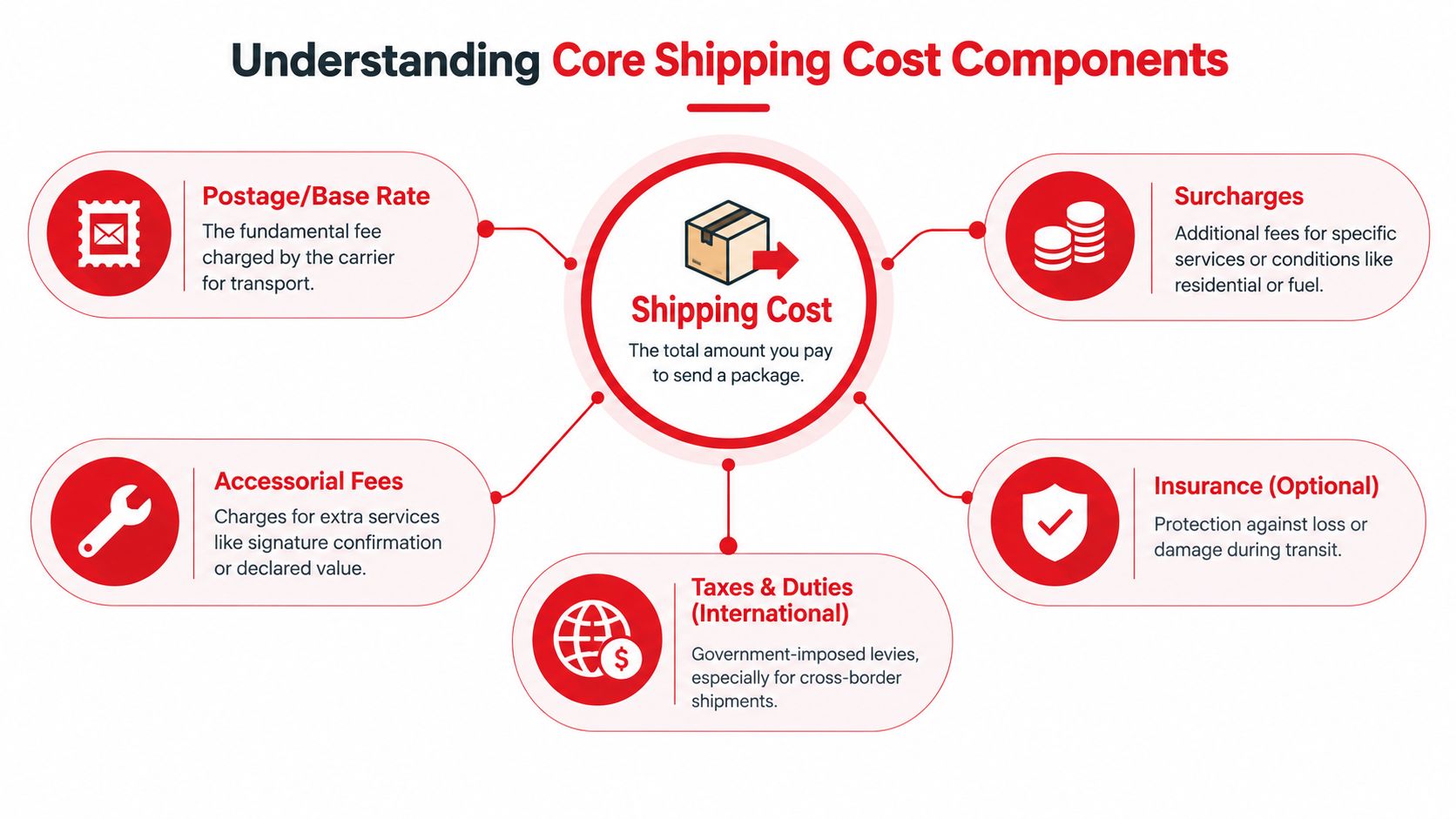
Total shipping cost = postage or base rate + packaging + handling + additional fees.
The base rate is the carrier's charge for moving the shipment. It reflects the selected service, the package's billable weight, and the route. Packaging includes the mailer, box, inner bag, tape, label, and any protective materials. Handling covers the time or fulfillment charge involved in folding the garment, preparing the label, and handing the parcel to the carrier.
Actual weight versus billable weight
Think of two packages that weigh the same. One contains a compact brick. The other contains an air-filled box that takes up much more room. A carrier has less space for other shipments around the large box, so some services price it according to the space it occupies rather than only its scale weight.
For USPS Priority Mail, actual weight generally applies unless the package exceeds one cubic foot. After that point, dimensional weight uses the formula length × width × height ÷ 139, with measurements rounded according to USPS rules, as explained on the USPS Priority Mail page. A thin mailer usually keeps a shirt below that dimensional threshold, while an oversized carton can create a higher billable weight even when the garment itself is light.
The garment and its presentation
A basic T-shirt in a slim mailer has a different shipping profile from a heavy hoodie in a box. For example, the RXB Marlboro Rodeo Hoodie is described as a heavyweight hoodie with an 8.5 oz./yd² 70/30 ring-spun cotton and polyester blend, a fleece-lined hood, and a generous fit. Those characteristics make packaging size and packed weight more important than they would be for a single thin shirt.
Extra charges can include tracking-related services, insurance, residential delivery, address correction, or international customs costs. Before you publish a flat shipping rate, weigh and measure the finished package, not the empty mailer and not the garment alone.
Key Factors That Determine Shipping Cost
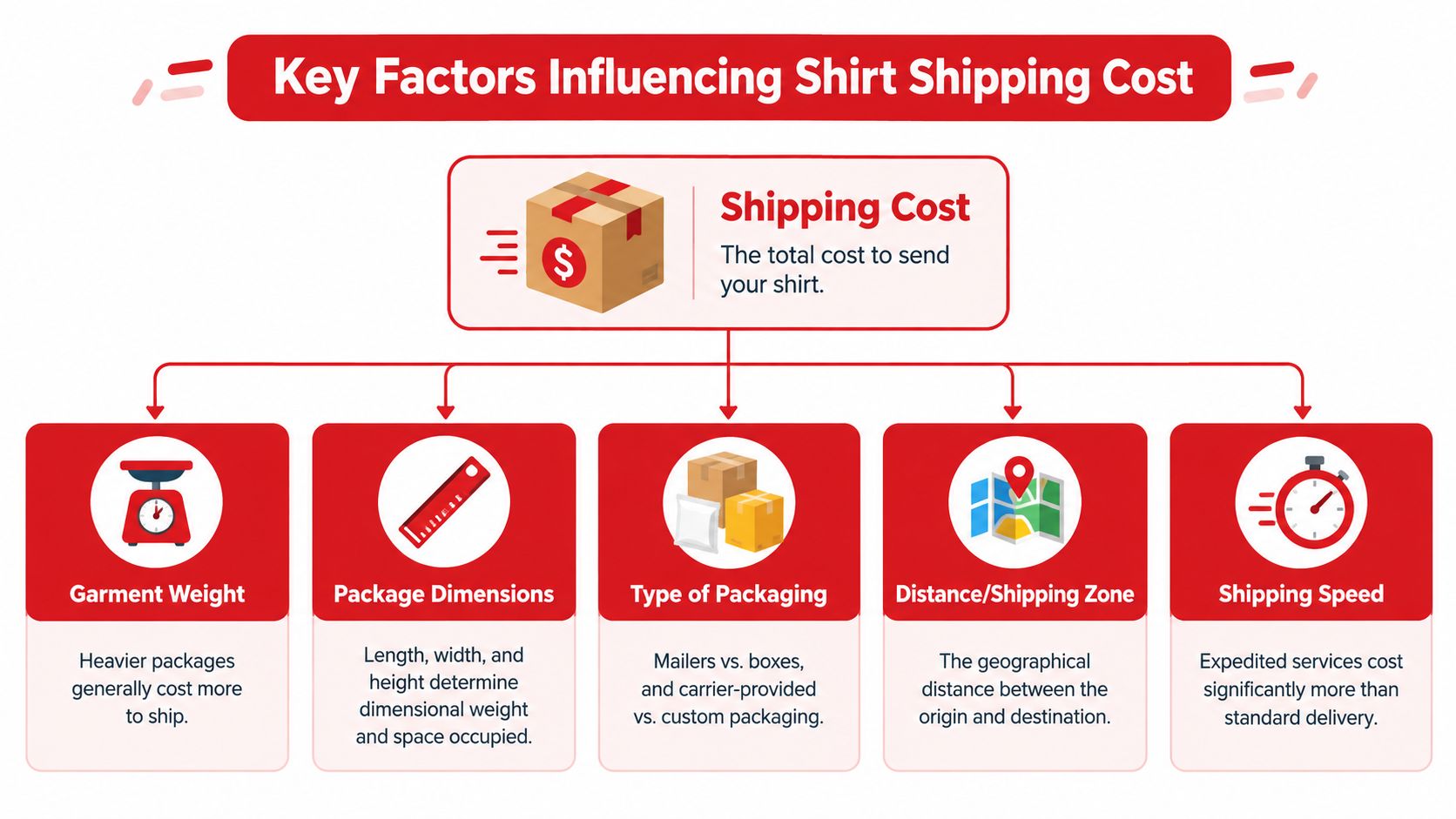
Five variables control most shirt-shipping estimates: weight, dimensions, packaging, destination, and speed. Change one of them and the carrier may move the shipment into another rate category.
Weight sets the first boundary
Carriers use the packed shipment's weight, including the garment and packaging. A small difference can matter when it crosses a pricing breakpoint, so weigh the parcel after folding, sealing, and adding inserts. Don't estimate from the product listing alone.
The service also matters. USPS Ground Advantage typically falls in the $4 to $6 range for small parcels, while Priority Mail commonly falls in the $8 to $14 range. UPS ground services often start at approximately $15.80 for small packages, according to the USPS and carrier comparison from Shipwave. These are practical ranges, not guarantees, because route, account pricing, package format, and delivery conditions still affect the quote.
Dimensions can override a light scale weight
A shirt packed tightly in a flexible mailer takes up little carrier space. A large branded box may look more premium, but unused air can create a larger billable measurement. USPS applies dimensional weight to Priority Mail packages exceeding one cubic foot, using the formula described earlier.
Practical rule: Measure the sealed parcel exactly as it will travel. A smaller safe package protects both the item and the shipping margin.
Packaging changes more than appearance
A poly mailer generally uses less material and occupies less space than a box for one soft garment. A box may make sense for multiple garments, a thick hoodie, or an order that needs additional structure, but it shouldn't be the default for every shirt.
Destination creates another variable. A nearby domestic shipment may price differently from a cross-country order, and international shipments add customs requirements, duties, taxes, and more complex carrier options. The final choice should match the buyer's location rather than relying on one universal rate.
Speed is a premium decision
Economy service is usually the starting point for a non-urgent shirt. Priority service can fit a time-sensitive order or a heavier package, while express service costs substantially more. Before offering free expedited delivery, compare the buyer's willingness to pay for speed with the margin available on the order.
For a visual reference on garment production and apparel presentation, see this DTF apparel example.
Hidden Costs That Raise Shipping Total
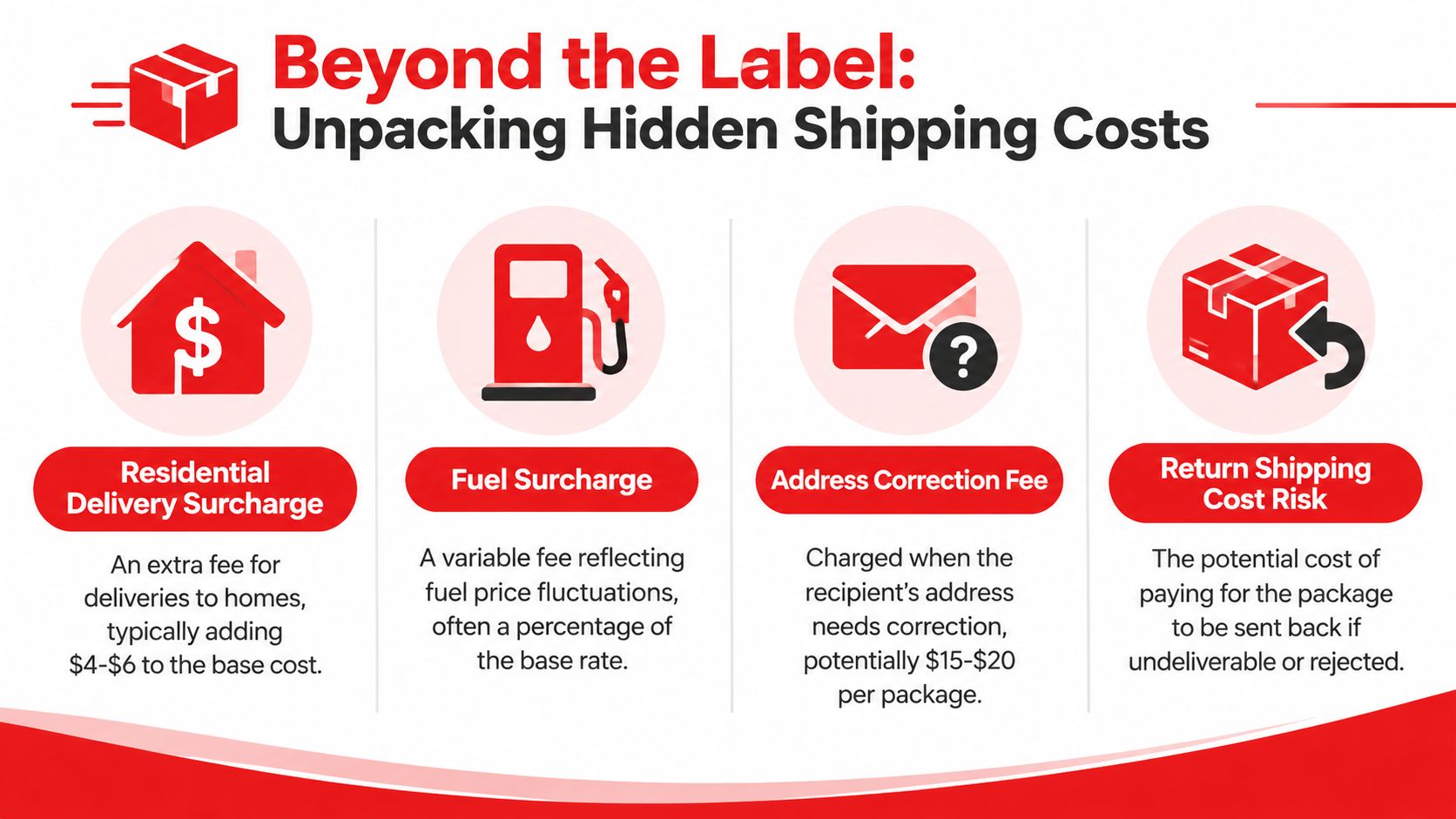
The label price is only one part of the seller's expense. A residential surcharge may apply when a private carrier delivers to a home. Fuel fees can fluctuate, and address corrections can appear after the shipment enters the carrier network. An undeliverable package can also create return postage and replacement costs.
A useful benchmark comes from a 2026 ecommerce shipping overview, which states that brands often pay $8 to $15 per order once fees are included and that 30% to 40% of total shipping cost can be hidden in surcharges, delays, and returns, as reported by GoBolt's ecommerce shipping overview. That doesn't mean every shirt order reaches that level. It does show why a base quote can understate the actual cost.
Where the extra expense appears
Review carrier invoices and fulfillment statements for line items such as residential delivery, fuel, remote-area handling, address correction, signature services, insurance, and return processing. Some fees are avoidable through accurate addresses and appropriate packaging. Others are a necessary part of serving a particular destination or service level.
A seller can reduce exposure by validating addresses, keeping package dimensions accurate, using the correct carrier packaging, and setting a clear returns policy. It also helps to separate postage cost from exception cost in your internal records. If returns and replacements are hidden inside one average rate, you won't know which problem is eroding the margin.
See this shipping-cost visual reference when reviewing the difference between a quoted label and the complete order cost.
Sample Shipping Cost Scenarios
The same shirt can produce very different totals depending on how it's packed and where it's going. The table below uses the verified ranges available for domestic economy, Priority Mail, and international apparel shipping. These are planning benchmarks, not guaranteed quotes for every origin, destination, or account.
Shipment Type | Service | Cost Range |
|---|---|---|
Single lightweight shirt, domestic | USPS Ground Advantage or similar economy parcel | $4 to $6 |
Single shirt, domestic, faster service | USPS Priority Mail | $8 to $14 |
Small parcel with a private-carrier minimum | UPS ground service | Starts at approximately $15.80 |
Single shirt, international | Worldwide apparel shipping benchmark | Approximately $11.99 |
Scenario one, lightweight domestic parcel
Fold one shirt tightly, place it in a slim mailer, seal it, and weigh the complete package. If the parcel remains light and compact, USPS Ground Advantage or a similar economy service may fit the $4 to $6 range. The important detail is that this range describes the carrier portion, not necessarily packaging, labor, insurance, or return exposure.
A seller charging a flat rate should compare the actual label cost across common destinations before setting the checkout amount. Shorter routes may be less expensive than distant zones, while a commercial label account may differ from a retail counter quote.
Scenario two, Priority Mail
Priority Mail can be sensible when the customer values faster delivery or when the order is heavier. The typical $8 to $14 range is notably higher than the economy range, so adding it as the default method can reduce margin on a low-value single-shirt order.
Flat-rate packaging can help with some heavier or distant shipments, but it isn't automatically the cheapest option for a lightweight garment. Compare the carrier's calculated rate with the eligible flat-rate format after packing the order.
Scenario three, international delivery
International shipping has more moving parts than domestic delivery. A worldwide single-tee benchmark of approximately $11.99 appears in the Printful shipping guide, but the buyer may also face customs charges, taxes, or destination-specific handling.
Before publishing an international rate, confirm the destination country, service, customs description, declared value, and responsibility for duties. For two or more garments, compare the cost of bundling against separate packages. The extra weight may increase postage, but combining shipments can still make the per-shirt cost more manageable when the service's pricing favors a single consolidated parcel.
Use this custom apparel production reference to connect production planning with the package you'll ultimately send.
Strategies to Lower Shipping Spend
Lower shipping costs by controlling the package before you compare labels. Start with the packed garment, then test the smallest protective mailer that keeps the shirt clean, dry, and secure.
Weigh the sealed order. Record the garment, inner protection, mailer, label, and inserts together. Reweigh whenever you change shirt style or packaging.
Remove unnecessary volume. Fold the shirt consistently and avoid oversized boxes. For a soft single garment, a flexible mailer can reduce empty space and help prevent dimensional pricing.
Compare service classes. Use economy shipping for orders without a tight delivery deadline. Reserve Priority or express options for customers who select or fund faster delivery.
Test bundles separately. A single shirt, a two-shirt order, and a hoodie order may belong in different packaging and rate rules. Don't assume one flat rate works equally well for all three.
Audit the complete invoice. Include packaging, handling, surcharges, returns, replacements, and international charges in your internal cost. The 2025 parcelLab benchmark found fashion customers paid an average of $8.07 for standard apparel shipping, according to the USPS newsroom release summarizing the rate environment.
Ask about commercial pricing. If you ship regularly, compare retail labels with available business or platform rates. A multi-carrier shipping tool can also show whether USPS, UPS, or another eligible service fits a specific destination.
The right target isn't the lowest label in isolation. It's a reliable total cost that preserves margin without creating an unpleasant checkout surprise.
Conclusion and Key Takeaways
The answer to how much does it cost to ship a shirt starts with the packed order, not the garment alone. Weigh and measure the sealed package, use a slim mailer when appropriate, compare economy and Priority services, and account for surcharges, returns, packaging, and international duties.
Run a small audit across a single shirt, a bundle, and a heavier garment. Then set shipping rules around real costs, review invoices for exceptions, and request commercial pricing if your volume supports it.
Wear X Apparel, LLC provides custom garment selection, DTF printing, and production support for T-shirts, hoodies, teams, events, organizations, and branded merchandise. Visit Wear X Apparel, LLC to explore ready-to-buy apparel or discuss a made-to-order project with shipping and fulfillment considerations built into the planning process.
Comments