


Polyester vs Cotton Shirts: A Practical Buyer's Guide

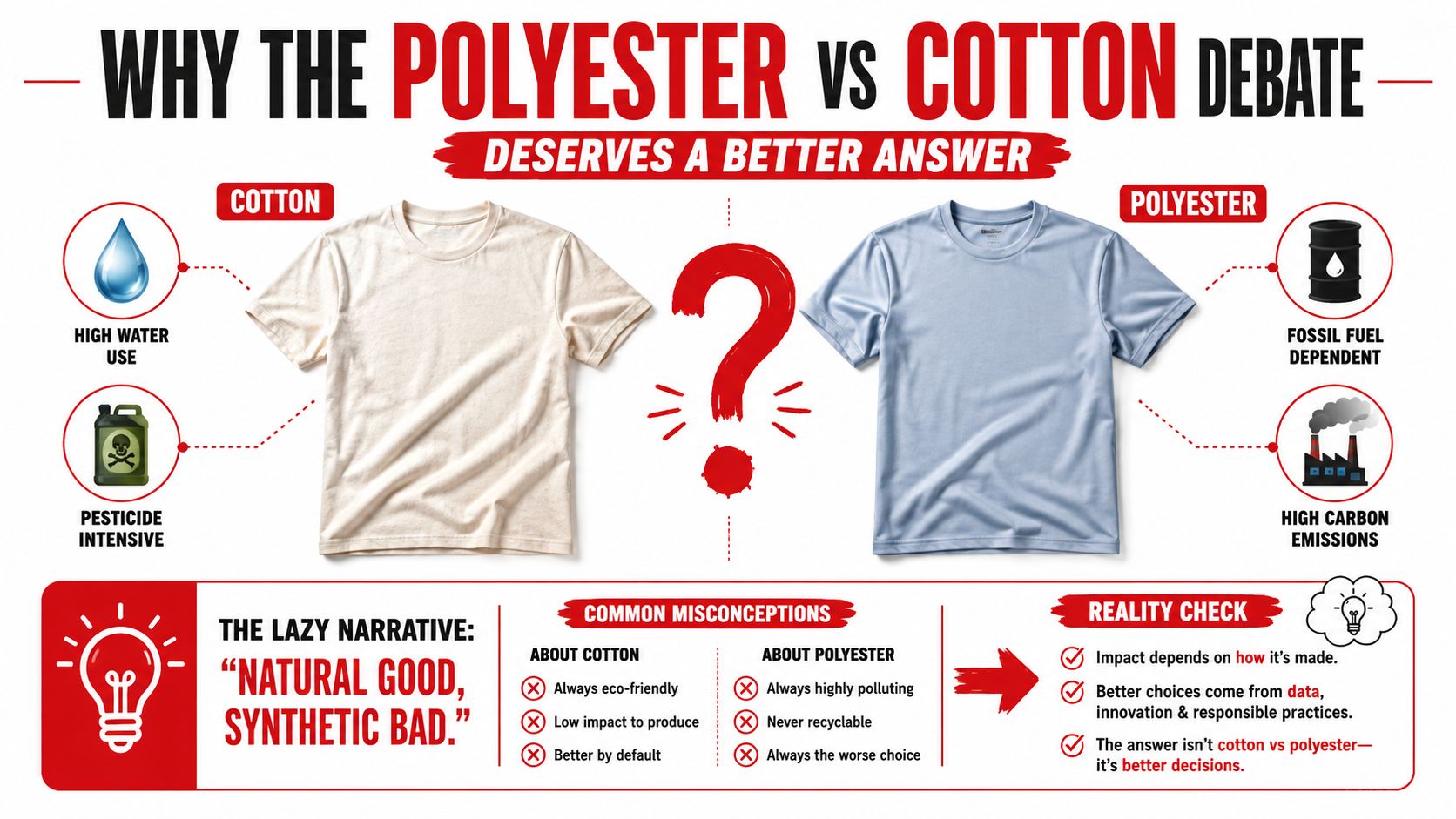
Most polyester vs cotton shirt advice is too lazy to be useful. “Cotton is natural, polyester is bad” sounds decisive, but it ignores cotton's agricultural burden, polyester's microfiber problem, and the practical reality of producing and washing a custom shirt.
The better question is not which fiber wins in every situation. It's which one performs best for comfort, moisture management, durability, DTF print quality, care, and the actual job the shirt must do. A cotton tee for a quiet day, a polyester team shirt, and a cotton-rich ranch hoodie shouldn't be judged by the same standard.
The biggest surprises are practical. Polyester can keep you drier during hard activity while holding onto odor after wear. Cotton can feel better against the skin while shrinking more in laundering. Under a heat press, the fibers also demand different production decisions.
Table of Contents
Why the Polyester vs Cotton Debate Deserves a Better Answer - The market reality - Score the shirt, not the label
Comfort, Breathability, and Moisture Management Compared - Where each fabric feels strongest
Durability, Shrinkage, and Everyday Care - The laundering tradeoff
How Polyester and Cotton Take DTF Prints - Cotton needs preparation - Polyester needs heat discipline - Blends sit in the middle
Sustainability Tradeoffs Most Comparisons Skip - The hidden cost of synthetic durability
Which Fabric to Choose for Your Custom Apparel Project - My recommendations by buyer - The one-minute decision test
Why the Polyester vs Cotton Debate Deserves a Better Answer
The natural-versus-synthetic argument breaks down as soon as you examine the full lifecycle. Cotton is an agricultural fiber, so its footprint includes cultivation inputs and land pressure. Polyester is synthetic and tied to fossil-based feedstocks, but its manufacturing scale, dimensional stability, and long service life can make it useful in demanding garments.
Neither material gets an automatic ethical victory. A shirt that lasts through heavy use may avoid replacement, while a short-lived synthetic garment can create a different environmental problem through persistent plastic fibers. A cotton shirt may avoid synthetic shedding but still carry meaningful agricultural impacts. The right decision depends on how the garment is worn, washed, printed, and discarded.
The market reality
Polyester is not a niche performance fiber. Global fiber production reached about 132 million tonnes in 2024, with polyester at 78 million tonnes and a 59% share, while cotton produced 24.5 million tonnes and represented 19% of production, according to Textile Exchange's Materials Market Report 2025. Polyester output was therefore a little more than three times cotton by volume.
That scale affects blank-shirt availability, color options, recycled feedstock, and production consistency. The same report recorded 9.3 million tonnes of recycled polyester in 2024, compared with about 0.3 million tonnes of recycled cotton, showing how much further the polyester recycling supply chain has scaled.
Score the shirt, not the label
For buyers, the useful checklist is straightforward:
Comfort: Cotton usually wins on a soft, familiar hand feel.
Moisture management: Polyester wins when sweat and fast drying matter.
Durability: Polyester generally wins on shape retention and wrinkle resistance.
DTF production: Both can print well, but press settings and dye behavior differ.
Care: Polyester is easier to maintain, while cotton requires more shrinkage control.
Use case: The intended work should decide the fiber, not a slogan about what's “better.”
That framework produces a more honest answer than treating either fiber as universally superior.
The Fiber Basics Behind Polyester and Cotton Shirts
Cotton and polyester behave differently because their structures are different. Cotton is a natural cellulose fiber that absorbs moisture into the fiber itself. Polyester, commonly made from polyethylene terephthalate, is a thermoplastic polymer with very low moisture regain.
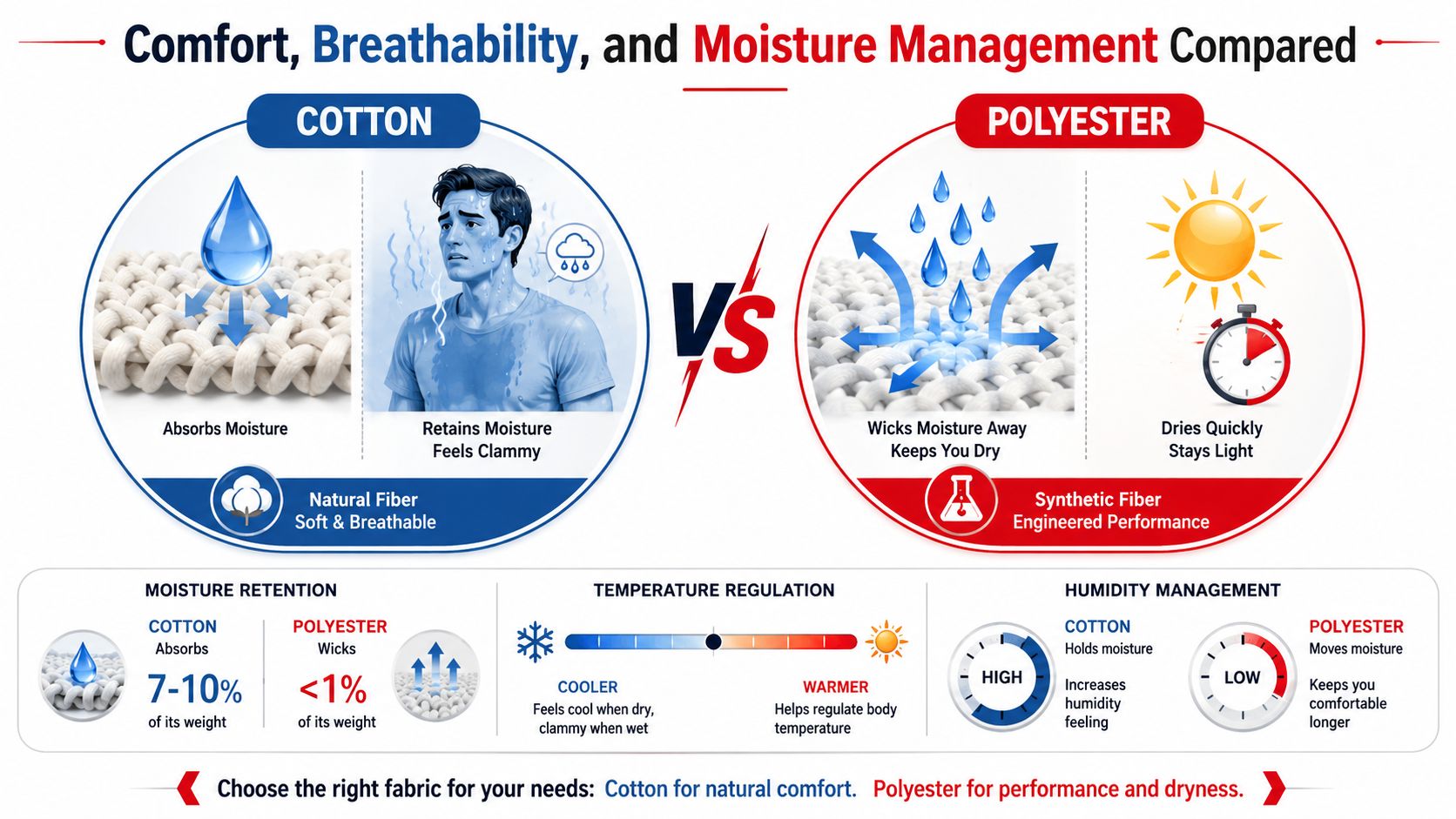
Technical comparisons place polyester moisture regain at about 0.4%, compared with roughly 7% to 8.5% for cotton, as summarized by Natuclothes' polyester versus cotton technical comparison. That distinction explains much of the wearer experience. Cotton takes sweat into the fiber, while polyester relies more on capillary movement across and through the fabric so moisture can evaporate.
Property | Polyester (PET) | Cotton |
|---|---|---|
Moisture behavior | Absorbs very little water into the fiber and can transport moisture across the fabric | Absorbs substantially more moisture into the fiber |
Shape response | Resists shrinkage and dimensional change | More vulnerable to laundering shrinkage |
Hand feel | Smooth, sometimes slick or technical | Soft, natural, and often more familiar |
Odor behavior | Can retain odor compounds after exercise | Generally releases odor more readily after wear and laundering |
Heat sensitivity | Thermoplastic, so heat-press control matters | Tolerates production heat more readily, though the garment still needs proper preparation |
Cotton's absorbent structure can feel pleasant in dry conditions because the fabric takes up moisture and feels substantial rather than slick. The tradeoff appears when the shirt becomes saturated. Wet cotton holds that water against the body and takes longer to dry.
Polyester's low absorption helps it stay light during activity and dry quickly. That same hydrophobic behavior can allow odor-related compounds to remain associated with the fabric. The difference isn't a minor comfort detail. It affects whether a team shirt, uniform, or event tee still feels usable after sweat, packing, and delayed washing.
A garment can also combine both behaviors. The RXB Marlboro Rodeo Hoodie uses a 70/30 ring-spun cotton/polyester blend, with a 100% cotton face, three-end fleece construction, and a fleece-lined hood. That type of construction puts a cotton-forward surface against the wearer and uses polyester in the blend for added structural support.
For a visual reference on garment construction and apparel presentation, see this apparel product reference image.
Comfort, Breathability, and Moisture Management Compared
Cotton feels better when the priority is softness and an easy, everyday hand feel. It's a strong choice for casual wear, low-exertion work, and cool or dry conditions where the shirt doesn't need to evacuate large amounts of sweat.
Polyester takes the lead once activity rises. Because it absorbs far less moisture into the fiber, it can move sweat toward the fabric surface for evaporation. That usually means faster drying and less retained wet weight, which is why polyester remains common in athletic apparel, uniforms, and performance-oriented custom runs.
Where each fabric feels strongest
Cotton is the more comfortable choice for shoppers who dislike a slick or technical texture. It tends to feel softer and more natural, and it can become even more comfortable with repeated washing. The weakness is moisture recovery. Once sweat or rain saturates the shirt, cotton stays wet longer and can feel heavy.
Polyester feels efficient rather than cozy. A well-designed polyester tee can move moisture away from the skin and dry rapidly, but fabric weight, knit structure, and finishing still affect airflow. A thick polyester shirt can feel warmer and less airy than a lightweight cotton garment.
Situation | Better choice | Reason |
|---|---|---|
Casual daily wear | Cotton | Softer hand feel and familiar comfort |
Hard exercise | Polyester | Faster moisture transport and drying |
Humid outdoor work | Polyester or a light blend | Less retained water during activity |
Cool, dry, low-exertion wear | Cotton | Comfortable absorbency without rapid saturation |
Mixed daily use | Cotton-poly blend | Balances softness with easier drying |
Odor changes the recommendation. A controlled wear trial found polyester T-shirts were rated significantly less pleasant and more intensely scented than cotton after exercise, with a reported P = 5.72×10⁻⁶, and odor-linked microbes such as Micrococcus were found almost solely on the synthetic shirts in that trial, as documented by the PubMed study on shirt fiber and odor.
Practical verdict: Choose polyester to manage sweat, but choose cotton when the shirt may be worn hard and washed late.
For staff uniforms, ranch workwear, event crews, and team kits, that distinction matters. A shirt that feels dry during the shift but smells strongly in a packed gear bag may create more practical trouble than a cotton shirt that becomes damp sooner.
Durability, Shrinkage, and Everyday Care
Polyester is the easier fabric for buyers who hate maintenance. It resists wrinkles, holds its shape, and generally experiences less dimensional change during laundering. Published apparel guidance places typical polyester shirt shrinkage under 1% to 2%, while untreated cotton can shrink about 3% to 10% during first home laundering, according to the technical comparison from Natuclothes.
Cotton's weakness shows up most clearly after the first wash. The garment may change size, the print may sit differently on the surface, and the wearer may need to iron or steam the shirt. Cotton can still deliver excellent everyday service, but the buyer needs to follow care instructions instead of treating the blank as maintenance-free.
The laundering tradeoff
Property | Polyester | Cotton |
|---|---|---|
Shrinkage control | Strong dimensional stability | More likely to shrink, especially during initial laundering |
Wrinkle recovery | Usually resists wrinkles | Wrinkles more readily |
Drying | Dries quickly | Takes longer to dry after saturation |
Odor after heavy wear | More likely to retain odor compounds | Generally less persistent odor retention |
DTF care | Use controlled heat and avoid excessive press exposure | Wash gently and control heat to protect the garment and print |
Best routine | Cold wash, low heat, remove promptly | Cold wash, low heat or air dry, reshape while damp |
Pilling and color performance depend on yarn quality, knit construction, dyeing, abrasion, and finishing, so fiber alone doesn't settle every durability question. A cheap polyester blank and a well-made cotton tee can perform very differently. Inspect the fabric weight, seam construction, collar recovery, and print area before judging the fiber.
Heat is especially important for polyester. It's a thermoplastic material, so excessive ironing or pressing can distort the surface or affect dye behavior. Cotton offers a wider comfort margin during ordinary ironing, but high heat can still damage dyes, fibers, and printed graphics.
Bleach deserves caution with both fibers. Chlorine products can weaken or discolor garments, and polyester can present additional color and dye-migration concerns when a printed design sits over a dyed blank. For custom shirts, oxygen-based alternatives and the manufacturer's care label are safer starting points than aggressive bleach.
Wash cotton shirts cold, dry them on low or air dry, and reshape them before they fully dry. Wash polyester cold as well, use low heat, and prioritize odor removal through adequate detergent and complete drying rather than turning up the dryer.
How Polyester and Cotton Take DTF Prints
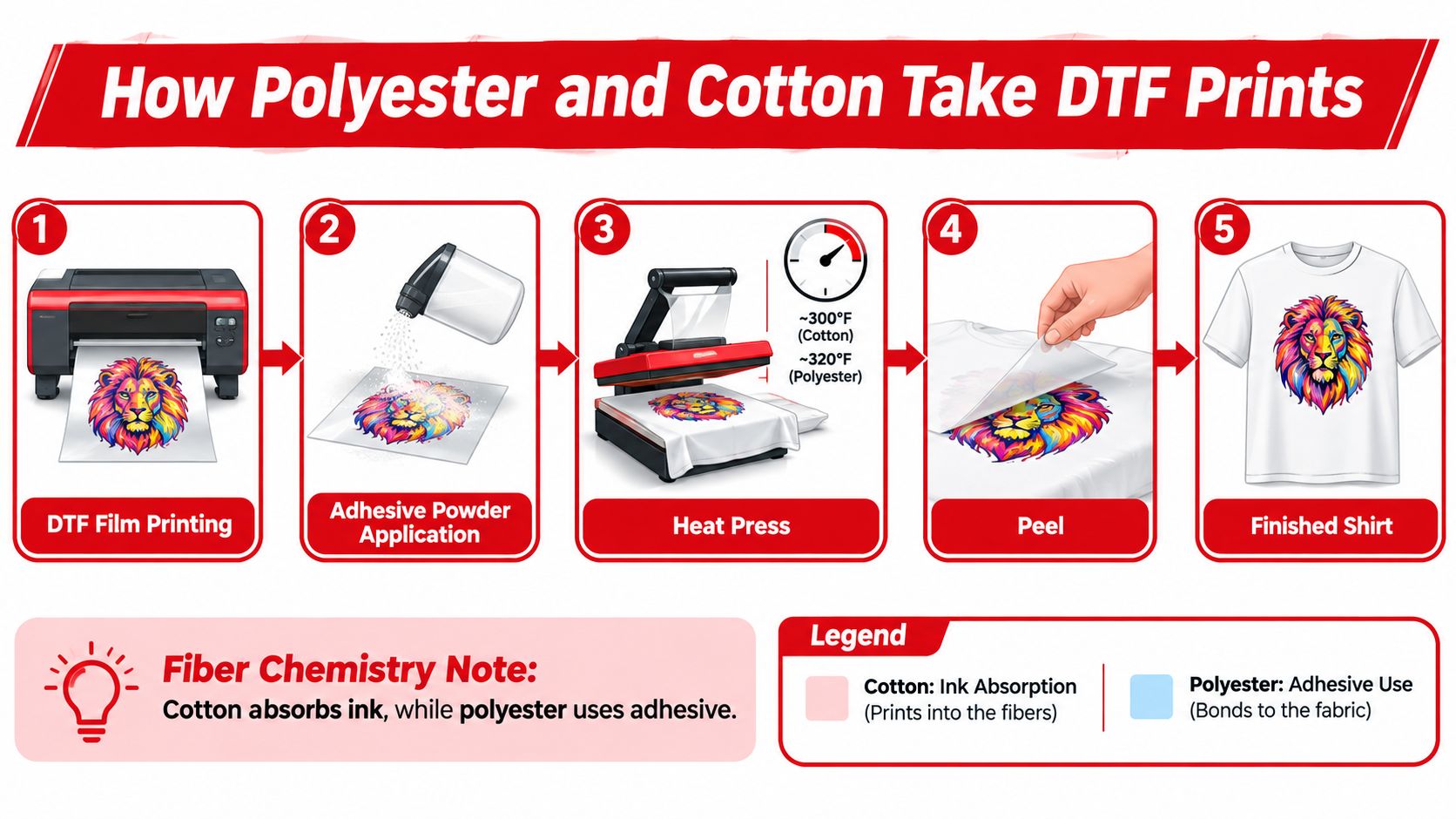
DTF production starts with a printed transfer film, adhesive powder, curing, and heat application. The design may look identical on screen, but the blank fabric changes the production equation. Cotton and polyester need different attention during pressing because their surfaces respond differently to heat, moisture, dyes, and adhesive.
Cotton needs preparation
Cotton absorbs moisture and can carry creases or residual humidity from storage. A short pre-press helps flatten the print zone and remove surface moisture before the transfer is positioned. If that step gets skipped, the transfer can bond inconsistently, especially across heavier or fleece-backed garments.
Cotton usually gives DTF transfers a dependable base because the fibers provide a receptive textile surface. The print can look bold and tactile, but the final result still depends on pressure, dwell time, powder coverage, curing, peeling method, and wash care.
Polyester needs heat discipline
Polyester can produce sharp, vibrant DTF results, but press temperature must be controlled. Too much heat can scorch the surface, flatten texture, or encourage dye migration from the garment into a light-colored transfer. Dyes used in some polyester blanks can move under heat and tint white areas or alter the intended color.
A production operator should test the exact blank, not rely on a generic setting. Press temperature, dwell, pressure, peel timing, and any protective sheet should be selected for the garment and transfer system. A standard cotton setting isn't automatically safe for polyester.
Blends sit in the middle
Cotton-polyester blends often offer a practical compromise. The cotton content contributes a familiar hand feel, while polyester improves shape retention and drying. For DTF, blends can be reliable, but the ratio, surface composition, dye system, and garment finish still determine how the transfer behaves.
The most common failure modes are edge lifting, dye bleed, incomplete adhesion, and cracking after repeated washing. Print longevity isn't guaranteed by fiber alone. It comes from matching the transfer recipe to the blank and giving the customer care instructions that reduce unnecessary heat and abrasion.
For a production-focused reference, review this DTF apparel workflow image.
My production recommendation is simple: cotton is forgiving, polyester is vibrant but demanding, and blends are often the safest compromise for broad audiences. Test before a large run, particularly when the design contains large white areas or the blank uses a saturated polyester dye.
Sustainability Tradeoffs Most Comparisons Skip
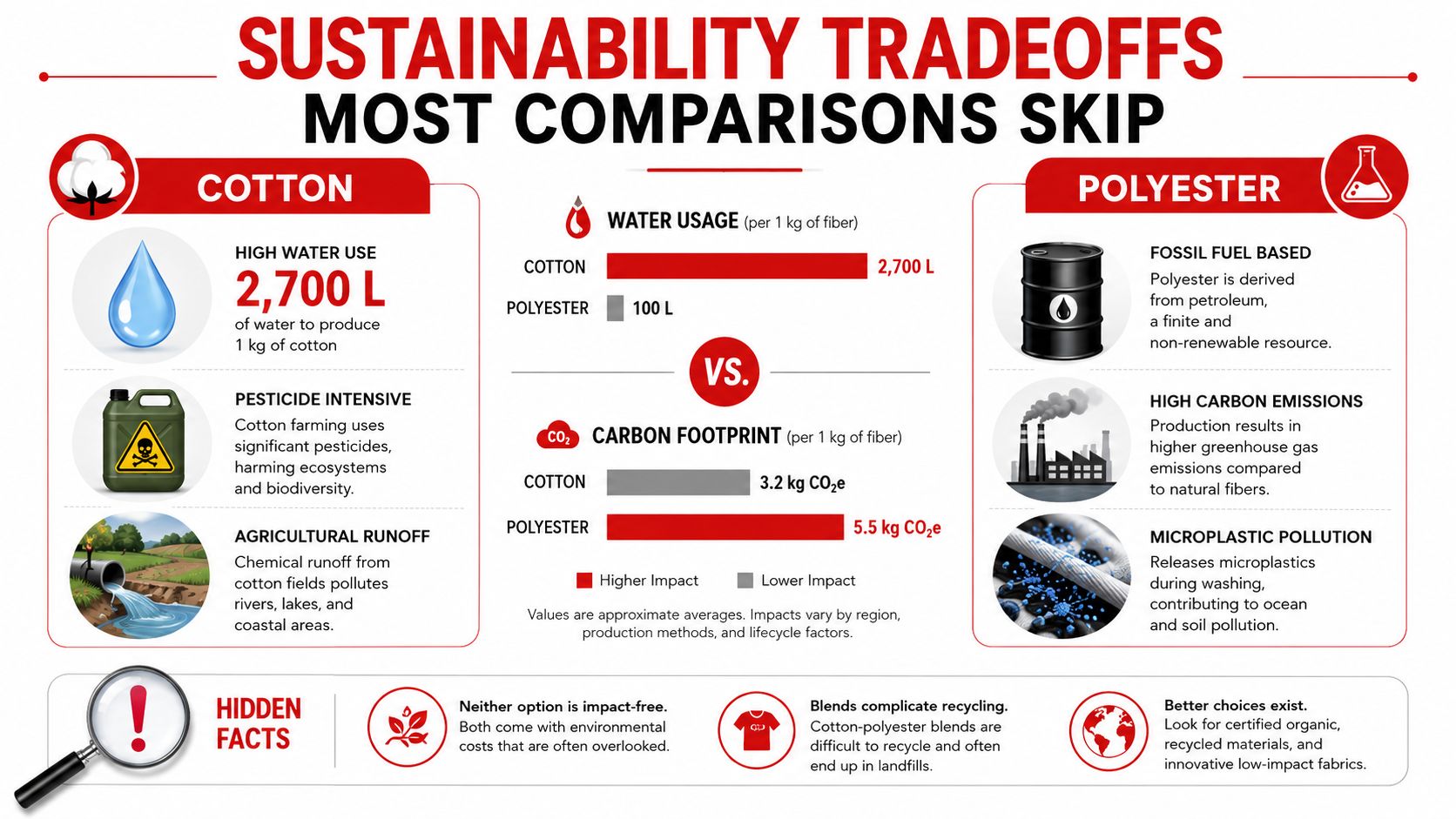
Cotton and polyester create different environmental pressures, so ranking one as universally “greenest” produces bad buying advice. Cotton's footprint begins with farming, including water demand and chemical inputs. Polyester brings fossil-based feedstocks, persistent plastic, and microfiber shedding during wear and washing.
Recycled polyester is more available at scale, as the same market report documents. That does not solve polyester's plastic problem. It does show why “synthetic equals waste” is too blunt for supply-chain decisions. Ask instead whether the shirt will be worn often, how long it will last, and what happens after disposal.
The hidden cost of synthetic durability
A life-cycle assessment reported a plastic accumulation potential of 1.0 kg per kilogram of polyester shirt, compared with about 0.1 kg per kilogram for a cotton shirt, as reported in the Sustainability study on textile plastic accumulation. The comparison shifts attention from cultivation and manufacturing alone to pollution that can remain after the garment leaves service.
Every shirt can shed fibers in the wash. Older garments can release nearly twice as many fibers as newer garments, according to the same research source. Polyester fibers deserve extra scrutiny because they are persistent plastic particles. Blends also complicate the picture, since their shedding behavior can change as the garment ages.
The intended use should decide the tradeoff:
Short-term promotional apparel: Avoid a disposable design. Durability matters only when people wear the shirt again.
Frequently washed workwear: Polyester can hold its fit and reduce shrinkage, but microfiber shedding becomes more relevant.
Long-life cotton casualwear: Cotton avoids synthetic microfiber persistence, while its agricultural impacts remain.
Blended garments: Blends can balance performance, but mixed fibers are harder to separate at end of life.
Odor retention also belongs in the sustainability calculation. A shirt that holds odor gets abandoned sooner, even if its fiber profile looks favorable on paper. For custom runs, choose the fabric that suits the wearer's routine, survives realistic washing, and keeps its shape and print quality after repeated use. Wash with less heat and abrasion, keep garments in service longer, and treat low purchase price as only one part of the decision.
Which Fabric to Choose for Your Custom Apparel Project
Custom apparel buyers should choose the blank before approving the artwork. The right fiber depends on the wearer's routine, the number of washes, odor tolerance, and how the finished design must behave under DTF heat. Softness alone is a poor deciding factor.
Use Case | Recommended Fabric | Why It Wins | DTF Notes |
|---|---|---|---|
Ranch and outdoor workwear | Cotton-rich or cotton-poly blend | Comfortable against the skin and less likely to retain exercise odor | Pre-press thoroughly and control wash heat |
Event tees and promotional runs | Polyester or a suitable blend | Holds shape and supports strong, vivid graphics | Test for dye migration before production |
Team uniforms and athletic kits | Polyester or poly blend | Moves moisture and dries quickly during activity | Use a polyester-aware press recipe |
Boutique retail merchandise | 100% ring-spun cotton | Premium soft hand feel and familiar retail appeal | Expect more shrinkage control than with polyester |
Large-volume giveaways | Cotton-poly blend | Balances comfort, durability, and dimensional stability | Confirm the surface and transfer settings on the exact blank |
My recommendations by buyer
For ranch crews, outdoor staff, and western workwear, start with cotton-rich fabric unless the job involves constant sweating. The cotton-forward surface feels less technical during long shifts and is less likely to make trapped odor the main complaint. A blend makes more sense when faster drying and shape retention outweigh natural hand feel.
For event shirts, polyester gets the nod when saturated color and repeated washing matter. Test the blank for dye migration before the full DTF run, because a sharp transfer can still develop a tinted cast if the fabric dye moves under heat. If attendees will keep wearing the shirt casually, choose a suitable blend rather than a highly athletic-feeling polyester.
Team kits and active uniforms should use polyester or a poly blend. Drying speed and moisture transport matter more than a soft lounge-shirt feel when players are moving, sweating, and wearing the garment repeatedly. Set the press recipe for polyester, then wash-test the actual blank and finished artwork.
Retail merchandise follows a different rule. Buyers handle the garment before they judge the print, so a high-quality ring-spun cotton blank often creates the stronger product experience. Cotton needs tighter control over shrinkage and press conditions, but its hand feel can justify that extra production work.
For broad giveaways, choose a blend when the budget and audience are unknown. It gives you a practical middle ground between cotton's shrinkage and polyester's odor retention. That choice also reduces the risk that recipients reject the shirt because it feels too technical or changes size after washing.
For a visual look at an on-demand apparel workflow, see this ON DEMAND apparel production example.
The one-minute decision test
Ask three questions:
Will the wearer sweat heavily? Choose polyester or a poly blend.
Does softness and natural hand feel matter most? Choose cotton or cotton-rich fabric.
Will the shirt face frequent washing, high heat, or demanding work? Choose polyester or a stable blend, then provide low-heat care instructions.
If the answers split evenly, choose a cotton-poly blend and test the exact blank with the finished DTF artwork. Wear X Apparel, LLC can help select the garment and apply DTF artwork for individual pieces, team orders, event runs, and branded workwear projects.
Comments